While the AI world obsesses over language models and chatbots, the robotics revolution just got its ImageNet moment.
AGIBOT has released AGIBOT WORLD 2026, an open-source dataset for embodied AI training built entirely from real-world scenarios. The dataset, now live on HuggingFace, provides structured, annotated data collected by the AGIBOT G2 robot platform across commercial spaces, home environments, and general-purpose settings.
Why This Matters
The biggest bottleneck in robotics hasn’t been hardware or algorithms — it’s been data. Training robots to manipulate objects, navigate spaces, and complete multi-step tasks requires enormous volumes of real-world demonstration data with precise annotations. Until now, most datasets were either simulated (and didn’t transfer well to reality) or too small and narrow to matter.
AGIBOT WORLD 2026 changes the equation. It’s the largest real-world embodied intelligence dataset released to date, collected through free-form operation in actual environments — not simulations. For researchers and companies working on robotic manipulation, this is the equivalent of ImageNet arriving for computer vision in 2009.
What’s Inside
The dataset covers five core research directions in embodied intelligence, released in phases:
Phase 1: Imitation Learning is live now. It includes:
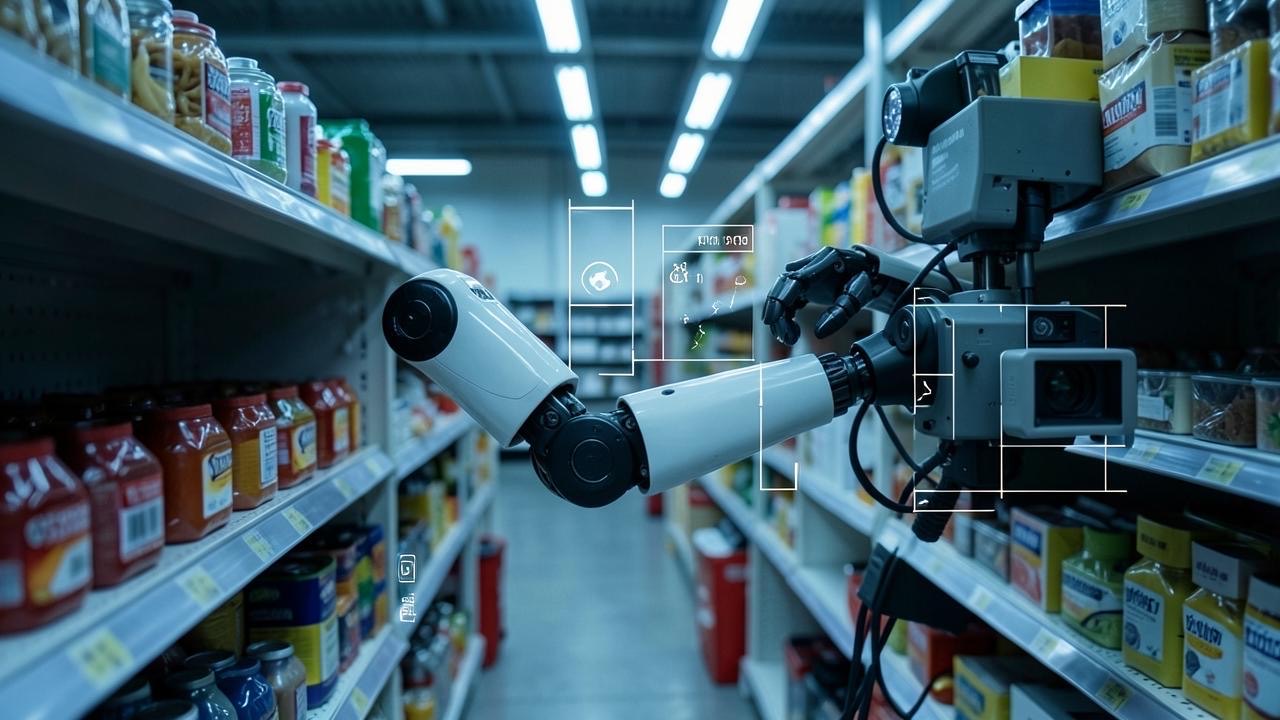
- Multi-camera video from top-head, hand-left, hand-right, and depth cameras on the G2 robot
- Three annotation layers: task-level instructions, 2D bounding box object labels, and step-level skill segments
- Long-horizon episodes: single episodes covering complete multi-step tasks (e.g., “Place the red-capped drinks and white yogurts from the shopping cart into the refrigerated cabinet”)
- Structured state/action vectors: full robot joint positions, velocities, and action commands
The annotation granularity is what sets this apart. Each episode includes:
- Task Frames — high-level subtask instructions with start/end frame boundaries
- 2D Bounding Boxes — labeled objects the robot interacts with, with normalized coordinates
- Instruction Segments — primitive skill labels (Pick, Place, Bend) with step-level instructions
This three-layer structure enables research into hierarchical policies, task-conditioned planners, and multi-granularity instruction following — all from the same dataset.
Technical Details
The dataset uses the LeRobot v2.1 format, making it compatible with existing training pipelines:
- Storage: Apache Parquet for episode data, MP4 for video
- Size: ~5TB total
- Download: Full dataset or individual tasks via git-lfs sparse checkout
- Split script:
split_episode.pyconverts long-horizon episodes into single-instruction episodes for standard training
A companion tool, GE-Sim 2.0 (GenieSim), provides a closed-loop simulation environment with action-conditioned video generation and auto-scoring — enabling sim-to-real transfer research without physical robot hardware.
The Bigger Picture
Embodied AI — robots that learn from real-world interaction rather than just text — has been advancing rapidly but quietly. While LLMs dominate headlines, the practical deployment of AI in warehouses, hospitals, homes, and manufacturing lines depends on exactly this kind of data: real, messy, annotated, and open.
AGIBOT’s release follows a pattern we’ve seen accelerate AI research before:
- ImageNet (2009) → computer vision breakthroughs
- Common Crawl → language model scaling
- AGIBOT WORLD 2026 → embodied intelligence?
By making 5TB of real-world robotic manipulation data freely available under CC BY-NC-SA 4.0, AGIBOT is removing the biggest barrier to entry for robotics research worldwide. Labs that couldn’t afford to collect this data themselves can now train on industrial-grade demonstrations.
What This Means for New Zealand
New Zealand’s robotics and automation sector — from agricultural robots to warehouse automation — stands to benefit directly. Open datasets like this lower the barrier for local companies to develop and deploy embodied AI without needing billion-dollar data collection infrastructure.
The open-access approach also contrasts with the closed-door model dominant in LLM development. If AGIBOT’s approach gains traction, we could see a faster democratization of physical AI capabilities — not just for tech giants, but for smaller economies and companies willing to build on shared foundations.