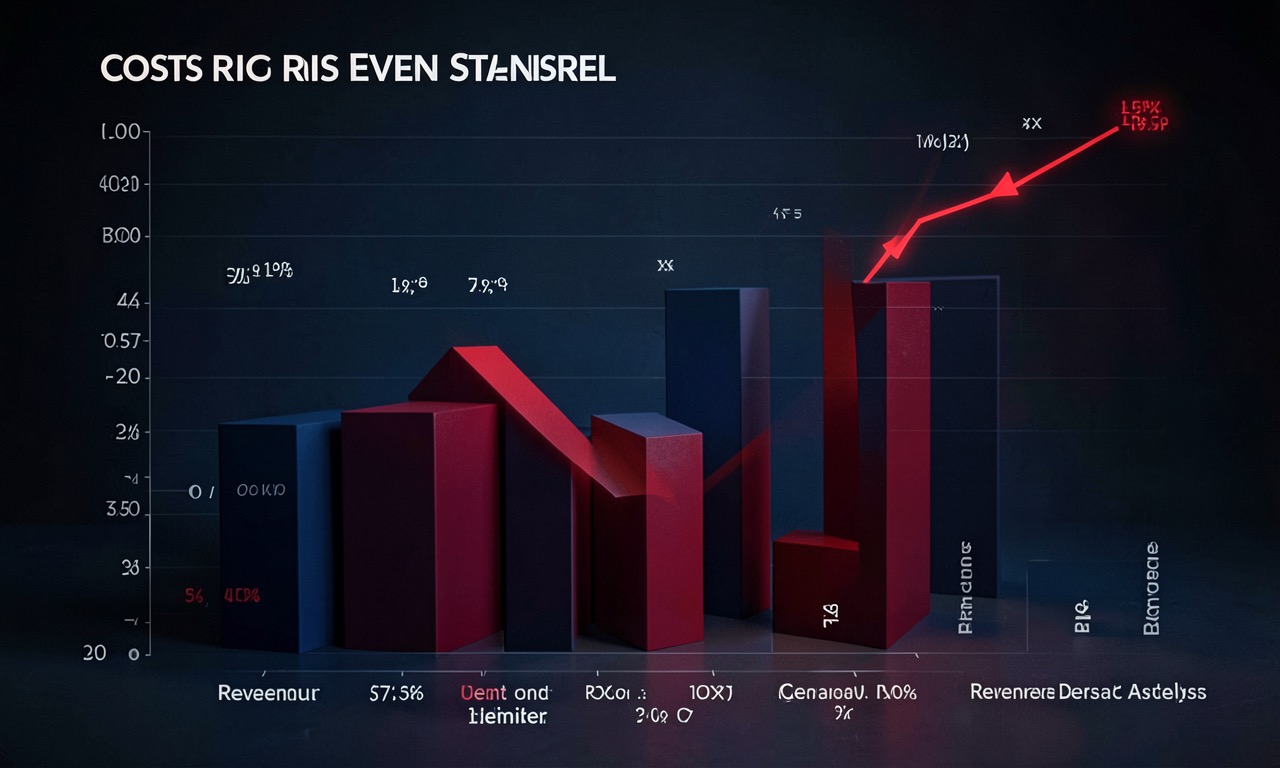
Software has near-zero marginal cost. Build it once, sell it a billion times. The 100 millionth user costs basically nothing to serve. That’s why Microsoft prints money, Google prints money, Meta prints money.
AI completely broke that model — and the numbers are brutal.
🔍 THE BOTTOM LINE
AI’s structural problem isn’t that companies haven’t figured out how to monetise. It’s that every single query costs real compute, and that cost scales linearly — or worse — with success. The more customers you get, the more money you lose.
Reverse Economics: The More You Succeed, The Faster You Bleed
Every tech company in history got cheaper as it scaled. More users meant lower costs per user. That’s the entire model that built Silicon Valley.
AI flipped it.
OpenAI hit $25 billion in annualised revenue by March 2026 — but is projecting $14 billion in losses for the year, nearly triple its previous losses. The company spends $1.69 for every dollar it earns. The numbers come from internal financial reports picked up by analysts at AlphaBriefing and confirmed by HSBC — who calculated that even after every funding round, OpenAI still faces a $207 billion shortfall before profitability.
Anthropic crossed $30 billion in annualised revenue. Still burning billions. Still raising tens of billions just to keep the lights on. It overtook OpenAI in enterprise market share (37-40% vs 33%) but is not profitable either.
xAI is reportedly burning $1 billion every single month.
Perplexity spent 164% of its revenue on AWS compute costs alone. They spent more on running the AI than they made from selling it.
And if you think the small players are fine — 966 AI startups died in 2024, a 25.6% jump from the year before. AI startups burn cash twice as fast as non-AI tech companies.
The $852 Billion Paradox
OpenAI’s latest funding round valued the company at $852 billion post-money. That’s the most valuable private technology company in history. And it has never turned a profit.
The gap between explosive revenue growth and accelerating losses comes down to one thing: compute. OpenAI is spending on AI infrastructure at a pace that makes hyperscalers look restrained. Through Stargate LLC — its joint venture with SoftBank, Oracle, and Abu Dhabi’s MGX — the company has committed $500 billion in US data centre spending by 2029, with $100 billion already underway in Abilene, Texas.
HSBC’s analysis concluded that even after every funding round, every investment, every deal, OpenAI still faces a $207 billion shortfall to reach profitability. The Decoder reported in May that OpenAI’s adjusted operating margin hit minus 122 percent in Q1 2026.
The industry response has been to raise prices. ChatGPT went from free to $20 to $200 for the Pro plan. And it’s still not enough, because the cost of running these models grows faster than any price increase consumers will accept.
Why AI Can’t Fix Itself
This isn’t mismanagement. It’s physics.
Traditional software: Serving 1 million users costs roughly the same as serving 100,000. The marginal cost is basically zero.
AI: Serving 1 million users can cost 10 times what 100,000 costs. Every new user is a new expense. Every new query is a new dollar burned.
Google once estimated that adding AI to every search query would require 500,000 A100 servers. The cost of answering a single AI query is 10x more than a traditional search result.
Ricardo @Ric_RTP put it bluntly: “AI is the first technology in history where more customers makes you POORER.”
And the numbers prove him right.
The Two Futures
If the economics hold — if compute costs don’t drop faster than usage scales — then the current AI market is a bubble that will burst. The $852 billion valuations are betting on a future where marginal costs collapse. If they don’t, the maths never works.
If the costs do collapse — through inference efficiency gains, specialised hardware, or fundamental breakthroughs — then the big players survive, and the current losses become a rounding error on a trillion-dollar industry.
The question isn’t whether AI will change the world. It will. The question is whether it can do it without going broke first.
What happens if the costs don’t collapse: OpenAI’s $207 billion gap becomes real. The IPO disappoints. Anthropic follows. The funding taps dry up and consolidation begins.
What happens if they do: The current $600 billion in infrastructure spending looks prescient. Token costs drop 100x. The marginal cost problem vanishes and AI becomes the most profitable industry in history.
Right now, every single number says the first scenario is more likely.
❓ Frequently Asked Questions
Q: What does this mean for NZ? New Zealand has limited exposure to AI infrastructure costs directly, but the flow-on effects are real. If the AI bubble corrects, so does demand for NZ data centre space (we have several underway) and the government’s AI investment strategy. If AI companies consolidate, the pool of available AI tools for NZ businesses narrows — and prices go up.
Q: Could the economics flip? Yes, if inference costs drop significantly. DeepSeek showed it’s possible — matching GPT-5.5 at 86% less cost. But the trend so far is that scale eats efficiency gains. Companies spend everything they save on compute.
Q: Is this just a bubble? The valuations have bubble characteristics — speculative, based on future promises, with no path to profitability in sight. But unlike the dot-com bubble, the underlying technology is genuinely transformative. The question is whether the market can tolerate the wait.
Q: What about open-source models? Open-source reduces inference costs dramatically — you’re not paying the 80% margin that cloud providers charge. But the hardware cost doesn’t disappear. Someone still pays for the GPUs, the electricity, and the RAM.
🔍 THE BOTTOM LINE
AI’s reverse economics are the industry’s biggest unspoken problem. Every major player is losing money on every query, betting that future improvements will bail them out. It worked for Amazon (decades of losses before profitability). It may not work for an industry where costs scale with usage, not with infrastructure.
📰 Sources
- Ricardo @Ric_RTP, X (cyberplayground.org syndication)
- AlphaBriefing: The $852 Billion Paradox: Inside OpenAI’s Race to IPO While Burning $14 Billion a Year
- The Decoder: OpenAI burned through $1.22 per dollar earned even after stripping out stock-based compensation (May 22, 2026)
- HSBC Research on OpenAI financial projections
- MIT Economics: Speculative-Growth and the AI “Bubble” (Caballero, May 2026)
- Citizen Watch Report: AI spending spree triggers global memory crisis