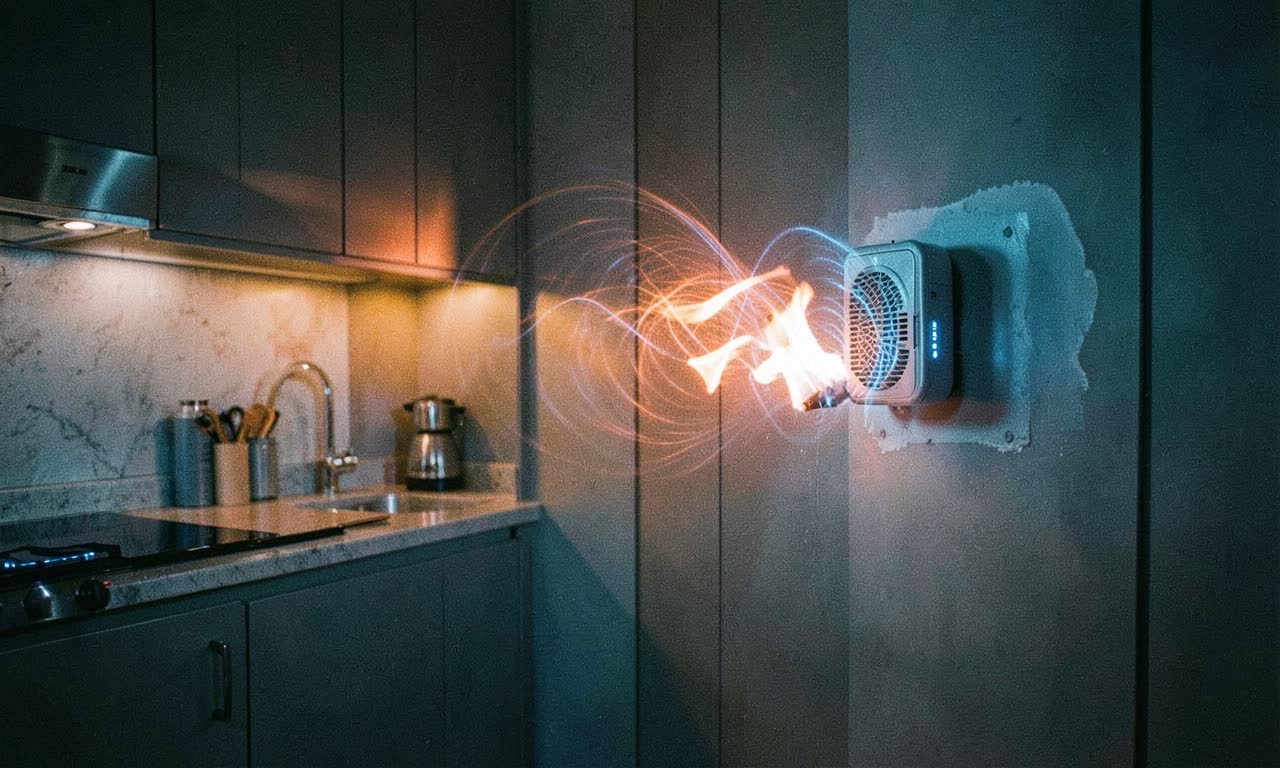
In a makeshift kitchen in Concord, California, cooking oil caught fire on a gas stove. Within moments, an AI-driven sensor detected the flames and wall-mounted emitters blasted infrasound waves at the blaze. The fire went out in seconds.
No water. No chemicals. No flooding. Just sound.
That’s the pitch from Sonic Fire Tech, the first company trying to commercialise acoustic fire suppression. And it genuinely works — for small, contained kitchen fires under controlled demonstration conditions. Whether it can replace the sprinkler system in your home is a much bigger question.
How acoustic fire suppression works
The science isn’t new. Acoustic fire suppression has been documented in scientific literature for over a decade. Low-frequency sound waves vibrate oxygen molecules away from the fuel source, depriving the fire of one of the three components it needs to burn. Remove the oxygen locally, and the flame suffocates.
Sonic Fire Tech’s innovation isn’t the physics — it’s the system integration. CEO Geoff Bruder says the company figured out how to “not just point-and-shoot like a fire extinguisher” but “run it through ducting and distribute it like a sprinkler system.” AI sensors detect the fire, identify its location, and target specific emitters. The system deploys in milliseconds, compared to the several minutes a traditional sprinkler head takes to activate after heat rises to its threshold.
The demonstration I witnessed, as reported by Ars Technica, was impressive. Cooking oil fire. Infrasound. Out. Clean kitchen. No water damage.
But kitchen fires in demonstrations are not the same as fires in real homes.
The sprinkler problem
Sonic Fire Tech says its system is “intended to replace interior residential sprinklers.” The company has secured third-party validation from Fire Solutions Group as “a viable NFPA 13D-equivalent alternative to conventional residential sprinklers.”
NFPA 13D is the standard for residential sprinkler systems — well-documented, widely adopted, and required in all new California homes built since 2011. Replacing it with infrasound would be a fundamental shift in home fire safety.
Here’s where it gets complicated. Fire protection engineer Nate Wittasek, based in Los Angeles, raised the key objections:
- Sound doesn’t cool hot surfaces. Water absorbs heat. A fire might be knocked down by infrasound, but if the surrounding materials are still hot enough to reignite, you haven’t solved the problem — you’ve paused it.
- Sound doesn’t wet fuel. A grease fire that’s been acoustically suppressed can reflash the moment sound stops if the fuel temperature is still above ignition point.
- Hidden fires and smoldering fires. Sound travels in a line. It doesn’t reach fires behind furniture, inside walls, or under floors. Water, for all its messiness, flows and spreads.
- Partial blockages. A sofa between the emitter and the fire renders infrasound useless. Water sprays reach around obstacles.
Wittasek’s assessment is blunt: “Sprinklers have a well-established role. They apply water directly to the fuel, cool the space, slow or stop flashover, and give people time to get out while reducing risk to firefighters. Sound may knock down a small flame, but it does not cool hot surfaces or wet fuel.”
The validation gap
Sonic Fire Tech declined to provide Ars Technica with the full test report from Fire Solutions Group, citing “confidential and patent-pending information.” The two-page executive summary states the system is “capable of delivering extremely rapid fire detection, meaningful suppression or extinguishment, and consistent performance across a variety of installation configurations.”
But the summary lacks detailed test conditions, specific fire scenarios tested, and — critically — any data on re-ignition rates. It also concludes that “additional testing and optimization are recommended” and that the products have “potential to complement or, in certain applications, serve as an alternative to traditional suppression systems.”
The NFPA’s Jonathan Hart is clear: “Equivalency can only be approved by the appropriate authority having jurisdiction and requires technical documentation be submitted demonstrating the equivalency.” Sonic Fire Tech has not publicly provided this documentation.
This is the AI hardware pattern we keep seeing: impressive demos, limited independent validation, and a gap between what the technology can demonstrably do and what the company says it will do.
Where infrasound actually makes sense
Despite the skepticism about replacing sprinklers entirely, there are use cases where acoustic fire suppression has genuine advantages:
- Data centres. Water destroys electronics. Infrasound doesn’t. If you can detect and suppress a fire in a server rack before it spreads, without flooding the entire facility, that’s a real win.
- Commercial kitchens. Grease fires are exactly the type infrasound handles well — contained, visible, and in an environment where water causes secondary damage.
- Historic buildings. Where water damage to irreplaceable materials is as devastating as fire damage, a non-water suppression system could be transformative.
- Wildland firefighting. Sonic Fire Tech is developing a backpack system for wildland firefighters — though experts are deeply sceptical about infrasound’s effectiveness against uncontrolled wildfires where flames can spread faster than the system can target them.
The AI angle
Sonic Fire Tech’s system isn’t just infrasound — it’s AI-driven infrasound. The AI components handle fire detection, location identification, and emitter targeting. This matters because the speed of detection and response is what makes the system competitive with sprinklers that take minutes to activate.
But it also means the system inherits AI’s well-known failure modes. What happens when the AI misidentifies a fire? What happens when it fails to detect a smoldering fire behind drywall? What happens when the sensor is fooled by steam from cooking?
Traditional sprinklers are stupid by design. They activate when a fusible link melts at a specific temperature. No AI, no sensors, no classification. They fail rarely and in predictable ways. AI-driven systems fail in novel and unexpected ways — exactly the kind of failure mode you don’t want in a life-safety system.
What this means for NZ
New Zealand doesn’t mandate residential sprinklers in the same way California does, but the Building Code requires fire safety systems in multi-unit dwellings and commercial buildings. If acoustic fire suppression achieves NFPA equivalency, it could become a compliance option for NZ buildings — particularly in data centres, heritage buildings, and commercial kitchens.
The technology is genuinely promising. The marketing is ahead of the evidence. That’s a familiar pattern in AI — the difference here is that the gap between promise and proof could cost lives.
🔍 The Bottom Line
AI-driven infrasound fire suppression works on small, visible, contained fires. That’s not nothing — kitchen fires represent roughly half of all residential fires. But “works on demo day” and “replaces sprinklers” are very different claims. The technology has real potential in specific applications (data centres, commercial kitchens, heritage buildings) but the evidence for whole-home sprinkler replacement doesn’t exist yet. Sonic Fire Tech is doing something genuinely new. It just needs to prove it works in the messy, unpredictable, real-world conditions where fire safety actually matters.