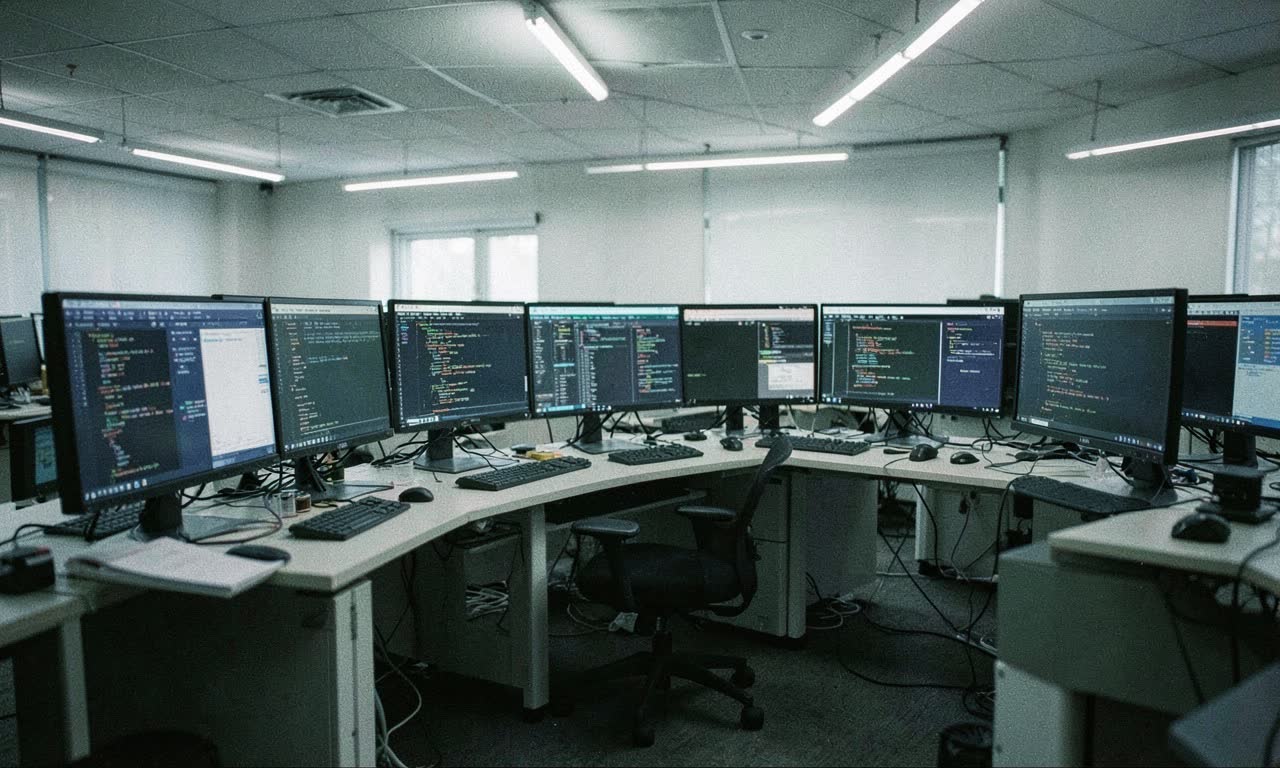
Airbnb CEO Brian Chesky used the company’s Q1 2026 earnings call to deliver a number that should make every software engineer in the world sit up: AI now writes 60% of Airbnb’s new code. And one engineer, Chesky said, can now do the work of 20.
🔍 THE BOTTOM LINE
If a company as mainstream as Airbnb is past the halfway mark on AI-generated code, the “AI coding assistant” era is over. This is the new baseline.
The Number That Matters
During the May 8 earnings call, Chesky devoted significant time to how Airbnb is using AI internally. The key figure: nearly 60% of the code produced by Airbnb engineers in Q1 2026 was written using AI tools.
This isn’t a startup bragging about a prototype. This is a $78 billion public company reporting a production metric on an earnings call — which means it’s auditable, material, and real.
Chesky also said that with AI, “one engineer can do the work of 20.” He framed this as empowerment rather than displacement — engineers are doing higher-level work while AI handles the repetitive parts.
Why 60% Is Different From 20%
When we first heard about AI writing 20-30% of code at companies like Google, it was interesting. It meant AI was a helpful assistant — like autocomplete on steroids.
Sixty percent is different. At 60%, AI isn’t assisting. It’s leading. The human role shifts from writing code to reviewing, directing, and validating code that an AI produced. That’s a fundamentally different job.
What does this mean in practice? At Airbnb, engineers now spend more time on architecture decisions, code review, and product strategy. The actual typing — the syntax, the boilerplate, the implementation — is increasingly machine work.
This tracks with what we’ve been seeing across the industry. In March, we covered the surge in AI automation engineer roles and the corresponding decline in traditional software engineering postings. Airbnb’s number is the most concrete data point yet.
The “Work of 20” Claim
“One engineer can do the work of 20” sounds like classic tech CEO hyperbole. But let’s be fair to Chesky: he’s talking about specific categories of work — boilerplate implementation, API integration, test writing, documentation. Not 20 senior architects. Not 20 system designers. Twenty engineers doing the kind of routine coding that constitutes most of a typical engineering team’s output.
The implication isn’t that Airbnb will fire 95% of its engineers. It’s that the nature of the job has changed. Engineering is becoming more about judgement and less about production. That’s both exciting and terrifying, depending on which side of the experience curve you’re on.
What This Means for Your Career
If you’re a software engineer, here’s the uncomfortable truth: the part of your job that can be measured in lines of code is being automated. Not in five years. Now. At a company near you.
The parts that aren’t being automated:
- Understanding what to build — product sense, user empathy, business context
- Architecture and system design — making decisions about trade-offs
- Code review and quality judgement — deciding whether AI-generated code is actually correct
- Cross-functional communication — translating between business needs and technical reality
If your value is purely in how much code you can write, you’re in trouble. If your value is in what you can decide and direct, you’re more valuable than ever — because now you have a force multiplier.
The NZ Angle
New Zealand’s tech sector is heavily weighted toward implementation work — web development, app building, integration. These are exactly the categories where AI coding tools have the most impact.
The good news: NZ companies that adopt AI coding tools aggressively will be able to do more with smaller teams, which is an advantage in a small market. The bad news: individual roles focused on implementation will shrink faster here than almost anywhere else, because NZ firms are cost-conscious and quick to adopt efficiency gains.
If you’re a developer in Aotearoa, the career compass points clearly: move toward architecture, security, and domain expertise. Move away from “I can write a lot of code fast.”
❓ Frequently Asked Questions
Q: Does “AI writes 60% of code” mean AI wrote 60% of the lines? Airbnb said 60% of new code in Q1 was “written using AI tools” — which likely means AI-assisted generation, not necessarily 60% of every file. The metric probably includes code suggested by AI tools that engineers then accepted or modified.
Q: Is Airbnb laying off engineers? Not announced. Chesky framed the AI productivity as enabling existing engineers to do more and different work, not as a headcount reduction plan. But the long-term implications for hiring are obvious.
Q: What AI coding tools does Airbnb use? Airbnb hasn’t specified publicly. Industry-wide, the most common tools are GitHub Copilot, Cursor, and Claude Code. Given the timing and Chesky’s enthusiasm, Claude Code seems likely.
Q: Should I be worried if I’m a junior developer? Worried is strong. But you should be adapting. Junior roles focused on implementation are shrinking. Roles focused on understanding what to implement are growing. Invest in product thinking and system design.
🔍 THE BOTTOM LINE
Airbnb just put a number on what everyone suspected: AI is past the assistant phase and into the co-author phase. Sixty percent isn’t a prediction — it’s a report from the field. The question isn’t whether your job will change. It’s whether you’ll adapt before the number hits 80%.
Sources
- TechCrunch — Airbnb says AI now writes 60% of its new code
- Business Insider — Airbnb’s CEO says AI writes 60% of the company’s code
- Benzinga — Airbnb Reveals AI Agents Now Handle 60% Of New Coding
- Economic Times — Airbnb says AI now writes 60% of its code as tech firms flatten teams