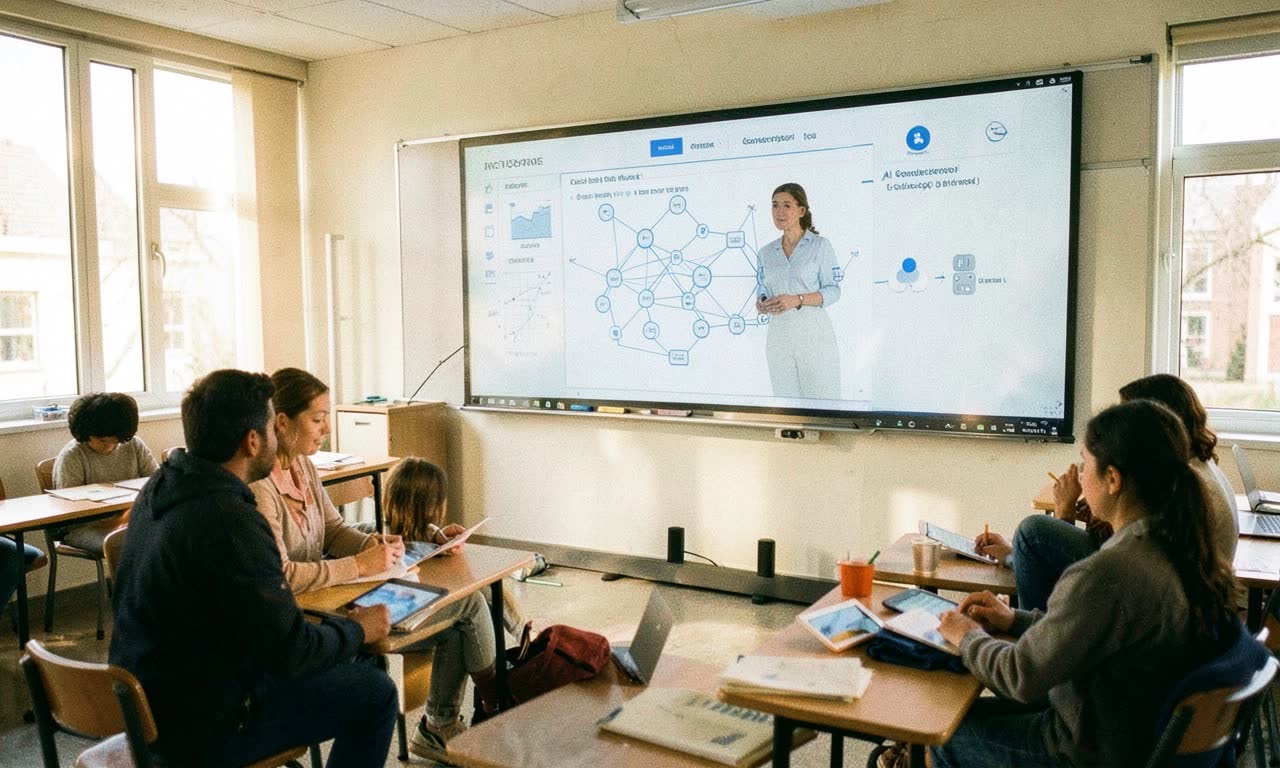
Alpha School — the Texas-based private school network that replaces classroom teaching with AI software and motivational staff it calls “guides” — opened three Greater Boston campuses this fall, and the reaction from the city’s teachers union has been anything but neutral. Boston Teachers Union president Erik Berg told GBH’s All Things Considered this week that his first reaction on learning the AI school was real was: “I wasn’t even sure it was real, because the notion that an AI bot would be instructing our children in how to succeed in their futures seems — it really just seems appalling.”
How the model works
The schools run what Alpha’s Boston site describes as a “mastery-based, AI driven approach” in which students “crush their academics in 2 hours.” Core academics happen each morning through adaptive software that assesses where each child is and serves material at their own pace — NBC Boston reported the co-founder MacKenzie Price’s example that “you might have one first grader who’s working on algebra, while the child sitting right next to him is working on his addition and subtraction.” The rest of the day goes to workshops in entrepreneurship, financial literacy and public speaking. There are no licensed teachers at the front of the room; guides, who need not be certified educators, coach and motivate students.
The network opened three campuses — Beacon Hill, Lexington and Jamaica Plain, the last in the former Croft School building — with capacity around 500 students and tuition of $65,000 a year. It is one of 27 new Alpha campuses opening nationwide this year, part of an expansion that also placed a campus in Kirkland, near Seattle. Boston’s School Committee approved the Beacon Hill and Jamaica Plain locations in June after finding Alpha met state requirements.
The union’s case, and Alpha’s response
Berg’s argument is that teaching is a relationship, not content delivery: schools exist to turn children into “citizens of a democratic society,” and outsourcing that to “bots from a billionaire-led tech company that cares more about profits than about children” is, he said, “outsourcing, frankly, part of what makes us human.” He referenced Alpha’s earlier work in Brownsville, Texas, saying it “certainly didn’t have good outcomes for the kids.”
Alpha’s response, included in the GBH transcript, was that Berg “hasn’t personally witnessed our school and may not present a fair and accurate view,” adding that critics “who have not been involved with our schools first-hand do not have accurate impressions … about the approach to learning, the use of AI, the use of screentime, the role of guides, the student experience, and the student-teacher connection.” GBH is scheduled to interview an Alpha guide in the coming days. A parent at the school, Paul Karger, told NBC Boston his son came home from a shadow day saying, “Daddy, I love learning. I love math. I love reading.”
The model comes with receipts both ways. Axios reported guides are paid at least $100,000 a year with no teaching certification required, and 404 Media’s February investigation, based on leaked internal documents, cited former employees describing AI-generated lesson plans that internal review found could “do more harm than good.” WBUR separately reported former employees’ allegations that recordings from student monitoring software were not securely stored — allegations the company contests. As of publication, none of those claims has been tested in court and Alpha disputes the characterisations.
Why Boston is a real test
Seattle’s public schools spent this same week pulling generative AI out of classrooms entirely — the mirror image of Alpha’s proposition, reported alongside this piece. That contrast is exactly why Boston matters as a test case: the public system is rejecting student-facing AI defaults while a private network scales them to families paying $65,000 a year, and the divergence splits along wealth. Alpha’s campuses are approved to operate by local committees and its waitlist is open, so the model will be judged by outcomes rather than op-eds — but this site’s earlier coverage of AI-in-schools backlash suggests the friction reproduces wherever AI arrives as a vendor decision rather than a pedagogical one. Boston Public Schools, for its part, is betting on the opposite approach: a $1 million AI-fluency curriculum to teach every high-school graduate to use AI critically — a model this site covered in March — rather than building the school day around it.
For New Zealand the relevance is indirect but real: Alpha has signalled international ambitions, and the same “two hours of AI, guides instead of teachers” pitch will eventually be marketed here to exactly the cohort least able to evaluate it. The question Boston raises — whether “guides” who motivate are a complement to teachers or a cheaper substitute for them — is the same question NZ’s teacher-supply debates will face when the software arrives bundled with a discount.
Sources: GBH News, NBC Boston, Boston.com, Alpha School Boston, 404 Media