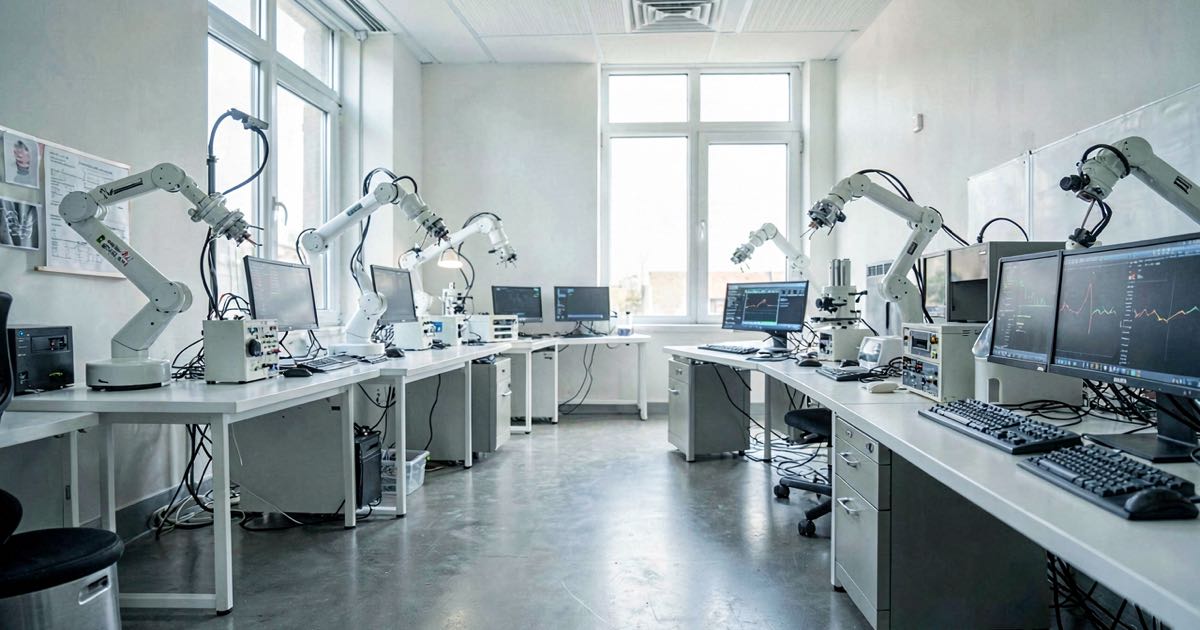
Anthropic has opened a research preview of the Model Hardware Standard (MHS), a specification that lets AI agents safely operate physical devices — microscopes, liquid handlers, robotic arms, laser systems — through a shared interface. The company is sharing an early version with scientific research labs and advanced manufacturers ahead of making the standard open source.
The announcement, published August 27, describes MHS as a standardised driver that translates between a computer’s operating system and hardware devices. Any device with a programmable interface can be connected. Any agent harness can access it using standard protocols, including the Model Context Protocol that Anthropic previously developed for connecting AI agents to data sources.
The problem MHS solves
Labs and manufacturing facilities typically spend weeks or months integrating hardware. Each device — a microscope, a liquid handler, a plate reader, a robotic arm — has its own programming interface. Getting them to communicate with each other requires specialists to build bespoke integrations. Once connected, there has been no standard way for an AI agent to discover and operate them.
MHS reduces that integration work to hours or minutes. The driver uses a simple set of primitives — commands like “read” (get temperature) or “write” (set temperature) — that any hardware device can understand. Devices become discoverable in a standard format, so agents and instruments can find each other across networks without a custom translator.
The driver also carries information about a device’s physical characteristics that may not be discernible from code alone — the weight of a robot arm, for instance, which matters for knowing how to manipulate it safely. Users can write this information in natural language, or an agent can interview them about their hardware setup and populate the tags itself. The driver then automatically produces a reference file describing what a device can measure, what can be adjusted, and what safety limits are enforced.
Early deployments
Anthropic tested MHS with a handful of labs and manufacturers. The results, according to partner statements, range from routine automation to genuinely novel capabilities:
Genentech implemented MHS as a proof of concept for automating the BCA protein assay — a standard procedure requiring coordination across a liquid handler, a robotic arm, and a plate reader.
University of Washington Baker and Pinglay labs used MHS to build a dashboard for remote instrument monitoring, an AI-supervised qPCR that watches amplification curves and halts at the right moment, and a robotic-arm-to-liquid-handler integration for collision-free plate handoffs.
Carnegie Mellon University ran serial dilution dose-response experiments about three times faster than before, with an AI agent orchestrating a liquid handler, plate reader, robotic arm, and monitoring cameras across three computers with incompatible interfaces.
QuEra Computing, which builds quantum computers using neutral atoms, gave an AI agent control over parts of its laser system. The agent developed a controller that recovers the laser’s “lock” — the ultra-precise frequency the lasers must hold to interact with atoms — 99.3 per cent of the time without human intervention.
HHMI Janelia researchers used MHS to unify a microscopy rig that previously involved seven different vendor programs with no shared interface.
Hardware partners are building support in
The standard is not just research labs. Hardware vendors and software companies are already building MHS support into their products:
- AWS will support MHS through Strands Robots, its library for connecting AI agents to physical devices.
- Doosan Robotics is testing MHS with their robotic arms for automated quality assurance and multi-robot coordination.
- Universal Robots has had early access and plans to add support to its robotics platform.
- Tecan is adding MHS support for its Fluent liquid handling platforms.
- QIAGEN has a working proof of concept on its nucleic acid purification platform.
- Danaher is exploring MHS-supported capabilities for smart instruments and autonomous labs.
- MBF Bioscience is building an MHS driver for ScanImage, software that runs laser-scanning microscopes in hundreds of neuroscience labs.
- Automata is adding MHS support to LINQ, its lab automation platform.
Hugging Face is adding MHS support to LeRobot, its robotics library. Raspberry Pi is enabling MHS integration across a number of its products following successful tests with a Camera MHS Driver.
What Claude actually does with hardware
The most revealing detail in the announcement is how Claude interacts with physical equipment. Anthropic describes Claude approaching experiments in an “exploratory manner, much as a scientist would.” In one example, Claude made an adjustment to a laser, observed the results through a camera to assess how its adjustment moved the beam, and repeated the process — seeking to understand the sequence of events. Claude then packaged what it learned into code files, writing a deterministic script that let it align the laser without reasoning at each step.
This is a meaningful shift. Most AI agent deployments operate in digital environments where actions are reversible and errors are cheap. Physical hardware is different. A wrong command can damage equipment, destroy samples, or create safety hazards. The fact that Claude can reason about physical outcomes — and then write its own deterministic code to lock in what it learned — suggests the gap between digital and physical AI agency is narrowing.
The limitations are honest. As a language model, Claude learns about the physical world through text and images, meaning its spatial and physical reasoning have constraints. Genentech researchers had to guide Claude to recognise that errors caused by foaming in protein samples were physical failures, not software bugs, that could only be mitigated through physical corrections. MHS also does not yet work with hardware that lacks a programming interface.
Why this matters
The connection between AI agents and physical equipment has been the missing piece in laboratory automation. Companies like Google DeepMind have focused on training models to control robots directly. Anthropic is taking a different approach: instead of training a model to be the robot, build a standard that lets any model operate any programmable device. The model-agnostic design — any agent harness can access MHS via MCP — is a deliberate play for ecosystem adoption.
The safety implications are significant. Anthropic says it is developing a “physical safety roadmap” to bolster safeguards against misuse of AI in the physical world. The research preview will build additional safety evaluations with launch partners before the standard is open-sourced. This is a rare case where an AI company is designing safety frameworks for physical world impact before, not after, deployment at scale.
For New Zealand, the relevance is indirect but real. NZ has a growing precision manufacturing sector and world-class agricultural research institutions. If MHS becomes the standard interface for AI-controlled lab equipment, NZ research labs and manufacturers using compatible hardware — Tecan liquid handlers, Universal Robots arms, Doosan cobots — would gain access to AI-orchestrated workflows without building custom integrations. The open-source release, when it comes, could lower the barrier for smaller institutions.
❓ FAQ
What is the Model Hardware Standard? A specification developed by Anthropic that lets AI agents operate physical devices — lab instruments, robotic arms, manufacturing equipment — through a standardised driver interface. It is model-agnostic and works with any device that has a programmable interface.
Is MHS open source? Not yet. Anthropic is running a research preview with selected partners to build safety evaluations and develop best practices before open-sourcing the standard.
Which companies are using MHS? Early partners include Genentech, University of Washington, Carnegie Mellon University, QuEra Computing, HHMI Janelia, and Tetsuwan Scientific. Hardware vendors including AWS, Doosan Robotics, Universal Robots, Tecan, QIAGEN, and Raspberry Pi are building MHS support into their products.
Can any AI model use MHS? Yes. MHS is model-agnostic and can be accessed via the Model Context Protocol, command line interface, or code files. Any agent harness that supports these protocols can operate MHS-connected devices.