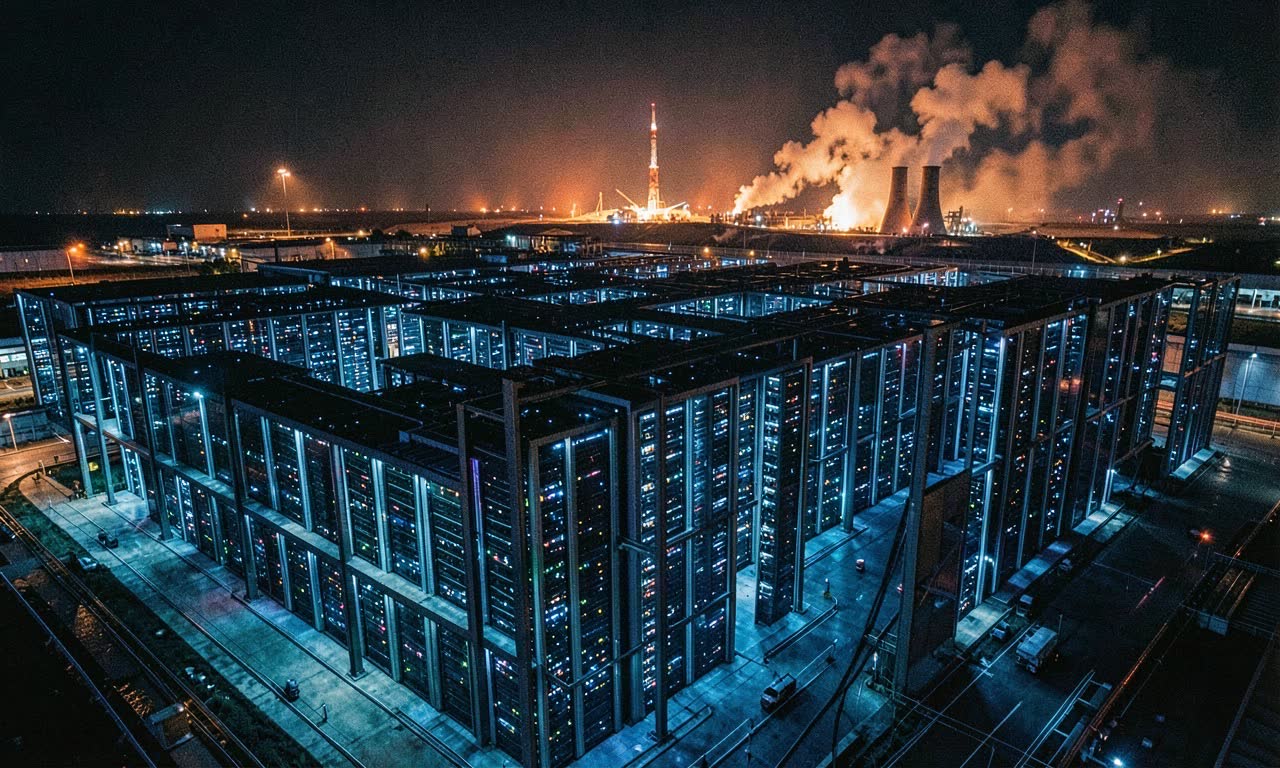
Anthropic announced a deal with SpaceX on May 6, 2026, to use the entirety of SpaceX’s Colossus 1 data center in Memphis, Tennessee — more than 300 megawatts of compute capacity, packing over 220,000 NVIDIA GPUs, coming online within the month. They also said they’re exploring putting AI compute in space. No, that’s not a typo.
🔍 THE BOTTOM LINE
The AI arms race isn’t just about models anymore — it’s about who controls the physical infrastructure. Anthropic just bought its way into the biggest GPU cluster on the planet, and they’re already talking about running compute in orbit.
The Deal
Anthropic’s announcement is straightforward: they’ve signed an agreement with SpaceX to use all compute capacity at Colossus 1. The numbers are staggering:
- 300+ megawatts of new capacity
- 220,000+ NVIDIA GPUs
- Live within the month — not next year, not “coming soon”
This isn’t a future roadmap. Anthropic is saying these GPUs will be running Claude within weeks.
The immediate benefit? Anthropic doubled Claude Code’s five-hour rate limits for Pro, Max, Team, and Enterprise plans, removed peak-hour throttling for Pro and Max, and raised Claude Opus API rate limits “considerably.” If you’ve been hitting Claude usage limits, this is why they’re loosening.
The Context: A Compute Empire
The SpaceX deal doesn’t exist in isolation. Anthropic has been on an infrastructure shopping spree that makes most sovereign nations look modest:
- Amazon: Up to 5 gigawatts, including nearly 1 GW by end of 2026
- Google + Broadcom: 5 GW agreement, coming online in 2027
- Microsoft + NVIDIA: $30 billion of Azure capacity
- Fluidstack: $50 billion investment in American AI infrastructure
Add SpaceX’s 300 MW and you’re looking at a company that’s essentially building a private compute nation. We wrote about Anthropic’s 900 billion valuation round and the S&P 500 rewriting its rules to accommodate AI mega-IPOs. This is where that money goes — straight into the ground, literally, in Memphis.
The Irony: Musk vs. Anthropic
Here’s where it gets fun. Elon Musk, who merged xAI into SpaceX earlier this year, has spent months publicly attacking Anthropic:
- “Anthropic hates Western Civilization” (February 2026)
- Called Anthropic “doomed to become the opposite of its name”
- Asked if there’s “a more hypocritical company than Anthropic”
Then on May 7, the day after the deal was announced, Musk posted on X that he’d spent time with Anthropic’s senior team and was “impressed.” His exact words: “Everyone I met was highly competent and cared a great deal about doing the right thing. No one set off my evil detector.”
Funny what a few hundred megawatts of GPU time will do for a relationship.
In a separate post, Musk said xAI “will be dissolved as a separate company” and rebranded as SpaceXAI. So the entity competing with Anthropic is now the entity powering Anthropic. Capitalism is wild.
Orbital Compute: The Sci-Fi Part
The announcement includes this throwaway line that deserves more attention: Anthropic “expressed interest” in partnering with SpaceX to develop multiple gigawatts of orbital AI compute capacity. In space. Orbiting the Earth.
SpaceX’s IPO filing already revealed in-house GPU manufacturing plans via its Terafab project. Orbital compute solves three problems at once: cooling (space is cold), energy (solar arrays are weightless), and jurisdiction (whose laws apply in low Earth orbit?). It also creates new ones: latency, radiation hardening, and the small matter of getting servers into orbit.
This is speculative — “expressed interest” is corporate-speak for “we talked about it over dinner.” But Anthropic wouldn’t put it in a public announcement if they weren’t serious about exploring it.
The Memphis Problem
Colossus 1 isn’t without controversy. xAI and its subsidiary MZX Tech installed dozens of natural gas turbines to power the facility, claiming temporary-use exemptions meant no federal permits were needed. Memphis residents and environmental groups disagree. The turbines reportedly worsened air quality in a community already dealing with pollution, leading to sustained protests.
Anthropic, to its credit, recently committed to covering any consumer electricity price increases caused by its US data centers. Whether that extends to the air quality impacts of burning gas in Memphis remains to be seen.
What This Means for New Zealand
NZ doesn’t have a Colossus. We don’t have a 300 MW GPU cluster. We don’t have orbital compute ambitions. What we have is a data centre conversation about whether Southland’s cheap power should host international AI infrastructure.
Anthropic’s announcement underscores the scale gap. The entire New Zealand electricity grid produces around 10 GW at peak. Anthropic just locked in agreements for more than 10 GW globally. One AI company will soon consume more compute power than an entire country generates.
For Kiwi businesses using Claude, the good news is immediate: higher rate limits, more capacity, better performance. The deeper question is whether NZ’s AI future depends entirely on infrastructure we’ll never own, operated by companies we can’t regulate, in jurisdictions we don’t control.
We covered this in our NZ AI Blueprint analysis — the “high-use, low-trust” problem. Anthropic is making the “high-use” part bigger. The “low-trust” part? Still working on it.
❓ Frequently Asked Questions
Q: What does 300 megawatts actually mean? It’s roughly the power consumption of a small city. For context, 300 MW running continuously for a year is about 2.6 terawatt-hours — roughly 5% of New Zealand’s total annual electricity generation. And that’s just one data center in one deal.
Q: Why is Anthropic partnering with SpaceX when Musk has been attacking them? Compute is compute. Musk publicly criticized Anthropic for months, then called them “impressed” the day after the deal. xAI is being dissolved into SpaceXAI, so the competitive conflict is being absorbed. Money and GPUs make strange bedfellows.
Q: Will this make Claude faster for NZ users? Anthropic says the SpaceX capacity will “directly improve capacity for Claude Pro and Claude Max subscribers.” Rate limits have already been doubled. Latency improvements depend on where inference runs — international expansion is planned but no ANZ-specific timeline yet.
Q: Is orbital AI compute realistic? “Expressed interest” is early-stage. The physics work — space offers free cooling and unlimited solar — but launch costs, radiation hardening, and latency (minimum 4ms round-trip to LEO) are real challenges. This is a 2028+ story, not 2026.
🔍 THE BOTTOM LINE
Anthropic just bought 300MW of the world’s most powerful GPU cluster from a CEO who called them hypocrites last month. The compute arms race has left the building — and might leave the atmosphere. If you’re a small country without your own infrastructure, now is the time to start paying attention.
Sources
- Anthropic official announcement: Higher usage limits for Claude and a compute deal with SpaceX
- CNBC: Anthropic, SpaceX announce compute deal that includes space development
- Bloomberg: Anthropic, SpaceX Sign Deal to Boost AI Computing Power