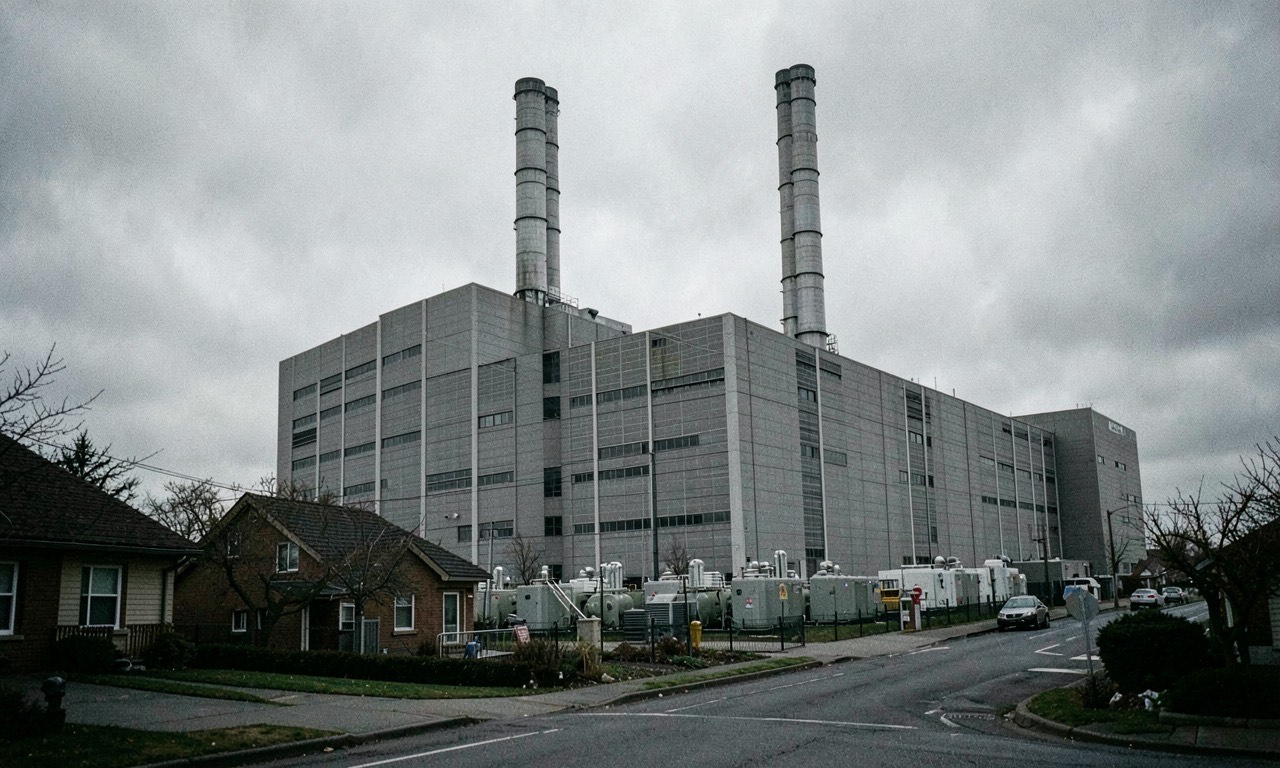
When West Footscray resident Sean Brown takes his 19-month-old son to the park, their walk passes an imposing building cheerfully spruiked as “Australia’s largest hyperscale AI factory” — a NextDC datacentre called M3.
He hates it. The constant construction noise. The looming towers and insistent background hum. The exhaust from the growing array of diesel generators powering the server racks inside. And he worries what it represents for his young child’s future.
“He is growing — neurologically, pulmonarily, physically — in the shadow of a facility whose cumulative environmental impact has never been assessed,” Brown told The Guardian.
This isn’t a story about whether datacentres are necessary. They are. This is a story about what happens when AI infrastructure gets dropped into residential neighbourhoods without asking the people who live there — and why that’s coming to NZ next.
🔍 THE BOTTOM LINE
AI datacentres are being fast-tracked into Australian suburbs with no cumulative environmental assessment and councils sidelined from planning decisions. NZ will face the same pressures — and we’re even less prepared.
M3: The Datacentre Next Door
The NextDC M3 datacentre in West Footscray, less than 10km from Melbourne’s CBD, is already massive. By the end of 2027, pending Victorian government fast-track approval, it will double in size to cover 10 hectares, drawing 225MW of power and running 24/7.
The diesel generators on site are expanding from 40 today to 100 at completion. That’s a small power plant’s worth of backup generators, in a residential area, running on diesel, with no cumulative environmental impact assessment ever completed.
NextDC CEO Craig Scroggie posted a video of the M3 site on LinkedIn calling the speed and scale “stunning”: “We’re building Australia’s largest hyperscale AI factory purpose-built for the new AI era of accelerated computing. This is how we build Australia’s digital future: speed, scale, sovereign, sustainable & secure.”
The word “sustainable” is doing a lot of heavy lifting in that sentence, given 100 diesel generators next to houses.
Brown, who works in the tech sector, understands the need for datacentres. His objection is about planning: “It’s like they’ve just gone: ‘Let’s just maximise this and don’t even consider the impact.’”
It’s Not Just Melbourne
The Guardian spoke to residents in three states. The pattern is the same everywhere:
-
Lane Cove, Sydney: A proposal for a new 90MW datacentre called “Project Mars” would be the fourth in the area — datacentres already occupy 40% of local industrial zones. The 22,000sqm, three-storey centre would exceed height limitations and sit next to bushland and residential zones. Local resident Daniel Bolger calls it a threat to “the lungs of Lane Cove.”
-
Across Australia: Communities report being sidelined from planning decisions while datacentres are approved through fast-track processes. Councils object. State governments override.
The common thread: datacentres are being treated as critical national infrastructure that trumps local planning concerns, but without the environmental oversight that normally applies to industrial facilities of this scale.
The “Ride the Boom or Be Left Behind” Argument
Datacentre proponents argue that Australia must compete in the AI infrastructure race or lose out economically. There’s some truth to this — datacentres bring investment, jobs in construction and operations, and position a country as a player in the AI economy.
But the “ride the boom” framing obscures a critical distinction: there’s a difference between building datacentres in appropriate locations with proper environmental assessment, and fast-tracking them into residential areas with none.
The M3 datacentre is “just a really inappropriate location for what is pretty much an intensive industrial building,” Brown says. “It’s right next to people’s houses.”
The original zoning decisions didn’t account for the sheer scale of modern AI datacentres. What was zoned for light industry is now being used for facilities drawing more power than a small city.
Why NZ Should Pay Attention
NZ is already having its own datacentre debate. The question isn’t whether AI infrastructure comes to NZ — it’s whether we learn from Australia’s mistakes before it does.
Three specific lessons:
-
Zoning isn’t keeping up with scale. NZ’s district plans weren’t written with 225MW AI factories in mind. When datacentre proposals arrive — and they will — councils need planning frameworks that match the actual scale of what’s being proposed, not frameworks written for 2010-era server rooms.
-
Cumulative impact matters. Australia’s mistake was assessing each datacentre expansion individually without considering the combined effect of multiple facilities in one area. NZ’s Resource Management Act requires cumulative impact assessment for many developments, but AI datacentres may slip through as “technology” rather than “industrial” facilities.
-
Fast-track is a choice, not an inevitability. When governments use fast-track consenting for datacentres, they’re making a values call: AI infrastructure matters more than community consultation. NZ should make that call deliberately, not by default.
When Coatue’s Next Frontier started buying rural land for AI datacentres, we noted the AI bottleneck was shifting from chips to real estate. The Australian experience shows what happens when that real estate is in someone’s neighbourhood.
The Environmental Blind Spot
Here’s what makes the datacentre boom particularly galling for affected residents: nobody knows the full environmental impact because nobody has measured it.
Individual datacentres go through environmental assessment. But the cumulative effect of multiple facilities — the combined noise, the diesel emissions, the water usage for cooling, the power grid strain — hasn’t been assessed anywhere in Australia.
A 225MW facility running 24/7 with 100 diesel generators isn’t a server room. It’s an industrial plant. The fact that it processes data instead of manufacturing steel doesn’t change its environmental footprint.
NextDC says the project complies with “local and state government processes and regulatory requirements.” That’s probably true. The problem is that those processes and requirements were designed for a different era and a different scale of facility.
❓ Frequently Asked Questions
Q: Don’t we need datacentres for AI? Yes. The question isn’t whether to build them — it’s where to build them, how big, and who gets a say. Datacentres don’t need to be in residential areas. They need power and connectivity, which can be provided in industrial zones or rural areas near transmission infrastructure.
Q: What about NZ specifically? NZ’s power grid is smaller and more renewable than Australia’s, which means datacentres here would have a different environmental profile. But our planning frameworks are also less prepared for AI-scale facilities. The Australian experience is a preview of the governance gap, not just the environmental one.
Q: Are datacentres really that big a deal environmentally? A single large AI datacentre can draw more power than a town of 100,000 people. The diesel generators alone at M3 will number 100 at completion. The water usage for cooling can strain local supply. Multiply by multiple facilities and it’s a genuine environmental concern — one that deserves measurement, not assumption.
Q: What should communities do? Demand cumulative environmental assessment. Challenge zoning that allows industrial-scale facilities in residential areas. Push for datacentre-specific planning frameworks rather than relying on outdated categories. And accept that datacentres are coming — the goal is good planning, not opposition for its own sake.
🔍 THE BOTTOM LINE
Australia is learning the hard way that AI infrastructure has a physical footprint that affects real people in real neighbourhoods. NZ has a chance to plan better — but only if we start before the boom arrives, not after. The datacentres are coming. The question is whether we’ll choose where they go, or just let them choose us.
SOURCES
- The Guardian — “Under a cloud: the growing resentment against the massive datacentres sprouting across Australian cities” (May 3, 2026)
- NextDC — Craig Scroggie LinkedIn post, M3 site video
- Maribyrnong City Council — Opposition to M3 expansion
- Lane Cove Council — Project Mars datacentre objection