The guy who bought 80 Pizza Huts and brought back the salad bar might have accidentally found the cure for what ails modern branding
Here’s a sentence I didn’t expect to write in 2026: Pizza Hut is cool again. Not because of a viral ad campaign or a celebrity menu tie-in, but because one franchisee decided that what the chain really needed was red plastic cups, a salad bar, and a Pac-Man arcade machine.
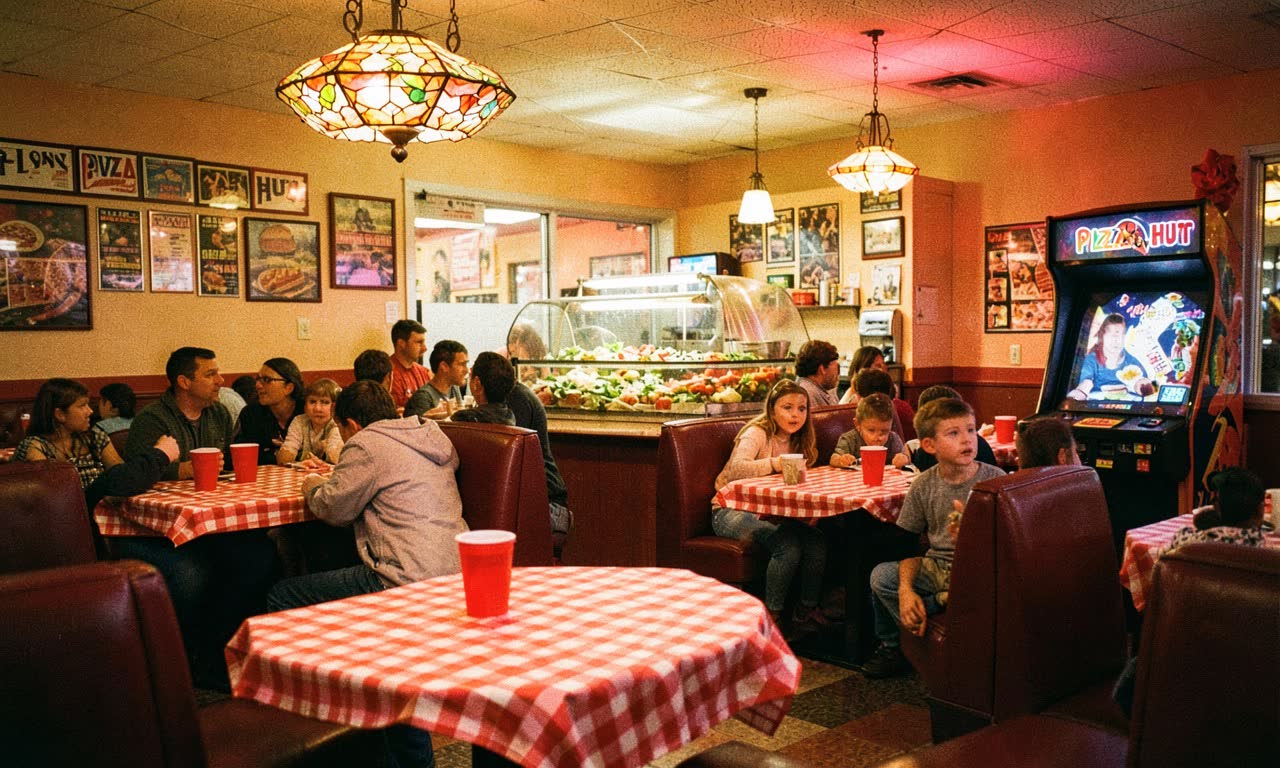
Tim Sparks, president of Deland Corporation, has been converting his Pizza Hut locations into “Pizza Hut Classics” — retro-fitted restaurants that look exactly like the Pizza Huts you remember from the 1990s. Vinyl booths. Checkered tablecloths. Stained-glass lamps. Book It! reading program posters on the wall. He’s already turned 38 of his 93 franchises into Classics, and according to his viral tweet, the response has been over 167,000 likes and 4.4 million views — mostly people saying “take my money, I want to go there.”
The tweet went viral because something about it clicked. And that something is bigger than pizza.
🔍 THE BOTTOM LINE
The “blanding” era — a decade of brands stripping themselves of personality in pursuit of sanitised minimalist universalism — is running out of road. Tim Sparks’ Pizza Hut bet proves nostalgia has commercial teeth. And AI, the very technology many blame for homogenising culture, might be the tool that finally lets brands be genuinely distinctive again — especially for small and new businesses.
The Great Blanding: How Every Brand Learned to Look the Same
Let’s rewind. Between roughly 2013 and 2022, something strange happened to the visual world. Almost every major brand flattened its logo. Burberry ditched its 117-year-old equestrian crest for a plain sans-serif wordmark. Balenciaga, Balmain, BMW, Johnson & Johnson, Pinterest — all of them. Same move. Same Helvetica-adjacent typeface. Same stripped-back aesthetic.
The critic Douglas Holt coined the term “blanding” to describe it, and the name stuck because it was painfully accurate. Every brand started to look like every other brand. The design world had converged on a single aesthetic language — flat, clean, sans-serif, cold, and interchangeable — driven by the logic that simpler = more premium = works better on mobile.
It wasn’t entirely wrong. For a while, it worked. But somewhere around 2023, the worm turned.
Burberry quietly brought its charging knight crest back. The design press called it “neo-minimalism” — minimalism with warmth, texture, intention. But really, it was the market saying what consumers had been saying for years: bland is forgettable.
Tim Sparks’ Pizza Hut bet is the working-class, Midwest-Ameriсan version of that same correction. Burberry brought back a knight. Pizza Hut brought back a salad bar. Same instinct, different price point.
Why It Matters That This Is a Franchisee, Not Corporate
This is the detail that makes the Pizza Hut story more than just a nostalgia piece: Sparks did this as a franchisee. Not as a Yum! Brands corporate initiative, not after a strategic review and three rounds of focus groups. He just… did it. Converted his stores. Watched people walk in and lose their minds with recognition.
That’s significant because it suggests the appetite for this kind of brand authenticity is so strong that it can be profitably executed at the franchisee level — not just as a limited-time marketing stunt from a global headquarters. Sparks didn’t need a $50 million ad campaign. He needed red cups, checkered tablecloths, and a salad bar. The nostalgia was already there, waiting to be unlocked.
And here’s where it gets interesting for the AI angle: what if AI lets every business do this?
The Paradox: AI Is Both the Problem and the Solution
Here’s the tension that makes this story worth watching:
On one hand, AI has been accelerating the homogenisation of brand identity. When every marketing team uses the same AI tools to generate the same corporate-approved variations, and every startup uses the same AI-powered logo generators, you get a world where everything looks like everything else — just faster and cheaper. The blandification problem doesn’t get solved by AI; it gets weaponised.
But on the other hand, AI also makes hyper-personalised branding viable at a scale that was previously impossible.
Think about what Tim Sparks did: he identified a specific generational cohort (Millennials and Gen Xers in their 30s-40s) and gave them back their childhood experience. That’s basically a persona play. AI can do that at scale — not just for Pizza Hut, but for any business that wants to target a specific generation with their own nostalgic brand language.
Imagine a world where:
- A new NZ cafe chain uses AI to generate retro 1980s milk-bar branding for Baby Boomers, Y2K cyber-cafe aesthetics for Millennials, and 2010s minimalist-scandi vibes for Gen Z — all from the same core business, adapted per location and audience.
- A boutique hotel uses AI to redesign its room interiors and collateral brand material per guest demographic, rotating through decades of design language based on what resonates with each booking cohort.
- A small business uses AI to generate entire brand identities inspired by specific eras — 1950s diner, 1990s skate shop, 1970s record store — without hiring a full design agency.
The barrier to distinctive, era-specific, personality-rich branding just dropped.
The Nostalgia Economy Has Real Teeth
This isn’t just about aesthetics. The numbers back it up.
- Forbes reported in April 2026 that Gen Z’s affinity for nostalgia marketing is one of the strongest engagement levers available to brands today — despite Gen Z being too young to have actually experienced most of the eras they’re nostalgic for.
- Adobe research cited by Free the Birds shows over 70% of Gen Z consumers feel fatigued by overly perfected digital aesthetics, preferring visuals that feel more “human and imperfect.”
- McKinsey reports that nearly 60% of consumers say emotional and sensory experience plays a decisive role in brand preference.
The Pizza Hut Classics response — 4.4 million views, 168,000 likes, and a flood of “I would go there tonight” comments — is data you can’t fake. People are hungry for brand experiences that feel designed for them, not for an algorithm’s conception of a universal consumer.
What Happens When AI Starts Designing for Cohorts, Not Demographics?
This is where the real opportunity lives.
Traditional brand targeting has been moving from broad demographics (women 25-54) to psychographic segments (health-conscious professionals, etc.). But AI enables something more interesting: micro-cohort targeting based on shared cultural touchpoints.
You don’t just target “Millennials” — you target “Millennials who remember Pizza Hut’s Book It! program in elementary school.” That’s a cultural cohort with shared memories, shared emotional associations, and a shared visual language. And AI can generate brand materials that speak directly to that cohort, in the visual language of their childhood, at virtually zero marginal cost.
The Pizza Hut Classics model proves this works offline, in an actual restaurant. The AI version scales it to every screen.
The NZ Angle: A Perfect Petri Dish for Personalised Branding
New Zealand’s media market is small, but its consumer market is remarkably cohesive — and we have a deep well of Kiwi-specific brand nostalgia that’s been largely untapped.
Think about it:
- The classic Edmonds Cookbook branding
- Tip Top Trumpet ice cream and its iconic yellow packaging
- Chesdale Cheese (the dancing cheese)
- Paua Shell House roadside attractions
- The Warehouse red shed aesthetic
- Raro and its 1990s summer campaign
- L&P branding from different eras
These are deeply nostalgic touchstones for specific Kiwi generations. And right now, almost none of them are being used in personalised AI-driven marketing. A small Kiwi business — a dairy, a cafe, a service provider — could use AI to build a brand identity that evokes 1990s Kiwiana for Gen X/Millennial customers while using completely different visual language for other cohorts. The technology exists. The nostalgia exists. The gap is execution.
The Other Side: Will AI Just Make Nostalgia Cheap?
There’s an obvious counterargument: if everyone can generate era-specific branding on demand, doesn’t that just create a new kind of sameness? If every cafe looks like a 1950s diner because the AI suggested it, we’ve swapped one bland aesthetic for another.
The answer depends on how AI is used. The brands that will win in the post-blanding era won’t be the ones that use AI to template their nostalgia. They’ll be the ones that use AI to discover what specific cultural touchpoints their specific audience actually cares about, and then design around that — with genuine intent, not just a prompt.
Tim Sparks didn’t bring back salad bars because an algorithm told him to. He brought them back because he remembered what Pizza Hut felt like, and he trusted that other people remembered it too. That human insight — that specific, lived understanding of a cultural moment — is the ingredient AI can’t generate on its own. It can help you execute it, scale it, and personalise it. But the insight has to come from someone who actually knows what a red cup means to a 45-year-old.
❓ Frequently Asked Questions
Q: What does this mean for NZ? New Zealand’s small, culturally cohesive market is an ideal testbed for hyper-personalised, nostalgia-driven branding. Kiwi businesses have deep wells of local brand nostalgia (L&P, Edmonds, Tip Top, The Warehouse) that remain largely un-tapped by AI marketing tools. The businesses that connect local cultural touchpoints with AI-powered personalisation will have a genuine first-mover advantage.
Q: Is AI making branding more or less bland? Both. AI accelerates homogenisation when used for generic templating (most current usage), but also enables hyper-specific, culturally-targeted branding at near-zero cost. The outcome depends entirely on whether the person using the AI has a specific audience and cultural reference in mind — and that’s still a human job.
Q: Is the Pizza Hut Classics trend replicable? Yes, but not as a corporate directive. The lesson from Tim Sparks is that nostalgia branding works best when it comes from someone who actually remembers the experience — not from a strategy deck. The most successful applications of this idea will come from local operators and small businesses who understand their audience’s cultural references, not from global headquarters trying to manufacture nostalgia.
Q: What generations is this nostalgia effect strongest for? Millennials and Gen X are the obvious sweet spot — they have clear, shared childhood memories of brands like Pizza Hut in its prime. But surprisingly, Gen Z also shows strong nostalgia responses for eras they didn’t experience directly, through cultural osmosis (Forbes, 2026). The “vintage” aesthetic is a Gen Z phenomenon, not just a Boomer one.
🔍 THE BOTTOM LINE
Tim Sparks bought 80 Pizza Huts and brought back the salad bar because he understood something most brand strategists forgot: people want to feel seen, not optimised. The decade-long slide into bland, universalist branding was driven by a logic of efficiency — make everything work everywhere for everyone. But what works for everyone appeals to no one.
The great correction happening now — Burberry’s knight, Pizza Hut’s red cups, the backlash against “blanding” — is the market re-asserting that identity matters. And AI, wielded the right way, becomes the tool that lets small businesses and new startups build that identity for the first time without a six-figure agency budget. Not by erasing personality, but by amplifying it.
The brands that win the next decade won’t be the ones with the cleanest sans-serif logo. They’ll be the ones that make you feel something.