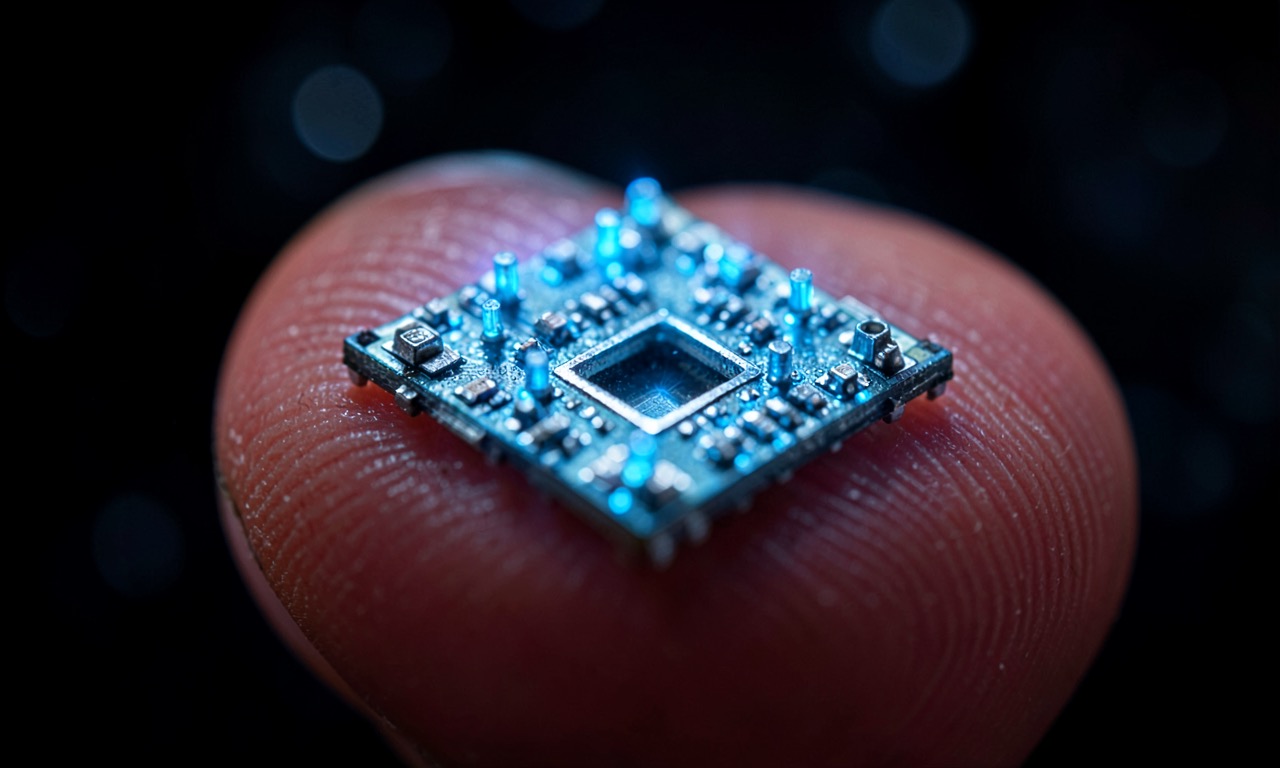
A former NASA propulsion physicist emerged from stealth this week with a company claiming to have built the first semiconductor chip that generates continuous electrical power from the quantum vacuum. The device, called MicroSPARC, reportedly produces measurable current using engineered Casimir cavities at the nanoscale — no batteries, no fuel, no moving parts.
It sounds impossible. It might be. But the backing behind it is real enough to take seriously.
🔍 THE BOTTOM LINE
This is either the most consequential energy technology since controlled fire, or the most sophisticated dead end in the long graveyard of zero-point energy claims. The science is plausible enough for NSF funding and a Physical Review publication, but no independent lab has replicated the results. Watch closely. Bet cautiously.
Who Is Sonny White?
Before you dismiss this as another free-energy crank, understand who Harold “Sonny” White is.
White spent two decades at NASA, where he founded and ran the EagleWorks Laboratories — the agency’s advanced propulsion physics research unit. He was DARPA-funded. He published in peer-reviewed journals on warp field mechanics and the dynamic vacuum. His warp drive concepts were fringe-but-respected: exotic enough to make physicists uncomfortable, grounded enough to keep NASA funding them.
He’s not a garage inventor with a YouTube channel. He’s a credentialed physicist who’s been working at the edge of established physics for 20 years — and has now raised $12 million from serious investors to commercialise the result.
What MicroSPARC Actually Is
A 5mm × 5mm semiconductor chip. Target output: 1.5 volts at 25 microamps — roughly 40 microwatts of continuous power. Comparable to a small watch battery, but it never depletes.
The physics goes like this:
The Casimir effect: Place two conductive plates 100 nanometres apart in a vacuum. Quantum fluctuations in “empty” space create a pressure imbalance — shorter wavelengths fit between the plates, longer ones don’t — and the plates get pushed together. This has been experimentally verified since the 1990s. It’s real.
The problem: In a normal Casimir setup, the plates eventually touch. You’ve extracted some energy, but you have to spend energy to pull them apart again. It’s a battery, not a generator.
White’s innovation: Replace the moving plates with static micropillars — tiny, fixed antennas arranged inside the cavity that are electrically isolated from the walls. The Casimir effect creates an electrostatic potential between the pillars and the walls. Because nothing moves, nothing needs resetting. Electrons preferentially tunnel in one direction, creating a continuous DC current.
The patent (US20240415034A1, granted May 2025) describes the geometry in detail. The theory was published in Physical Review Research in March 2026. An NSF SBIR Phase I grant (#2423233, $274,920) funded early validation.
The Case for Skepticism
Let’s be honest about the red flags.
A graveyard of failed claims. “Zero-point energy extraction” has been a magnet for pseudoscience and outright fraud for decades. The phrase alone makes most physicists roll their eyes. Every previous claim has evaporated under scrutiny.
EmDrive adjacency. White was tangentially associated with the infamous EmDrive — a reactionless thruster that turned out to be thermal expansion, not new physics. That association doesn’t make him wrong, but it means his credibility has been tested before.
Picoamp measurements. The team reported outputs “ranging from millivolts to volts at picoamp current levels” — extremely small signals. At those scales, noise is a nightmare. They say they used RF-sealed enclosures and precision electrometers, but independent replication is the only thing that would settle this.
No independent verification yet. Multiple scientists contacted by The Debrief declined to comment publicly. That could mean they’re skeptical but don’t want to pick a fight, or they’re waiting for data. Either way, silence isn’t confidence.
Thermodynamics. The fundamental question: does this violate the second law? White says no — the system is converting existing quantum field energy, not creating it. The vacuum isn’t “nothing” in quantum field theory; it has a ground-state energy density. But the question of whether you can extract useful work from that ground state without paying an equalising cost is one the physics community hasn’t settled.
Why This Time Might Be Different
The distinguishing factor here isn’t the claim — it’s the infrastructure around the claim.
| Factor | Past attempts | Casimir Inc. |
|---|---|---|
| Credentials | Garage inventors | NASA/DARPA physicist |
| Peer review | None or predatory journals | Physical Review Research |
| Government funding | None | NSF SBIR Phase I |
| Venture backing | None | $12M oversubscribed seed |
| Patent | None or implausible | Granted US patent, detailed design |
| Board | Nobody | Kam Ghaffarian (Intuitive Machines) |
Kam Ghaffarian’s presence on the board is notable. He founded Intuitive Machines (the company that landed on the Moon), X-energy (nuclear), and Axiom Space (commercial space stations). He’s a serious technologist who does not back obvious nonsense.
Tim Draper (Draper Associates) also invested — the same Draper behind Theranos and several other bets that went badly wrong, so that cuts both ways.
If It’s Real: What Changes
Assume for a moment the replication happens. Independent labs confirm a single chip can produce 40 microwatts continuously. What then?
The roadmap: White says stacking and aggregation scales the output. A 5mm chip targeting 40μW → a similarly sized chip delivering 200× that power (~8mW) → chip aggregation on PCBs → 0.5W trickle chargers → $100/watt generators the size of a loaf of bread delivering 500W continuous.
Self-powered sensors everywhere: Tire pressure monitors that never need batteries. Structural sensors in bridges and buildings that run for decades. Agricultural sensors scattered across paddocks. The Internet of Things stops being a battery-replacement problem.
Medical implants without surgery: Pacemakers, nerve stimulators, insulin pumps — devices that currently require surgery every 5-10 years for battery replacement. A tiny chip that never depletes could be implanted for life.
Off-grid infrastructure: Remote weather stations, ocean buoys, seismic monitors in backcountry NZ. No solar panels, no wind turbines, no battery swaps. Just continuous low power drawn from the vacuum itself.
Space exploration: Deep space probes beyond the solar system where solar panels are useless and RTGs (radioisotope thermoelectric generators) are heavy, expensive, and politically fraught. A chip that harvests quantum vacuum energy would work anywhere in the universe, forever.
The phone that never dies: A continuous 0.5W trickle charge. Your phone would fully recharge in ~24 hours under normal use. For most people, that means never plugging in again. White calls this “making the device immortal for typical daily operation.”
NZ implications: Self-powered sensors across our vast agricultural and conservation estates. Remote DOC monitoring, farm soil sensors, marine buoys around our coast. No battery logistics, no solar dependence, no maintenance runs. For a country with a lot of land and a small population, this is transformative.
The Bottom Line
If the replication holds: This is the most important technology story of the decade — possibly the century. Clean, continuous, decentralised power from a source that exists everywhere. It would fundamentally rewrite our relationship with energy.
If it doesn’t: This joins the long list of vacuum-energy claims that couldn’t survive independent scrutiny. White’s career takes a hit. The investors lose $12M. The physics community gets another example of why extraordinary claims need extraordinary evidence.
The target is 2028 for first commercial chips. Between now and then, we need to see independent replication, third-party validation, and transparent data. Nothing less.
But for the first time in decades, a serious zero-point energy claim has enough institutional backing that it demands to be taken seriously — not as proven, but as worth watching.
❓ Frequently Asked Questions
Q: Does this violate the laws of physics? White says no. The quantum vacuum has measurable energy density — the Casimir effect itself proves that. The question is whether you can extract net useful work from it without paying an equilibrium cost. The physics community is divided.
Q: When can I buy one? Casimir targets 2028 for first commercial MicroSPARC chips, initially for industrial sensors and IoT. Consumer products would follow if the scaling roadmap works.
Q: Has anyone independently verified this? Not yet. The NSF Phase I grant validated the design approach. The Physical Review paper passed peer review. But no third-party lab has built and tested their own MicroSPARC chip. Until that happens, treat the claims as unconfirmed.
Q: Could this power a house? In theory, yes — if the physics holds and the stacking roadmap works. Casimir’s roadmap shows a loaf-of-bread-sized 500W assembly at ~$100/watt. That’s a long way from here, but not physically impossible if the underlying mechanism is real.
Q: What does this mean for NZ? NZ has significant remote infrastructure — conservation sensors, marine monitoring, farm IoT — where “fit and forget” power would save enormous logistics costs. If the tech works, NZ could leapfrog battery logistics for off-grid sensing.
🔍 THE BOTTOM LINE
Harold White’s MicroSPARC chip is either the biggest energy breakthrough in human history or the most credible dead end in vacuum-energy research. The science is published, the patent is granted, the funding is real, and the investors are serious. But a chip that generates measurable current in a lab is a long way from a product that powers your phone. We’ll be watching every step of the replication process.
📰 SOURCES
- The Debrief — Free Energy from the Vacuum?
- NextBigFuture — Casimir Microsparc Target is 40 Microwatts
- Quantum Insider — Casimir Launches With $12M Seed Round
- NSF SBIR Award #2423233 — Casimir Inc.
- US Patent US20240415034A1 — Casimir Power Cell
- Physical Review Research — Emergent quantization from a dynamic vacuum (2026)