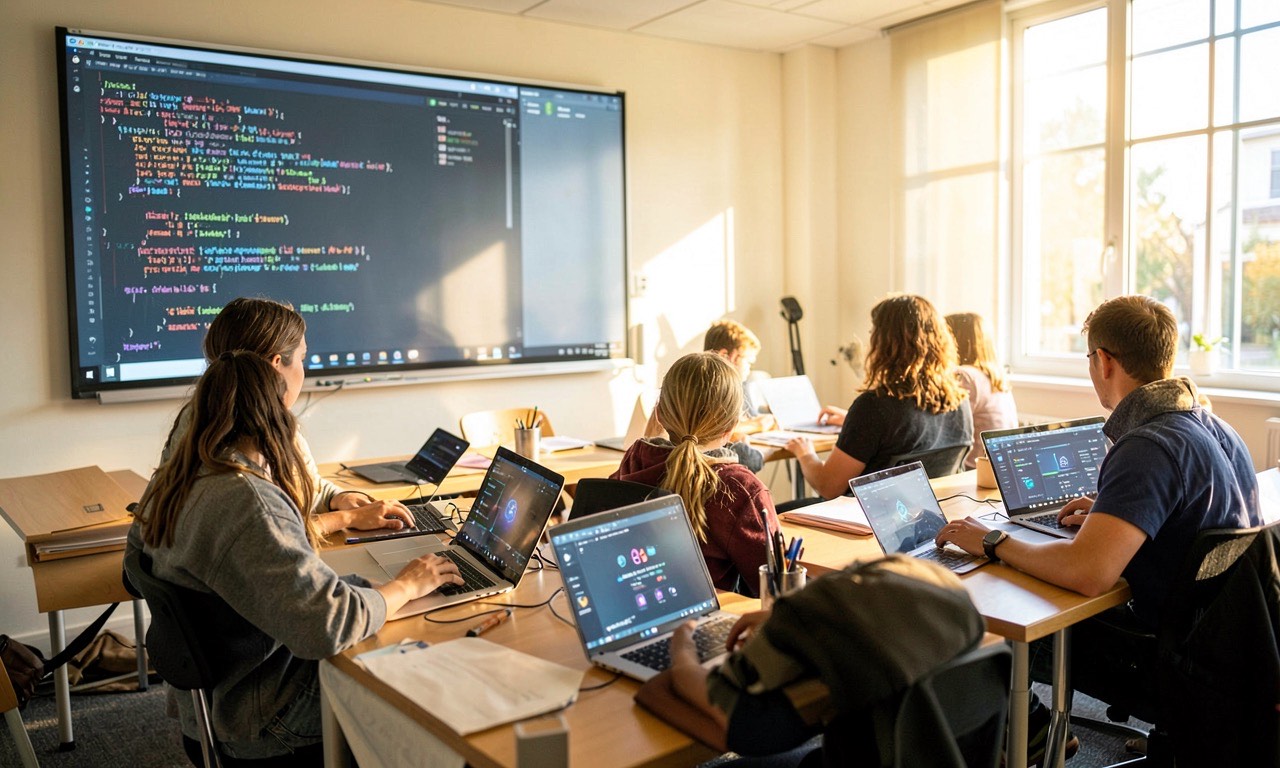
Google allows AI assistants in coding interviews — the end of “whiteboard” computer science education
Google is piloting a new interview format that lets software engineering candidates use AI assistants during a “code comprehension” round. The company calls it reflective of “how our teams are operating in the AI era.”
Why this matters for education: Every university computer science department in the world just got a new curriculum document. If Google — the company that defined the technical interview — says AI fluency is the skill you’re testing for, then “learn to code without assistance” is no longer the end goal. The question becomes: how do we teach students to use AI effectively while still building foundational understanding?
🔄 Cross-link: This connects directly to our coverage of Khan Academy’s AI-powered learning platform and the new Bachelor’s in AI+ degrees — the credentialing system is catching up to this reality.
OpenAI’s Codex Chrome extension — the teaching tool that works on real websites
OpenAI launched a Chrome extension for Codex that performs tasks on websites including LinkedIn and Salesforce. It’s part of the “super app” strategy combining ChatGPT, Codex, browsing, and agentic capabilities.
Why this matters for educators: This is a watershed moment for project-based learning. Students can now build real-world automations — not in a sandbox, but on live systems. The teaching challenge shifts from “how do I set up a development environment” to “how do I design an agent that solves a real problem safely.”
🔄 Singularity take: Every educator I know is both excited and terrified. The teaching opportunity is enormous — real projects, real impact, immediate feedback. The risk is that students skip the understanding part and just automate everything without comprehension. The best teachers will design curricula that require both.
The “prompt engineer” role fades — what does this mean for AI literacy education?
Anthropic’s Claude Code alone generates over $1B ARR, but the role of standalone “prompt engineer” is being absorbed into broader roles. As models improve at understanding intent, the narrow skill of crafting prompts is becoming less valuable relative to domain expertise and system thinking.
Why this matters for education: The lesson is clear: teach AI literacy as a layer on top of real skills, not a replacement for them. Programmes focused solely on “prompt engineering certificates” are already losing relevance. The most valuable education combines domain expertise (health, law, engineering, creative) with AI literacy — not AI in isolation.
NZ angle: The AI Blueprint for Aotearoa’s “Building Talent” pillar includes strengthening AI literacy through “inclusive education pathways and upskilling the existing workforce.” The blueprint explicitly notes NZ sits in a “high-use, low-trust” position — meaning we’re using AI but don’t understand it well. That’s an education gap, not a technology gap.
BCG research: AI reshapes more jobs than it replaces — education must follow
BCG’s 2026 research finds AI shifts engineers’ work toward “system-level thinking, orchestration, and product and design tasks.” It’s not that jobs disappear — it’s that the skill mix changes.
Why this matters for education: If you’re designing a curriculum in 2026, you should be asking: are we teaching skills that AI will handle (rote coding, basic analysis) or skills that AI augments (systems thinking, problem framing, ethical judgment)? The education systems that answer this well will produce graduates who are genuinely valuable in the AI-augmented workplace.
🔄 Cross-link: This connects to our ongoing coverage of the 93,000 tech layoffs where AI is now the #1 reason — the jobs being cut are largely in categories where AI can absorb the work. The jobs being created require different skills entirely.
The AI Blueprint for Aotearoa: what it means for NZ educators
The AI Forum NZ launched the “AI Blueprint for Aotearoa” on May 6, a refreshed national programme to 2030. The blueprint explicitly calls out education and talent as one of five pillars: “Building talent — strengthening AI literacy and skills through inclusive education pathways, and upskilling the existing workforce.”
Key education milestones from the blueprint:
- May–June 2026: Sustainable AI discussion series (Auckland, Wellington, Christchurch)
- 18–24 May 2026: Techweek26 — education-focused events nationwide
- 3–10 August 2026: AI Hackathon Festival (nationwide, student-focused)
- Mid-2026: AI and Productivity research survey including measures of trust
Why this matters: This is NZ’s most concrete AI education roadmap to date. The blueprint acknowledges that NZ’s challenge isn’t technology access — it’s AI literacy and trust. For educators, this means there’s a growing infrastructure of events, research, and resources aimed at closing the literacy gap. The AI Hackathon in August is a particularly good opportunity for students to build real projects.
🔍 THE BOTTOM LINE
If Google says AI is part of the test, Codex can act on the internet, and prompt engineering is already commoditising, then the question for every educator is: what should we actually be teaching? The answer isn’t “teach AI” or “don’t teach AI” — it’s “teach AI literacy as a layer on top of real, transferable skills.”
❓ FAQs
Q: Should schools ban AI coding tools to preserve foundational learning? A: No — but they should explicitly design when and how AI tools are used. Students need unassisted practice to build understanding, and AI-assisted practice to build fluency. The key is intentional curriculum design, not blanket bans.
Q: What should a student focus on learning right now? A: Systems thinking, problem decomposition, and domain expertise — combined with fluent use of AI tools. The student who can identify a problem, structure it for AI assistance, validate the output, and integrate it into a real workflow is unstoppable.
Q: Is NZ’s education system ready for this shift? A: The blueprint suggests leadership is aware of the gap but execution is slow. Individual educators and institutions are moving faster than the system. The AI Hackathon this August is a good opportunity for students to get hands-on regardless of their school’s AI readiness.
🔍 THE BOTTOM LINE
The “learn to code” advice of 2026 sounds different: learn to think, learn to design, learn to validate — and use AI as the tool that handles the implementation. That’s a harder educational challenge than teaching syntax, but it produces graduates who can actually work in an AI-augmented world.
📰 SOURCES
- TechCrunch — Google AI-assisted interviews
- The Decoder — OpenAI Codex Chrome extension
- Financial Times — Anthropic revenue and services
- BCG — AI reshaping jobs
- RNZ — NZ AI education coverage
- NZ AI Forum — AI Blueprint for Aotearoa
- Stanford HAI — AI Index 2026
- OpenAI — Codex announcement
- NZ Ministry of Education — digital technology curriculum