Answer-First Lead
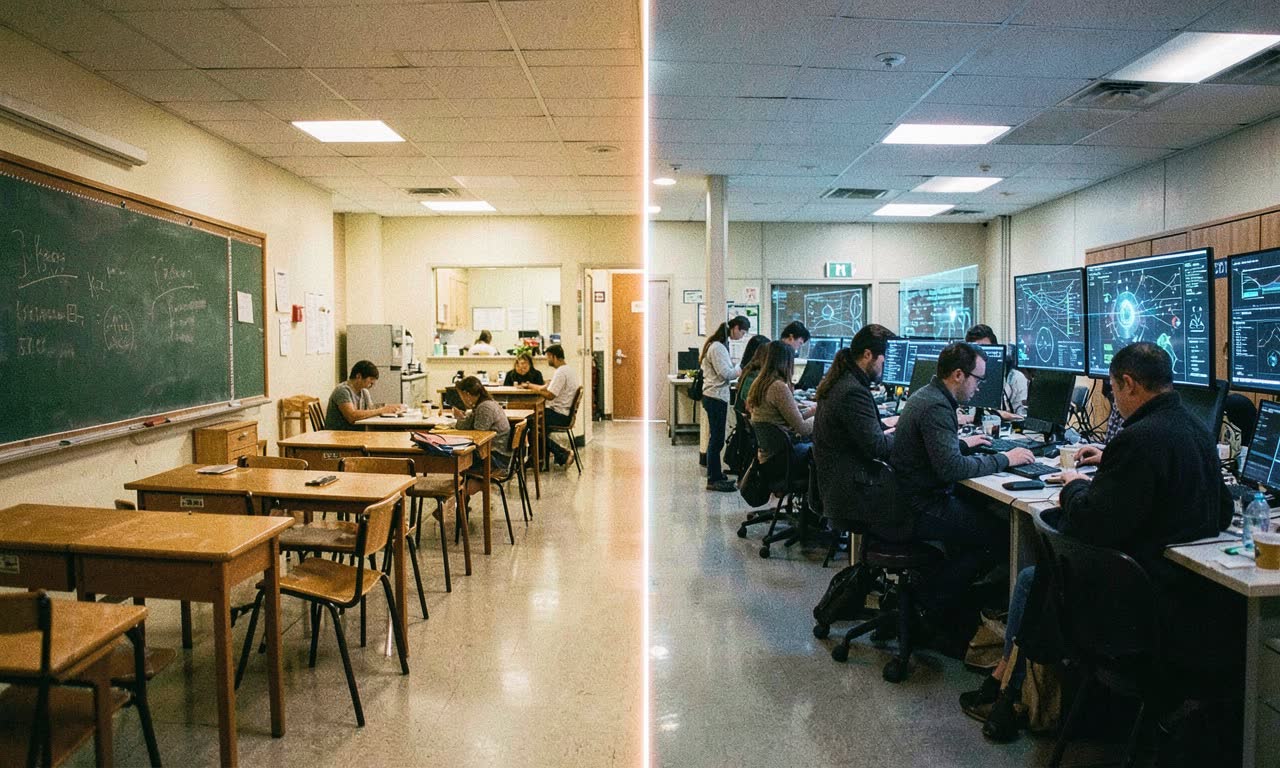
Two hundred and fifty education experts signed an open letter calling for a five-year moratorium on AI use in schools, citing risks to child development, critical thinking, and social skills — even as Khan Academy, Duolingo, and a growing number of schools prove AI can improve learning outcomes. The tension between “AI will break education” and “AI is already improving education” has never been sharper. This week’s stories sit squarely on both sides.
🔍 THE BOTTOM LINE
The education-AI debate is past the theoretical stage. Schools are either banning AI or building it into their curriculum. The ones in the middle — doing nothing — are the ones falling behind. The evidence for both improved outcomes AND genuine risks is mounting simultaneously.
🎓 Today’s Stories
1. 250 Education Experts Demand Five-Year AI Moratorium in Schools
An open letter signed by 250 education researchers, child psychologists, and former education ministers calls for a global five-year moratorium on AI use in primary and secondary classrooms. The signatories argue AI disrupts cognitive development, weakens critical thinking, reduces social interaction, and creates data privacy risks for minors.
The letter explicitly names personalized AI tutoring platforms — including Khan Academy’s Khanmigo — as examples of technologies being deployed too fast without long-term studies on child development impacts.
Why it matters: This isn’t a fringe petition. These are the people who design education policy. If even half of their concerns prove valid, the cost of deploying AI too fast in schools could be measured in developmental outcomes of a generation. On the other hand, a five-year ban in a field moving at this pace would leave the signatories’ own students behind globally.
2. Florida’s OpenAI Lawsuit — Implications for School AI Policies
Florida’s unprecedented lawsuit against OpenAI and Sam Altman — alleging ChatGPT aided mass shooters — has immediate implications for school AI policies. School districts in Florida are reportedly re-evaluating their classroom AI tool lists, and the Florida Department of Education is reviewing whether existing AI use policies provide adequate liability protection.
Why it matters: If the lawsuit succeeds, it could establish that AI companies are liable for how their products are used in schools — not just as “tools used by bad actors” but as products with foreseeable risks that companies have a duty to mitigate. Every school board in America should be watching this case.
3. Khan Academy Rolls Out LLM Teaching Assistants Across Peru
Khan Academy announced a nationwide partnership with the Peruvian Ministry of Education to deploy Khanmigo — their AI-powered teaching assistant — across 12,000 primary and secondary schools. Peru becomes the first country to use Khan Academy’s LLM-based tutoring at national scale, with the system available in Spanish and Quechua.
The deployment covers math, science, and reading comprehension. Khanmigo acts as a classroom co-teacher, providing real-time feedback to students and surfacing struggling learners to human teachers. Early pilot data shows improved test scores in math and higher student engagement.
Why it matters: This is the first national-scale deployment of LLM tutoring anywhere in the world. If it works in Peru — with infrastructure challenges, multiple languages, and wide socioeconomic diversity — it works everywhere. The Quechua language support is particularly notable: AI bringing educational access to underserved language communities.
4. New Zealand High School Teaches Students to Build AI Agents
A New Zealand high school in Christchurch launched an elective course teaching students to build their own AI agents as part of digital technology classes. Year 12 and 13 students are creating agents for homework management, study planning, and community service projects — learning Python, prompt engineering, and responsible AI deployment.
The course has a waitlist three times its capacity. Students who complete it earn NCEA credits toward university entrance.
Why it matters: While 250 experts call for a ban, a Christchurch school is teaching the skills students will need in an AI-driven economy. The demand proves students want this. The question is whether the rest of NZ’s education system will follow — or leave private schools and motivated students to pull ahead.
5. The AI-First Classroom — What Schools That Actually Use AI Are Learning
A roundup from ISTE documented findings from schools that fully integrated AI into their teaching in 2026:
- Teacher workload: AI grading and planning reduced teacher overtime by 40%
- Student outcomes: Personalized pacing improved math scores by 18% in pilot programs
- Social skills: The schools that scored highest on social-emotional learning were the ones that explicitly taught AI’s limitations alongside its capabilities
- Cheating: Detection tools caught ~3% of submissions — but AI-assisted students who cited their AI use showed better learning outcomes than those who hid it
Why it matters: The data on schools that actually use AI is more nuanced than either side of the moratorium debate admits. AI reduces teacher burnout AND creates new classroom management challenges. The schools that succeed are the ones that teach AI literacy as part of the curriculum — not just AI as a tool students use without understanding.