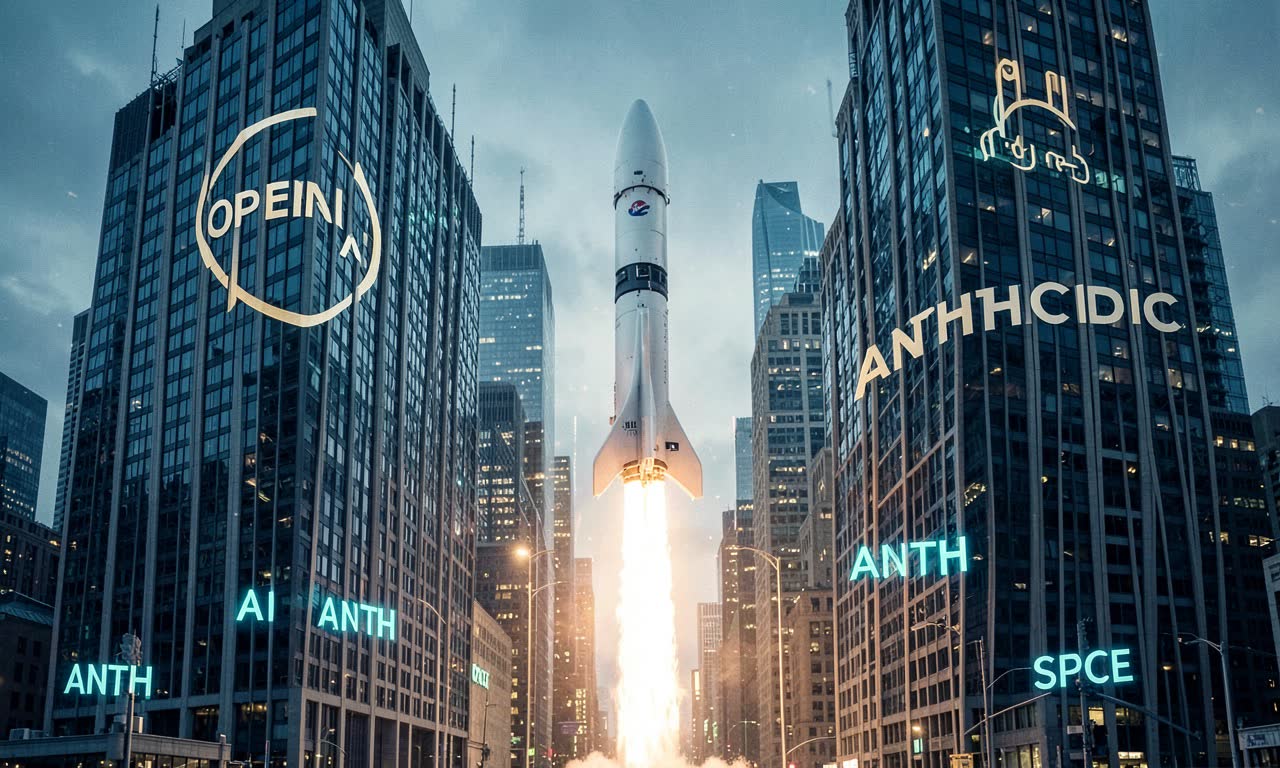
1. OpenAI Files for IPO: $25B ARR, $852B Valuation — The Most Anticipated Tech Listing Since Coinbase
OpenAI confidentially filed its IPO prospectus on May 22, disclosing $25 billion in annualized recurring revenue against an $852 billion valuation from its last private round in March. Goldman Sachs and Morgan Stanley are leading the deal, with a public listing expected later in 2026 pending SEC review.
The filing comes exactly one day after the Wall Street Journal reported Anthropic’s profitability milestone, creating an awkward comparison: OpenAI is running at a loss on $25B ARR while Anthropic is on track for $43.6B annualized revenue at a $900B valuation and already turning a profit. Two of the most valuable companies in tech history are about to have their numbers laid bare for public market scrutiny — and the one with the higher valuation has worse fundamentals.
The prospectus confirms OpenAI is pursuing a traditional IPO rather than a direct listing or SPAC. The race to file first was partly about setting the narrative before Anthropic’s numbers become the comparable denominator.
Why it matters: This opens the first period in AI history where two frontier labs navigate public market disclosure simultaneously. Investors and regulators get unprecedented visibility into AI economics — revenue concentration, compute costs, customer churn, the works. For anyone who’s been asking “how much money are these companies actually making?” — you’re about to find out.
2. Anthropic Closes $30B Round at $900B+ Valuation — and Turns Its First Profit
Anthropic’s $30 billion funding round closed at a valuation above $900 billion — nearly tripling its $380 billion February valuation in under four months. Led by Sequoia Capital, Dragoneer, Greenoaks, and Altimeter, the round makes Anthropic the most valuable private AI company, surpassing OpenAI’s $852B March valuation.
The fundraise was supported by $10.9 billion in Q2 2026 revenue and — for the first time — $559 million in operating profit. That’s two years ahead of projections, which is either a testament to Anthropic’s execution or a sign that compute costs came in lower than expected thanks to the SpaceX Colossus deal.
Amazon and Google, committed to $25B and up to $40B respectively, were not confirmed participants in this specific round. The shift toward new investors suggests Anthropic is diversifying its cap table beyond the cloud hyperscalers — smart, given both Amazon and Google are also building competing models.
Why it matters: Profitability changes the conversation. A safety-first AI company that can also generate profits is a much more powerful story than one that needs endless charity. It also puts pressure on OpenAI to demonstrate a path to profitability before its IPO goes live. The narrative war just got real.
3. SpaceX S-1 Reveals: Anthropic Paying $1.25 Billion Per Month for Compute Through 2029
SpaceX’s IPO S-1, filed May 21, contains a bombshell: Anthropic has agreed to pay $1.25 billion per month for compute access on Colossus through May 2029 — $45 billion total. At that monthly rate, the compute deal alone generates more annual revenue for SpaceX ($15B) than the company’s entire 2025 standalone revenue.
Colossus 1 was originally built for xAI’s Grok models. After xAI moved to Colossus 2, Colossus 1 became a revenue-generating asset worth $15 billion per year simply by leasing to a competitor. The GPU clusters being built today by Amazon, Google, and Microsoft aren’t just infrastructure investments — they’re potential revenue streams if any AI lab is willing to pay frontier prices for guaranteed capacity.
Why it matters: The number reframes how we think about AI compute. A single GPU cluster generating $15B/year in lease revenue is an asset class of its own. Every hyperscaler building AI infrastructure today should be asking: “Are we building for our own models, or are we building to lease to Anthropic at a 90% margin?“
4. Trump Delays AI Executive Order — David Sacks and Industry Voices Prevail
President Trump postponed signing a planned AI security executive order on May 21, after calls from David Sacks and industry voices warning the 90-day frontier model testing regime “could have been a blocker.” The White House had a signing ceremony scheduled — and cancelled it hours before.
The executive order was expected to establish a voluntary 90-day pre-release model-disclosure framework with the federal government, covering critical infrastructure AI deployments. Axios reported Trump “just hates regulation” and spoke with Mark Zuckerberg, Elon Musk, and Sacks right before the scheduled signing.
The delay leaves the current framework — including the CAISI pre-deployment evaluation agreements with the five frontier labs — in place without statutory backing. State-level AI laws and sector-specific guidelines continue filling the gap.
Why it matters: The US is now effectively deregulating AI at the federal level while states scramble to build their own rules. For New Zealand, which has no binding AI regulation at all, the US pivot away from oversight removes any pressure to follow a global standard. We’re now in a world where nobody is leading on AI safety regulation — and that’s a dangerous place for small economies.
5. EU Reaches Digital Omnibus Agreement — AI Act Simplified, Nudifier Apps Banned
EU negotiators reached a provisional agreement on the Digital Omnibus on AI on May 7, marking the first major revision of the AI Act since it passed. The deal pushes back several high-risk compliance deadlines by up to 16 months, simplifies reporting requirements for low-risk systems, and — notably — bans AI “nudifier” apps at the EU level.
The nudifier ban is significant because it was initially removed during the simplification process, then restored after public outcry. Minnesota became the first US state to ban these apps just weeks earlier, and the EU’s parallel move suggests a rare transatlantic consensus on at least one AI harm.
Why it matters: The EU is sending a mixed signal: “We’re serious about AI regulation — just not too serious, and not too fast.” The deadline relief helps businesses, but the overall trajectory is a softening of what was supposed to be the world’s strictest AI framework. If the EU won’t hold the line, who will?
6. Pentagon Pulls Away From Anthropic Claude — Testing OpenAI and Google Instead
The Pentagon is moving away from Anthropic’s Claude models, testing OpenAI and Google’s alternatives for classified military networks, according to NewsBytes. Anthropic is fighting the decision in court — the company sued the US government earlier this year over a “supply chain risk” designation that effectively blocked Claude from DoD contracts.
This comes after months of escalating tension. Anthropic refused Pentagon requests to deploy Claude in certain military applications, the government designated the company as a supply chain risk, and now the Pentagon is actively diversifying away from Anthropic’s technology. The legal battle over the $5 billion+ in potential lost revenue continues.
Why it matters: The largest military customer in the world is walking away from the most safety-conscious AI company. The message to the industry is clear: if you build safety guardrails the Pentagon doesn’t like, you lose the contract. That’s a powerful incentive for every other AI lab to think twice before adding restrictions.
7. Waymo Pauses Service in Four Cities — Robotaxis Keep Driving Into Floods
Waymo has now paused autonomous taxi operations in four cities because its robotaxis are struggling to handle flood conditions. TechCrunch reported the expansion of the pause on May 21, following incidents where vehicles drove into standing water.
The problem isn’t that the cars can’t see the water — it’s that they can’t reliably distinguish between a large puddle and a flooded intersection. In at least one case, a Waymo vehicle entered a flood zone that human drivers were actively avoiding. Passengers had to be rescued.
Why it matters: Edge cases in autonomous driving keep finding new ways to humiliate the technology. Weather-related failures are the hardest to solve because you can’t train on every flood scenario. The pause is smart, but it reinforces the gap between “works in ideal conditions” and “works everywhere, always.”
8. Andrej Karpathy Joins Anthropic — OpenAI Co-Founder Crosses the Floor
Andrej Karpathy, one of OpenAI’s original co-founders, joined Anthropic to lead pretraining efforts, marking the most high-profile talent defection in the AI industry this year. Karpathy will build a team focused on using Claude to train the next generation of Claude models.
The hire is a double blow to OpenAI — Karpathy was one of the most visible and respected figures in the AI research community, and his move to the direct competitor signals that Anthropic’s research culture is the more attractive destination. He was previously at Tesla leading Autopilot AI before returning to OpenAI, and then went independent as an AI educator.
Why it matters: Talent wars in AI are intensifying, and this one cuts deep. Karpathy isn’t just a researcher — he’s a cultural icon in the AI community. His move suggests Anthropic is winning the “who has the best research environment” battle, at least among the people who build the models.
9. OpenAI Opens Singapore AI Lab — First Permanent Overseas R&D Hub
OpenAI opened its first overseas applied AI lab in Singapore with a $235 million investment, coinciding with Singapore’s IMDA updating its agentic AI framework. The lab will focus on applied research in Southeast Asian languages, cultures, and enterprise use cases.
Singapore has been aggressively positioning itself as Asia’s AI hub, and OpenAI’s lab is the latest validation of that strategy. The IMDA’s updated framework covers agentic AI specifically — a sign that Singapore is thinking about the regulatory challenges of autonomous AI systems before most governments have even noticed the category exists.
Why it matters: Singapore is doing what New Zealand isn’t — actively courting frontier AI investment while simultaneously building regulatory frameworks. The contrast is stark: Singapore creates the conditions for responsible AI adoption while NZ is still debating whether we need a strategy at all.
10. Newsom Signs First-of-Its-Kind Executive Order on AI Workforce Disruption
California Governor Gavin Newsom signed an executive order on May 21 directing state agencies to prepare workers and businesses for potential AI-driven disruption. The order requires the California Workforce Development Board to develop sector-specific AI transition plans, and directs the state’s employment development department to track AI-related job displacement in real time.
It’s the most concrete government action on AI workforce disruption to date — not banning AI, not promoting it uncritically, but building the infrastructure to monitor and respond to its effects. The order also establishes an “AI Disruption Advisory Council” with representatives from labor, industry, and academia.
Why it matters: California is the 5th largest economy in the world and home to most frontier AI labs. If any government has the data to understand AI’s workforce impact, it’s California. The real-time monitoring component is the key — within months, we’ll have actual numbers on AI-driven job changes from the world’s most AI-exposed economy.
11. GitHub Supply Chain Attack Compromises 500+ Software Packages
Wired reported that a group claiming responsibility for a GitHub repositories breach executed 20 waves of supply chain attacks, compromising over 500 pieces of software. The attack vector specifically targeted AI-adjacent developer tooling — packages commonly used in LLM integration and agent framework development.
GitHub confirmed the breach. The attack underscores the Five Eyes agencies’ joint guidance from May 8 on agentic AI security risks: as AI becomes embedded in software supply chains, attacks on developer infrastructure become attacks on AI systems downstream.
Why it matters: The AI supply chain is only as secure as the packages it depends on. When attackers specifically target AI development tools, they’re not just after code — they’re after model weights, API keys, and the credentials that control AI systems. Supply chain security isn’t a DevOps problem anymore. It’s an AI safety problem.
12. Taiwan Establishes National AI Committee — Mandates Risk Assessments by July
Taiwan’s Executive Yuan announced a new AI committee on May 22, requiring all government agencies to complete AI risk assessments by July and issue internal control rules within a year. Premier Cho Jung-tai said the focus is on promoting “safe chat” AI usage across government.
The move places Taiwan among a growing list of Asia-Pacific governments establishing formal AI governance structures — including Singapore, Japan, South Korea, and Australia. Taiwan’s approach is notable for its speed: risk assessments in two months, control rules in twelve.
Why it matters: APAC is becoming the de facto global laboratory for AI governance — faster timelines, more pragmatic approaches, less ideological baggage than Europe or the US. Taiwan’s move reinforces the pattern: the region is building AI frameworks while the West is still arguing about them.
🔍 THE BOTTOM LINE
Three massive financial stories — OpenAI’s IPO, Anthropic’s profitability, SpaceX’s compute deal — all broke within 48 hours of each other, and they tell the same story: the AI industry has entered its financial maturity phase. The companies are real. The revenues are real. The valuations may be insane, but the underlying economics are solid enough to survive public scrutiny. Meanwhile, regulation is retreating on both sides of the Atlantic, and the gap between “AI companies get serious” and “governments get serious” keeps widening.