NVIDIA Unveils Vera CPU and Rubin GPU Architecture at Computex — Not Just an AI Chip Company Anymore
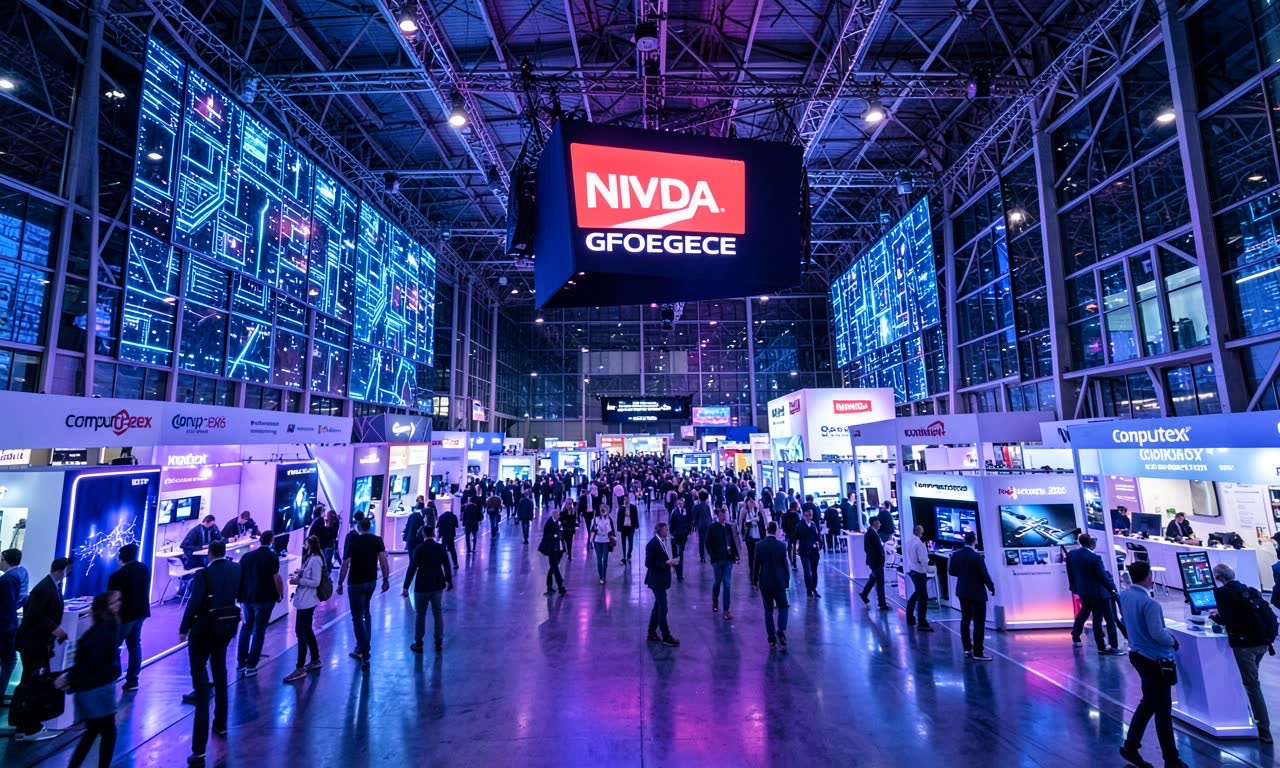
NVIDIA used its Computex 2026 keynote on June 4 to unveil Vera, its first server CPU, paired with the next-generation Rubin GPU architecture — a clear signal that Jensen Huang has his sights set well beyond AI accelerators.
Vera is an ARM-based server CPU designed to work alongside NVIDIA GPUs in data centres, aiming to replace the x86 CPUs that currently act as host processors in GPU servers. The spec sheet is impressive: more cores, higher memory bandwidth, and native NVLink-C2C interconnect to Rubin GPUs. The Vera+Rubin combination targets the massive AI training clusters where CPU-GPU communication is currently a bottleneck.
Rubin, as previously announced, is the successor to Blackwell, promising significant performance-per-watt improvements. Jensen showed benchmarks claiming 3× training throughput over the same-power Blackwell cluster.
Why it matters: This is NVIDIA’s “everything but the kitchen sink” moment. Vera means NVIDIA no longer needs to rely on Intel or AMD CPUs in its reference architectures. If hyperscalers adopt Vera+Rubin as a unified platform, NVIDIA captures the CPU revenue too — and locks customers even more tightly into its ecosystem. The ARM server CPU market just got its most credible entrant.
Microsoft Launches Seven New MAI Models Across the Enterprise Stack
Microsoft released seven new models under its MAI branding, covering everything from coding (MAI-Code-1-Flash, launched earlier in the week) to image generation, document understanding, summarisation, and multilingual translation. The models are available in Azure AI Studio and GitHub Copilot.
The portfolio now spans MAI-Thinking-1 (reasoning), MAI-Code-1-Flash (efficient coding), MAI-Vision-1, MAI-Document-1, and three smaller niche models. All are MoE architectures designed for cost-efficient inference.
The strategic signal is unmistakable: Microsoft is building a complete model stack that doesn’t depend on OpenAI. While OpenAI’s GPT models remain available in Azure, Microsoft now offers first-party alternatives for every major capability — and given Microsoft’s pricing power on its own infrastructure, the incentives to shift workloads to MAI models are strong.
Why it matters: Microsoft is quietly decoupling from OpenAI. The MAI family now covers the full enterprise AI stack — coding, vision, language, document processing — with models built in-house. For enterprises evaluating AI platforms, the question shifts from “which model?” to “which vendor’s model ecosystem do I bet on?”
Google DeepMind’s Gemma 4 12B — Encoder-Free Multimodal That Runs on a 16GB Laptop
Google DeepMind’s Gemma 4 12B is the new lightweight champion of on-device AI — a 12-billion-parameter model that handles images, text, and audio natively without a separate encoder. It runs on a 16GB laptop, making it one of the most capable open-weight models that can operate entirely offline.
The encoder-free design is the standout feature: most multimodal models use a separate vision encoder to process images before feeding them into the language model. Gemma 4 12B treats visual tokens as first-class citizens in the same architecture, improving cross-modal reasoning. Google claims it outperforms Gemma 3 27B on several benchmarks despite being less than half the size.
The model is Apache 2.0 licensed and available on Hugging Face.
Why it matters: This closes the gap between cloud and edge AI significantly. A model that fits on a consumer laptop and handles vision, text, and audio means real on-device AI assistants are viable — no cloud round-trip required. For privacy-conscious users and offline scenarios, this is a step-change.
AI-Powered Browsers Reshuffle How We Navigate the Web — Summarisation and Auto-Search Become Default
The browser wars are back, and this time AI is the weapon. Both Arc Browser and Opera have released major AI features that change the fundamental browsing experience: auto-summarisation of pages, proactive search queries, and AI-curated reading lists that appear before traditional search results.
Arc’s latest update includes “Auto Search” — where typing a query into the address bar triggers an AI agent that searches, analyses results, and presents a summary rather than a list of links. Opera’s “Aria 2.0” similarly offers page summarisation, note-taking, and chat-based browsing assistance. Both operate on-device where possible, with cloud fallback for complex queries.
Early reviews are divided: power users love the efficiency, publishers hate that content is summarised rather than visited, and privacy advocates worry about what data browsers collect during AI processing.
Why it matters: The browser is the last interface that hasn’t been disrupted by AI — until now. If summarisation becomes the default browsing experience, it fundamentally changes web economics (fewer page views, more extractive AI) — the same conflict that wrecked Google’s relationship with publishers is coming to every browser company. The question isn’t whether AI browsers are coming; it’s whether websites will start blocking them.
🔍 THE BOTTOM LINE
Computex week is traditionally about hardware, but this year’s theme is platform consolidation. NVIDIA wants you on Vera+Rubin. Microsoft wants you in Azure with MAI models. Google wants you on Gemma. And AI browsers want to become your default interface to everything. The battle isn’t model-vs-model anymore — it’s platform-vs-platform, and the winner takes the entire stack.
❓ Frequently Asked Questions
Q: Will Vera CPU replace Intel/AMD in data centres? Not immediately, but it’s the first credible threat to x86 dominance in server CPUs. Hyperscalers like Google and AWS could design Vera-based clusters for AI workloads, while maintaining x86 for general compute. The shift will be gradual over 3-5 years.
Q: Can I run Gemma 4 12B on my MacBook? Yes — if you have 16GB+ RAM. The model is on Hugging Face under Apache 2.0, and with llama.cpp or MLX you can run it locally. For inference, expect usable but not blazing speeds on Apple Silicon.
Q: Should Microsoft customers switch from OpenAI models to MAI? Not yet. MAI models are competitive but haven’t proven themselves at scale. The strategic direction is clear (Microsoft will increasingly push MAI), but enterprise customers should evaluate both — and watch pricing. The MAI models will almost certainly be cheaper on Azure.
Q: Do AI browsers change how I manage my tabs? Yes. Arc’s AI features can proactively organise tabs, suggest relevant pages, and even auto-archive tabs you haven’t visited. The browser is becoming an assistant, not just a viewer.
SOURCES
- AnandTech — NVIDIA Vera CPU Rubin GPU Computex 2026
- Ars Technica — NVIDIA unveils Vera CPU at Computex keynote
- Tom’s Hardware — NVIDIA Computex 2026 live coverage
- Microsoft AI Blog — Introducing seven new MAI models
- Google AI Blog — Introducing Gemma 4 12B
- MarkTechPost — Google DeepMind Gemma 4 12B
- The Verge — Arc Browser AI features
- WIRED — AI browsers reshape web navigation
- Ars Technica — Opera Aria 2.0 review