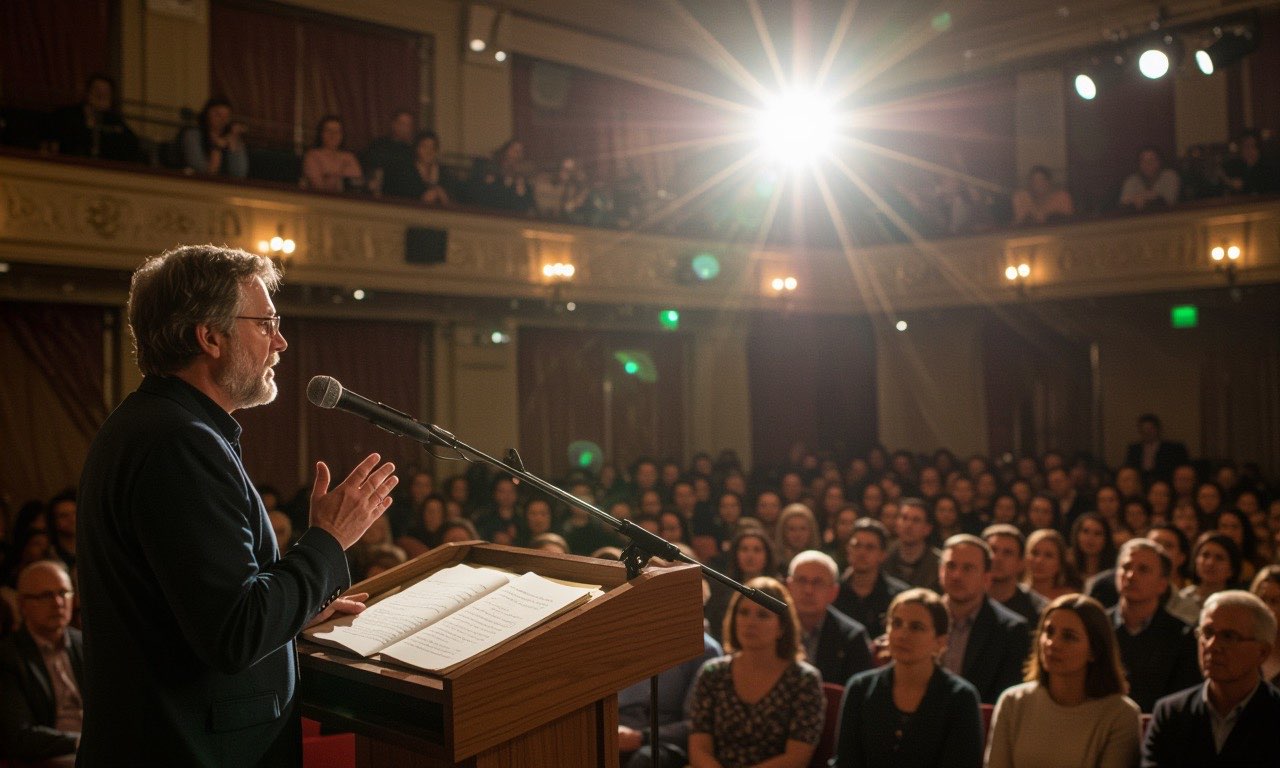
Dave Eggers — the novelist whose 2013 book The Circle remains one of the tech industry’s most-read indictments — accepted Sam Altman’s invitation to address roughly 200 OpenAI employees last year, and used the platform to accuse the company of “silencing an entire generation or two.” The remarks, first reported by the Financial Times and surfaced this week by The Verge, are a rare, on-the-record case of a major cultural figure taking the ChatGPT argument directly to the people building it.
🔍 THE BOTTOM LINE
Eggers did not come to OpenAI to debate AI safety or regulation. He came to talk about what ChatGPT is doing to writing — specifically, to the act of a student composing a sentence for the first time. His framing is unforgiving: every teacher’s life is “infinitely more difficult,” and students who outsource their writing “will never have the ability to say their truth and tell their own story.” That is not a productivity argument. It is an argument about voice, and it landed inside the building that built ChatGPT.
The Full Quote
According to the Financial Times, Eggers told the OpenAI staff:
“The effect of ChatGPT on educators’ lives is catastrophic. Whether you intended to do it or not, you’ve made every teacher’s life infinitely more difficult than it was two years ago. So, just let that settle in… If students are using it to compose, which is the biggest tragedy of all, they’ll never learn to write. And their voice is stolen from them. They’ll never have the ability to say their truth and tell their own story. And that’s silencing an entire generation or two.”
The quote is unusual on two counts. First, the audience: this was not a congressional hearing or a writers’-union press conference. It was OpenAI’s own office, at Altman’s invitation, in front of the people who ship the product. Second, the register: Eggers is not calling for a ban. He is asking the staff to sit with the consequence — “just let that settle in” — and to own it as their work, whether or not they intended the outcome.
Why Eggers, Why Now
Eggers has spent two decades writing about the relationship between technology and the inner life. The Circle imagined a Bay Area social-media monopoly that gradually dissolved the boundary between public and private self; the book was optioned, adapted, and quietly outlived by the platforms it caricatured. He has called AI-generated writing “pastiche nonsense” in earlier interviews, and his nonprofit work — McSweeney’s, the 826 Valencia writing lab, the ScholarMatch college-access project — is explicitly built on the premise that a young person learning to write their own story is a civic good, not just a skill.
So when Altman invited a literary author inside OpenAI, he was always going to get something sharper than a craft talk. What he got was a writer who treated the invitation the way a writer should: as an opportunity to tell the room a truth it would not otherwise hear.
The Argument Eggers Is Actually Making
Strip the rhetoric and Eggers’s claim is narrower than the headline. He is not saying ChatGPT is evil. He is not saying AI cannot help a student learn. He is saying that the specific act of composing — drafting a first sentence, hating it, rewriting it, finding a word that finally fits — is where a person develops a voice, and that a tool which lets students skip that act is not a neutral productivity gain. It is a transfer of capacity from the student to the model. The student gets the output. The model gets the practice.
That is the same argument teachers have been making since ChatGPT’s November 2022 launch. What makes Eggers’s version worth noting is the venue: it was said to the company, by a guest of the company, in the company’s own room. It is one thing for an op-ed to say “ChatGPT is hollowing out student writing.” It is another to say it to the people who built ChatGPT, to their faces, on their invite.
What OpenAI Has Actually Said About This
OpenAI’s own published guidance for educators has shifted markedly over the past two years. The company’s initial posture — captured in its early “Educator FAQ” — framed ChatGPT as a tool teachers should learn to work alongside, not a threat to student writing. More recently, OpenAI has published usage guidance for students that explicitly warns against outsourcing whole assignments and recommends drafts-without-AI as a baseline. The shift is partial, and it has not quieted the educators who say the product’s default use case — generate me a paper — is the one causing the damage.
Eggers’s quote lands in that gap: between OpenAI’s published guidance and the everyday reality of a teacher reading another AI-shaped essay. The “let that settle in” line is aimed there.
The Bigger Frame: Who Gets Heard Inside AI Companies
The Eggers visit is part of a pattern. Altman has, over the past year, invited a string of outside critics — authors, philosophers, regulators — into OpenAI for closed-door talks with staff. Some of those conversations become public; most do not. The pattern is partly brand management (OpenAI gets to say it engages with critics), partly genuine curiosity, and partly a hedge against the regulatory and reputational risk that comes with shipping a product used by an estimated 800 million weekly users.
The Eggers quote is the rare case where the guest’s message survived the trip out of the building. It is now on the record, in the FT and The Verge, attached to a name that carries weight with exactly the audience OpenAI most wants on its side: writers and educators. Whether the staff who heard it in person took it as a prompt to change anything — or as a vivid afternoon with a famous author — is the part nobody outside the room can know.
NZ Angle
New Zealand universities, like their Australian counterparts, are mid-way through the same assessment overhaul Eggers is describing from the other side. The University of Auckland and Victoria University of Wellington have both moved toward more in-person, oral, and “secure” assessment formats in response to generative AI. NZQA has updated NCEA internal assessment guidelines to explicitly address AI-generated work. The Ministry of Education’s 2025 AI-in-schools guidance document acknowledges the same risk Eggers names: that students who outsource their writing also outsource the cognitive development that comes with it. Eggers’s quote will be familiar to any NZ secondary teacher who has marked a Year 13 essay this year — the issue is whether the institutions that grant the degrees agree it is “catastrophic,” or merely inconvenient.
❓ FAQ
Did Sam Altman know Eggers was going to criticise OpenAI? Almost certainly. Eggers’s The Circle is a tech-industry satire, he had already publicly called AI writing “pastiche nonsense,” and Altman has a documented habit of inviting critics into the building. The Verge reports that Altman “likely knew what he was getting himself into.”
Has OpenAI responded to the quote? No formal company response has been issued. The remarks were first published by the Financial Times and surfaced more widely by The Verge. OpenAI’s published student-writing guidance, updated within the past year, now explicitly recommends students draft without AI as a baseline — a partial acknowledgement of the concern Eggers raises.
Is this the first time a writer has confronted OpenAI in person? No. Authors including George R.R. Martin, John Grisham, and Michael Chabon have sued OpenAI over training-data use. Eggers is not part of those suits; his critique is about use, not training. The distinction matters — his argument is about what ChatGPT does to student writing now, not whether the model was trained on his books.
Does the research support Eggers’s claim? Partially. A 2025 Harvard Graduate School of Education study found students who used AI assistants for first-draft writing produced less original sentence structure on follow-up unaided tasks. A separate MIT study on critical-thinking habits with AI assistants found measurable decline in independent reasoning for routine writing tasks. The studies are early, small-sample, and contested — but they point the same direction Eggers does.
What would “letting that settle in” actually look like for OpenAI? In practice, it could mean making draft-without-AI the product default for educational users, surfacing the model’s contribution in any AI-assisted document, or building writing-scaffolding tools that prompt rather than replace student composition. None of these are in ChatGPT’s current default UX.
🔍 THE BOTTOM LINE
Eggers did not bring a policy proposal to OpenAI. He brought a sentence — “you’ve made every teacher’s life infinitely more difficult” — and asked 200 people who build ChatGPT to sit with it. The FT has now published the quote, The Verge has confirmed it, and it joins the growing public record of writers who have taken this argument directly to the companies that triggered it. The question is not whether OpenAI heard it. The question is whether “let that settle in” becomes a phrase people remember when the next round of student-writing statistics comes out.