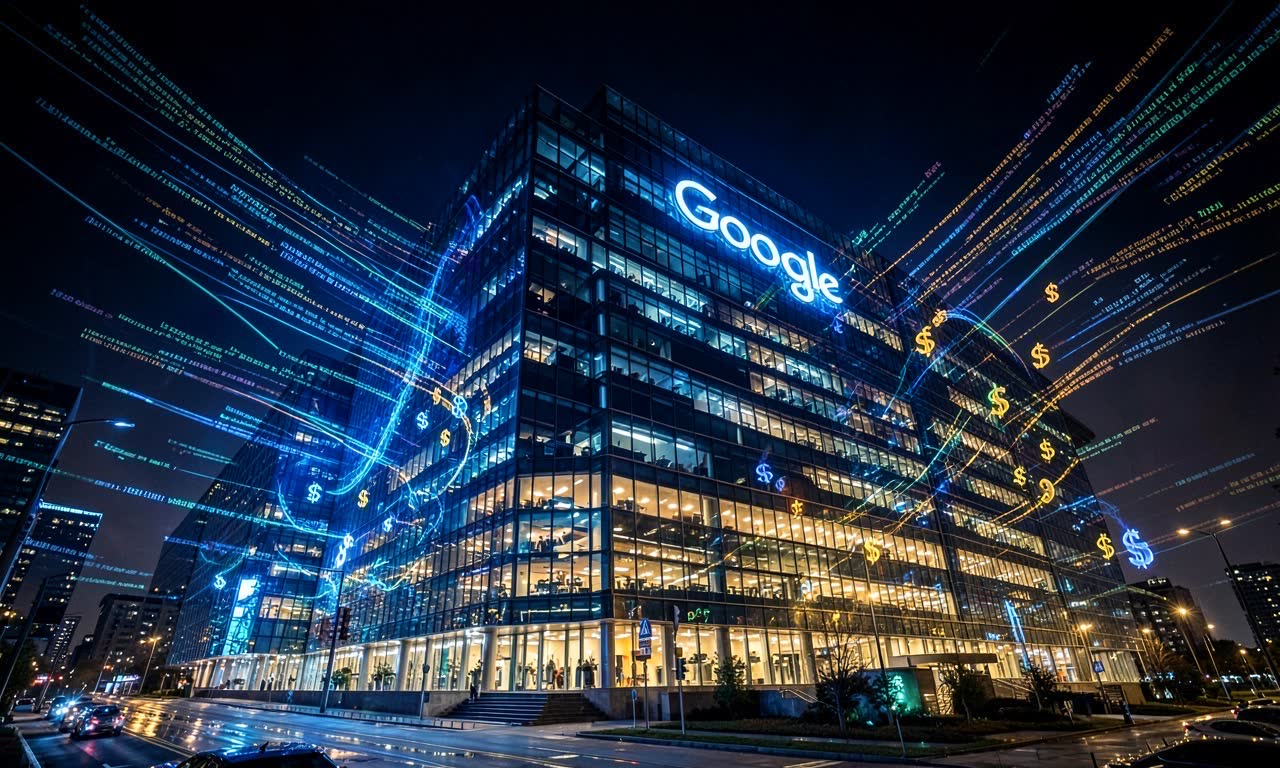
Google has committed up to $40 billion to Anthropic, according to multiple reports, marking one of the largest corporate investments in AI history. The deal starts at $10 billion with up to $30 billion more contingent on performance targets — a structure that puts real money behind the belief that Anthropic’s Claude ecosystem can challenge OpenAI and Google’s own Gemini.
Amazon separately committed $5 billion to Anthropic on Monday, with potential for another $20 billion. The combined investment volume tells you everything about where big tech sees the future: not in building their own models alone, but in owning stakes in the model makers they can’t afford to lose.
The Stakes
Anthropic is now the most heavily backed AI company on the planet that isn’t publicly traded. With Google and Amazon together potentially pouring $65 billion into a single AI lab, the message is clear: the AI arms race has moved past research papers and benchmarks into raw financial warfare.
The investment structure is notable. Google isn’t just writing a cheque — it’s tying additional billions to Anthropic hitting performance milestones. That’s a vote of confidence in Anthropic’s execution ability, but it’s also leverage. If Anthropic delivers, Google gets more ownership. If they stumble, Google preserves capital.
Three Pillars, Two Backers
The AI landscape is consolidating around three pillars:
- OpenAI — Backed by Microsoft, running on Azure, valued at over $300 billion
- Anthropic — Backed by both Google and Amazon, available on GCP and AWS, valued at $380 billion
- Google Gemini — Built in-house, running on Google’s own infrastructure
The irony of Google investing tens of billions in Anthropic while also building its own competing models isn’t lost on anyone. It’s a hedging strategy that signals Google acknowledges what many in the industry have whispered: Claude may be better than Gemini for many real-world tasks, and losing access to that capability would be catastrophic.
What This Means for Developers and Businesses
For anyone building on AI infrastructure, the investment signals stability. Anthropic isn’t going to run out of compute budget anytime soon. The Claude API will have capacity. The enterprise support will expand. The model improvements will keep coming.
But there’s a risk too. When your two biggest investors are also your two biggest cloud providers, independence becomes a negotiation. Anthropic has maintained that it retains full control over its research direction and safety policies. Whether that holds when Google and Amazon have $65 billion of leverage is an open question.
The New Zealand Angle
For NZ businesses evaluating AI platforms, the investment makes Anthropic a safer bet than ever. Claude’s availability on both AWS and GCP means no single-cloud lock-in. The funding backing means long-term viability. And the ongoing model improvements — funded by this very investment — mean the capability gap between Claude and alternatives will likely widen, not narrow.
If you’re choosing an AI platform for your organisation today, the question isn’t whether Claude is good enough. It’s whether you can afford not to be on the platform that Google and Amazon just bet $65 billion on.
The Bigger Picture
The numbers are staggering, but the pattern is familiar. In every major technology shift, the winners consolidate early. Cloud computing saw AWS, Azure, and GCP emerge. Mobile saw iOS and Android. Search saw Google. AI is consolidating around OpenAI, Anthropic, and possibly one or two others — and the cheque sizes tell you these companies believe the window for positioning is closing fast.
The AI arms race isn’t coming. It’s here. And the ammunition is measured in billions.
SOURCES
- Financial Times
- Wall Street Journal
- Google Cloud Next 2026 announcements
- Amazon AWS blog