The goalposts didn’t just move — they were packed up and shipped to a different stadium.
In the span of 48 hours, two of the most influential figures in AI declared that artificial general intelligence is no longer a future milestone. It’s here. Right now. Already done.
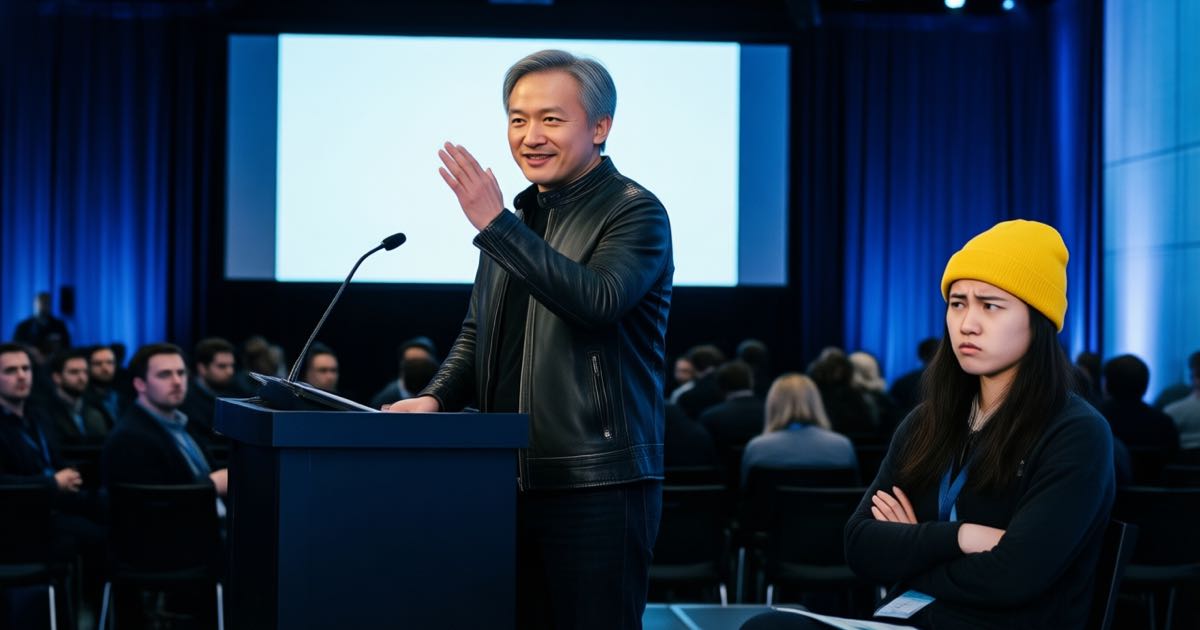
NVIDIA CEO Jensen Huang told Lex Fridman on April 20: “I think we’ve achieved AGI,” defining it as AI capable of building a billion-dollar company. OpenAI’s Sam Altman, on Alex Kantrowitz’s podcast the same day, said “AGI is something we’ve already reached without noticing,” citing GPT-5.2 Pro’s reported 142 IQ score and outperformance on 74% of tasks across 44 occupations.
Both executives are now pivoting their language toward ASI — artificial superintelligence — as the next frontier.
From “Within Two Years” to “Already Done”
This is a dramatic rhetorical shift. As recently as January 2026, Altman was saying he was “confident” AGI would arrive within two years. Huang’s public timeline was similarly forward-looking. The move from “AGI is coming” to “AGI is here” represents not just an acceleration of claims, but a qualitative change in posture.
The definitions matter. Huang’s benchmark — AI that can build a billion-dollar company — is specific enough to test, vague enough to claim. Altman’s reference to GPT-5.2 Pro’s performance across occupational tasks echoes the METR and ARC benchmark arguments that have been circulating in AI safety circles for months.
But here’s the thing: if you move the goalposts close enough, you can score from the parking lot.
Why Now?
The timing raises questions. Both declarations came within the same weekend, from executives whose companies have enormous financial incentives to frame current AI as transformative:
- NVIDIA needs enterprise buyers to believe AI capability has reached a threshold worth investing billions in GPU infrastructure for
- OpenAI is in the middle of its largest funding round ever — reportedly targeting $122 billion in valuation
- Microsoft’s 2019 OpenAI contract has a clause tied to achieving AGI — declaring it achieved could trigger contractual provisions
None of this means the claims are wrong. But it does mean they deserve scrutiny proportional to the financial stakes involved.
What Changes If AGI Is “Achieved”
If we take these declarations at face value, several things shift immediately:
Regulatory urgency. If AGI is here, governance frameworks designed for “pre-AGI” systems are already obsolete. The EU AI Act, New Zealand’s emerging AI policy, and every national framework built on the assumption that AGI was years away need updating — now.
Economic impact. If AI can outperform humans on 74% of tasks across 44 occupations, labor markets are already in a different phase than most policymakers assume. The “gradual displacement” narrative looks increasingly generous.
Safety timelines. If AGI is achieved, ASI is the next threshold — and the same people saying AGI is here are the ones building toward ASI. The safety runway just got dramatically shorter.
The New Zealand Angle
New Zealand’s AI policy discussions — including the AI Forum’s recent work — have largely operated on the assumption that AGI is a medium-term challenge. If it’s already here, the country’s regulatory timeline isn’t just behind — it’s irrelevant to the current reality.
As data center infrastructure expands in Southland and AI adoption accelerates across NZ businesses, the gap between what leaders are declaring globally and what local policy assumes is widening fast.
The Real Question
Whether AGI is “truly” achieved is almost beside the point. What matters is that the people building these systems are now behaving as though it is — directing resources, shaping narratives, and making strategic decisions based on that belief.
The shift from “AGI is coming” to “AGI is here” isn’t just a timeline update. It’s a fundamental change in how the most powerful AI companies see themselves and their role in the world. And the rest of us are going to have to figure out what that means — whether we agree with their definition or not.
SOURCES
- Lex Fridman Podcast (April 20, 2026)
- Alex Kantrowitz Interview with Sam Altman (April 20, 2026)