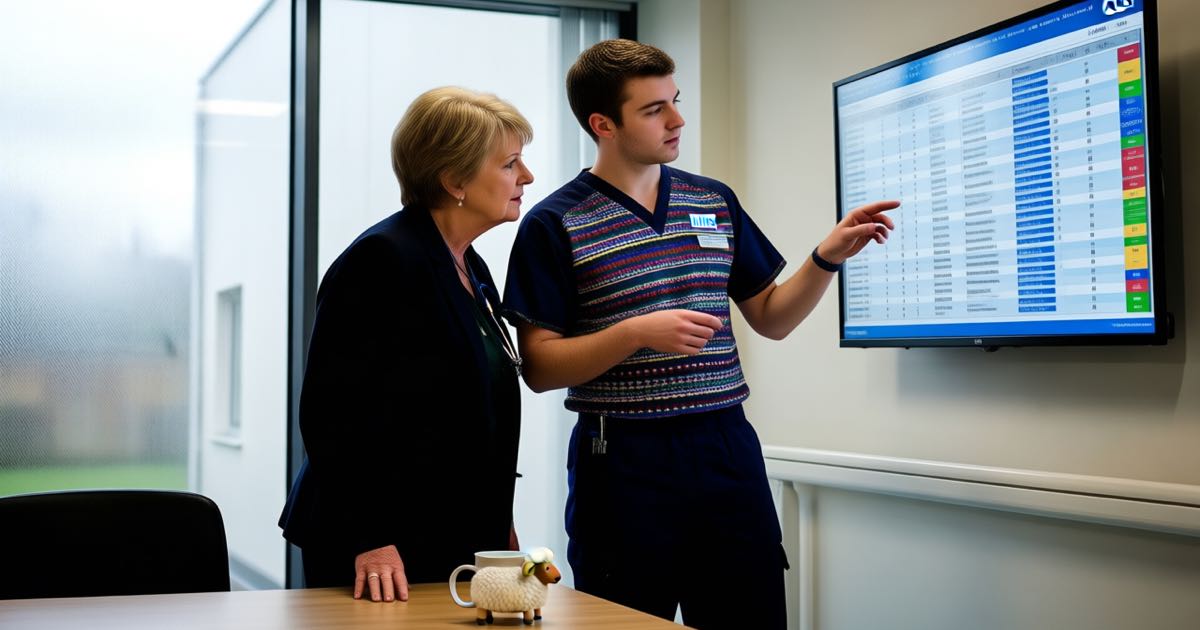
The NHS will begin using AI on its app to direct patients to the appropriate service — GP appointment, pharmacy, or A&E — in a rollout expected to reach 200,000 patients over the next year and all users by April 2028. The announcement, reported by The Guardian, is part of a £10 billion government funding package to overhaul NHS technology and data systems.
🔍 THE BOTTOM LINE
A 29% drop in call-queue pressure at the trial site is a real number. But health leaders are not celebrating — they are warning that the productivity evidence is thin, patient privacy is untested at national scale, and the rollout risks leaving behind the people who need the NHS most. This is AI triage at population scale with no population-level safety net.
What the Trial Actually Showed
The trial at Wealden Ridge Medical Partnership, which operates surgeries across Sussex, reported a 29% fall in patients queueing for a GP appointment on phone lines. The AI tool triages patients through the NHS app, deciding whether they need a GP slot, a pharmacy visit, or emergency care.
A separate trial led by Great Ormond Street Hospital across nine London sites found staff spent 25% more time interacting with patients when using AI scribe tools to record consultations — the ambient-voice productivity claim that has driven much of the UK’s health AI enthusiasm. Health Secretary James Murray said he was “certain” the technology would “get patients to the right care faster, free our brilliant clinicians from mountains of paperwork, and help drive down waiting times.”
The £10bn package also includes AI consultation recording — the same technology that Australia’s federal health department just warned doctors about over privacy concerns, and that Ontario’s audit found hallucinating drug dosages in 60% of reviewed notes.
The Problem With “29%”
The Royal College of Nursing’s chief nursing officer Lynn Woolsey called the rollout “an important step” but flagged what she described as “growing concerns about overstated, overly optimistic assessments of the productivity benefits from AI.”
“We cannot have situations where it increases bureaucracy through the need to correct flawed or inaccurate work. Patients must be reassured that any new systems handling their information, such as ambient voice technology, are accurate and properly protect confidentiality.”
This is the same concern that surfaced in Health NZ’s shadow-AI incident, where staff used unapproved AI tools for clinical notes under workload pressure — and were threatened with discipline rather than offered a safe alternative. The NHS is deploying the approved path. But “approved” does not mean “validated at scale.”
Tim Horton, deputy director of policy at the Health Foundation, called the funding “positive recognition” but said the “missing piece in the transformation puzzle is a broader strategy for guiding the use of AI across the health system, where important questions remain about the approaches and safeguards needed.” Without it, he warned, “the NHS risks piecemeal adoption of AI, struggling to achieve benefits at scale.”
The Privacy Gap — and the NZ Parallel
The NHS app rollout handles patient symptoms, triage decisions, and — in the consultation-recording component — the full content of doctor-patient conversations. That is among the most sensitive data categories in any healthcare system. The UK has the NHS Data Strategy and GDPR. But as Australia’s experience shows, regulators are still scrambling to establish safeguards for AI scribes specifically — the technology is moving faster than the governance.
New Zealand’s position is worse. There is no national AI triage rollout. There is no equivalent of the NHS app at population scale. Health NZ’s approved AI scribe Heidi — which security researchers jailbroke with three prompts — remains the closest analogue, and it has not been independently audited at the depth Ontario’s scribes were. A national-scale AI triage deployment in NZ would arrive without the regulatory framework Australia is building, without the NHS’s £10bn infrastructure, and without a single published trial on Kiwi patient data.
Who Gets Left Behind
Pritesh Mistry, a fellow at healthcare charity The King’s Fund, raised the exclusion risk: “For patients, the real test will be whether these investments make care feel more joined up… The NHS will need to keep a strong focus on ensuring that people are not digitally excluded as clinical services become increasingly reliant on technology.”
The NHS rollout assumes smartphone access, app literacy, and a willingness to describe symptoms to a machine before speaking to a human. For the 200,000 patients in the first wave, that may be fine. For the elderly, the digitally excluded, and the patients whose symptoms do not fit the triage model’s training data, the 8am scramble may not end — it may just move to a different queue.
Ciarán Devane, chief executive of the NHS Alliance, flagged the funding risk: “It is vital that this funding is not whittled away as we have seen all-too-often in the past when the squeeze for savings has landed on NHS capital budgets. That would be a very damaging, false economy.”
❓ FAQ
Has AI triage been tested before in the NHS? Yes — the Wealden Ridge trial in Sussex is the cited evidence base, along with a Great Ormond Street Hospital scribe trial across nine London sites. But these are trial sites, not national deployments, and the 29% call-queue reduction is a single-site result.
Could this happen in New Zealand? Not yet — NZ has no national health app with AI triage, no equivalent funding package, and no published trial on Kiwi patient data. The closest parallel is Health NZ’s Heidi AI scribe, which is unapproved in many regions and was demonstrated to be jailbreakable.
What are the privacy risks? AI triage tools process symptom descriptions and triage decisions; AI scribes record full consultations. Both create sensitive data streams that require encryption, access controls, and retention policies. Australia’s health department is already warning that safeguards are not yet in place.
What happens if the AI gets the triage wrong? The NHS has not published an error-rate framework for the rollout. The Ontario audit of AI medical scribes found 60% of drug dosages were wrong and 9 in 20 notes contained fabrications — a warning about what “approved” AI can do without ongoing auditing.
🔍 THE BOTTOM LINE
The NHS is doing what every health system is being pressured to do: deploy AI to cut the access crisis. The Sussex trial shows it can work at one site. But rolling from 200,000 patients to the entire NHS app user base by 2028 — with AI scribes recording consultations in the same package — is a governance leap, not a technology leap. The nurses and policy leaders asking for evidence before scale are not Luddites. They are the ones who will be answering the phone when the app gets it wrong.