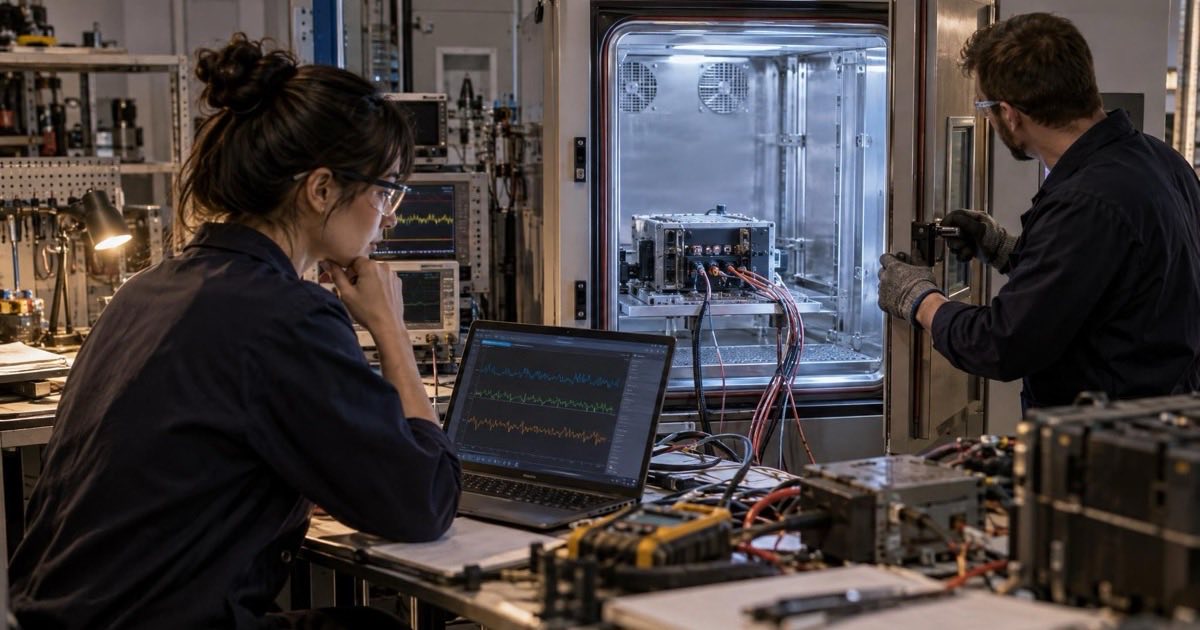
Nominal, the Los Angeles company building a software platform for hardware testing and engineering, raised $240 million in a Series C at a $3 billion valuation on 9 November 2026. Lightspeed Venture Partners led the round with Insight Partners co-leading; Lux Capital, Sequoia Capital and strategic investors participated. Eight months ago the company was valued at $1 billion in an $80M Series B extension.
Why it matters: the robotics and defence hardware boom has created a bottleneck nobody sees — you cannot ship an autonomous system until you have proven it works, and proving it works is still mostly spreadsheets, scripts and lab software designed decades ago. Nominal sells the evidence layer.
The round and what it funds
The company says the money goes into its four-layer “Hardware Intelligence Platform”: connected control, which links directly to hardware and test systems; a data infrastructure layer; an intelligence layer; and engineering applications on top. Its first purpose-built AI agent, Nominal Analyst, investigates engineering test data with answers traceable back to underlying evidence — a deliberate contrast with chatbots that answer from a prompt.
The numbers suggest the pitch is landing. More than 300 engineers at Anduril use Nominal’s software, according to Resilience Media’s Carly Page, with analysis that previously took five to six hours now completed in near real time. General Atomics also works with the company. In October, Nominal was selected for $71.2 million in US Air Force and Navy funding supporting test and data infrastructure for the Collaborative Combat Aircraft programme. The company’s air-and-space orientation complements the ground-autonomy wave — where ATI Robotics just became the first robot maker cleared onto the FCC’s covered list, defence-adjacent robots remain the segment where test evidence decides procurement.
That is a serious customer list for a company most people have never heard of — and it explains the valuation. $1B to $3B in roughly eight months is the kind of repricing defence software gets when procurement cycles compress and every programme office suddenly wants data infrastructure yesterday.
Why test infrastructure is the quiet choke point of the autonomy boom
Every headline about humanoid robots and autonomous aircraft is downstream of a mundane problem: hardware iteration is slow because test is slow. Nominal’s own announcement makes the point bluntly — when engineers built the Apollo capsule and the SR-71, test was a discrete phase in a decade-long cycle. Modern hardware evolves at software speed, and the test stack never caught up.
The company’s framing is that AI needs “access to that evidence and context instead of producing answers from isolated prompts.” That is more than marketing copy. It is the same insight driving the physical-AI data gold rush — embodied models are only as good as the real-world telemetry they train and validate on. A platform that owns the data plumbing between machines and engineers sits at a choke point: every robot, drone and hypersonic vehicle that flows through it makes the platform more valuable.
Competitive context: the space is not empty. Nominal’s most direct competitor is UK-based PhysicsX, and every major engineering-simulation vendor is bolting AI onto existing tools. But Nominal’s wedge — starting with test data capture for defence programmes rather than simulation — gives it the telemetry gravity that simulation vendors lack.
The picks-and-shovels read
There is a clean way to think about this round. The 2020s autonomy boom has its GPU trades (Nvidia), its model trades (the foundation-model labs) and its robot trades (the humanoids). Nominal is a picks-and-shovels trade: sell everyone the infrastructure, regardless of which robot wins. If Anduril, General Atomics and the CCA programme all run through your platform, you profit from the arms race without betting on a single airframe.
The risk is equally clear: hardware testing is a bureaucratic, sticky, low-glamour market where revenue grows at procurement speed, not software speed. It is a different rhythm from consumer-exposed autonomy plays like Europe’s air-and-wheeled humanoid push, where spectacle outruns evidence. A $3B valuation implies the market will not stay that way — that AI-era test cycles compress everything. The eight-month tripling says investors believe it. The CCA contract says it is at least partly true already.
New Zealand angle: nothing here maps directly to a local market, but the pattern does. As NZ’s space and defence-adjacent firms scale, the lesson from Nominal’s round is that test data infrastructure is where the durable software value sits — not in the vehicles themselves.
Sources: Nominal announcement (primary, 9 November 2026); Resilience Media by Carly Page; Unite.AI; the round was also reported by Axios on 9 November 2026.