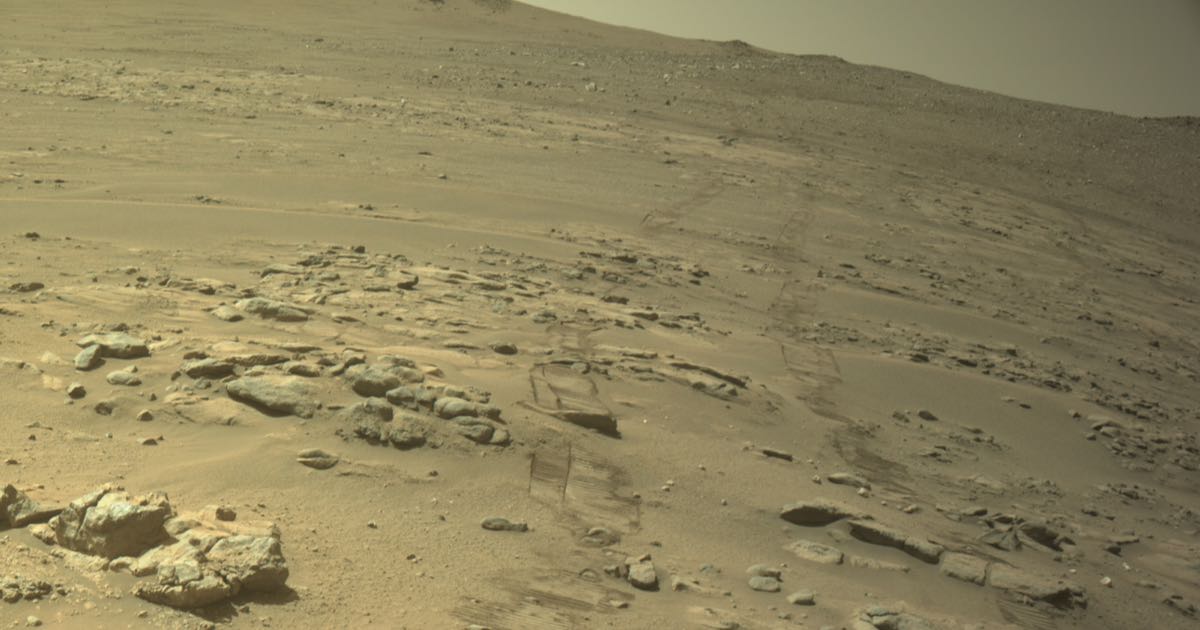
NASA’s Perseverance rover has driven farther than any vehicle ever has on the surface of another world. On October 11 — the 2,006th Martian day of its mission — its odometer reached 28.10 miles (45.22 km), passing the 28.06 miles Opportunity logged over nearly 15 years of driving before falling silent in 2018. Perseverance covered the same distance in five and a half years. The record was announced by JPL on October 12 and quickly picked up across robotics and space press, including IEEE Spectrum and Interesting Engineering.
The record didn’t fall because Perseverance drives harder. It fell because Perseverance mostly drives itself. Its AutoNav system images the terrain while rolling, builds a 3D map of hazards, and plots a safe course between waypoints chosen by engineers on Earth — what the team calls “thinking while driving.” More than 90% of the rover’s total distance has been driven under AutoNav, against roughly 5% autonomous under Opportunity and Spirit’s first-generation system. Perseverance manages as much as 412 metres in a single Martian day. For scale on how much the sensing changed: Sojourner, NASA’s first Mars rover in 1997, assessed its path with 20 measurement points; Perseverance processes 600,000 with every look.
Mark Maimone, deputy team chief for robotic operations on Perseverance, drew the connection explicitly. “The rover that broke this record did so by making its own decisions about the path. Given the autonomy to just go, Perseverance is a better driver than the one that landed, and we’re not done,” Maimone said, adding that newer software “teaches Perseverance to steer less and roll more, and to check its own position against orbital maps mid-drive.” The next frontier, per Maimone, is sunlight itself — glare in the navigation cameras currently forces the rover to park by mid-afternoon when driving toward the Sun, and solving that would extend every future rover’s working day. Steven Lee, project manager for Curiosity and Perseverance at JPL: “The original mission called for no more than 12.4 miles of driving. We’ve blown well past that, and with all mobility systems fully operational and favorable extended-ground-life test results, we expect Perseverance to keep adding to this record for many years to come.”
The milestone came as the rover travels toward a target called Idubi through a region off Jezero Crater’s western rim nicknamed Lac de Charmes, hunting what may be some of the oldest terrain ever explored — rocks around 4 billion years old whose Earthly equivalents have been erased by erosion and plate tectonics. The science team hopes to find traces of ancient hydrothermal systems there, possible habitats for ancient microbial life. Perseverance has now collected 29 rock and regolith samples and previously identified a potential biosignature at a rock called Cheyava Falls — a possible indicator, not proof of life. NASA recently approved the mission’s first extension, carrying rim exploration through roughly the end of 2028. For the record book: the rover has also rolled past the Moon’s travellers, Apollo 17’s 22.2 miles (1972) and the Soviet Lunokhod 2’s 24.2 miles (1973).
It’s worth sitting with what the autonomy share actually means. A rover’s radio link to Earth is minutes deep, so every autonomous decision is one that didn’t wait for a human to review a stereo pair and send tomorrow’s route. That labour asymmetry is the whole story: Opportunity drove 28 miles on human-in-the-loop teleoperation-by-consent, one planned drive at a time; Perseverance outsourced the path decisions to onboard software and covered the same ground in a third of the calendar while doing science on the side. The record isn’t really a distance record — it’s a throughput measurement of machine-decision-making in an environment you can’t resend a technician to.
There’s a quiet lesson in it for robots much closer to home. The Mars problem — slow, variable, unstructured terrain where remote control is impractical — is structurally the same problem every warehouse, orchard and construction site poses, and Perseverance’s answer wasn’t a better chassis, it was software that decides for itself. That’s the same bet the terrestrial autonomy wave is making, from causal verification for robot tasks to the whole-body control race that produced a Shanghai lab’s whole-body intelligence debut. The rovers got there first because they had to. Down here, the deadline is economic instead of orbital — but the direction of travel points the same way: machines that plan, humans that aim.
Source note: story draws on NASA’s official release (science.nasa.gov, Oct 12), IEEE Spectrum’s distance-record analysis with Maimone’s autonomy record, and Interesting Engineering’s coverage; figures cross-checked across all three.