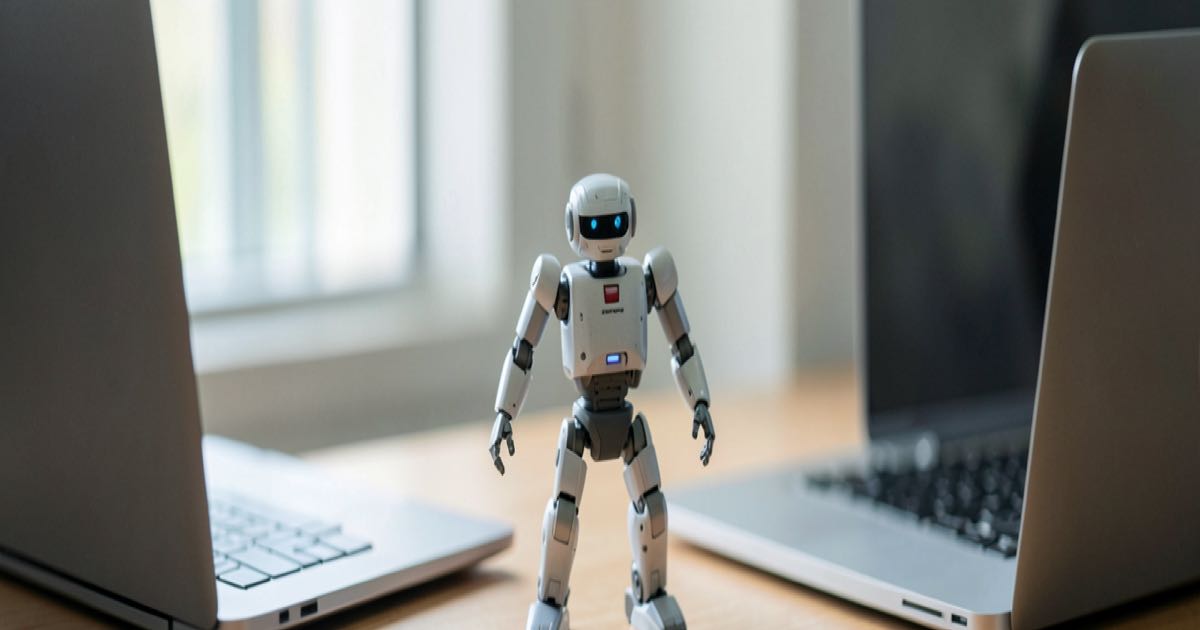
Pollen Robotics
Bordeaux-based robotics company, now owned by Hugging Face. Built Microduck and Reachy Mini — small, affordable, open-source robots that make physical AI accessible to everyone.
Key Specs
At a glance.
Latest Developments
Where the company stands in 2026.
Pollen and Hugging Face opened pre-orders for the Microduck, a $399 open-source waddling research robot designed to make training physical AI cheaper and less fragile, according to The Next Web and New Atlas. 10,000+ units sold in its first week — over $4M in sales, with new-order delivery pushed past Christmas 2026, per CNBC. The onboard brain is Rockchip's Chinese-made RK3566, a supply-chain story that drew coverage from Global Times to Quartz. Reachy Mini also earned a TIME Best Inventions special mention, capping a year in which more than 10,000 units shipped worldwide.
Launched Microduck — a $399, 25cm biped robot for reinforcement learning. 15 motors, camera, LiDAR, articulated beak. Ships with 7 pre-trained behaviours including walking, kicking, and roller skating. Pre-orders open, deliveries before Christmas 2026.
Nvidia agreed to acquire Hugging Face (Pollen's parent company) for $12.9 billion. If the deal completes, Pollen Robotics will sit under the same umbrella as the world's dominant AI chipmaker and largest open-source model hub.
Launched Reachy Mini — a desktop robot for human-robot interaction. Over 10,000 units sold worldwide. Voice-driven, expressive, designed for conversational AI and vision model experiments.
Overview
Pollen Robotics is a French robotics company founded in Bordeaux, now operating as a subsidiary of Hugging Face. The company builds small, affordable, open-source robots designed to make physical AI accessible outside of research labs.
Where most robotics companies target factories and warehouses, Pollen targets desks, classrooms, and workbenches. The philosophy is simple: learning movement is messy. Robots need to try, fail, and try again. A small robot that costs $399 and recovers from its own falls makes that loop practical for anyone with a laptop and a flat surface.
The full software stack — robot control, simulation, reinforcement learning training, and sim-to-real deployment — is open source under Apache 2.0. No licensing restrictions, no vendor lock-in. You can read, fork, modify, and commercially reuse every line of code.
Microduck
Microduck is a 25cm tall biped robot with 15 motors, a front-facing camera, a small LiDAR depth sensor, two IMUs, and an articulated beak that picks up objects. It weighs under 800 grams and fits on a desk.
It ships with seven learned behaviours: walking, sitting and standing, kicking, grabbing objects with its beak, getting back up from falls, and roller skating. Each behaviour is a reinforcement learning policy trained in MuJoCo physics simulation and deployed to the real robot using sim-to-real transfer.
What sets Microduck apart is the training pipeline. You can retrain any shipped behaviour on your own machine, or on Hugging Face Jobs, and deploy it back to the robot. The goal is for robot behaviours to become shareable artifacts — train a walking gait, publish the policy, someone else downloads it and deploys it on their Microduck.
Available in four colourways: Cream, Graphite, Lavender, and Sky. Each Microduck gets its own unique audio identity the first time it wakes up, kept for life.
Reachy Mini
Reachy Mini is Pollen's first robot — a desktop robot designed for human-robot interaction. It sees, listens, speaks, and uses its head and body to communicate. Voice is its primary medium, making it a platform for conversational AI, vision models, and expressive human-robot interaction.
Over 10,000 units have been sold worldwide since launch. Reachy Mini and Microduck are complementary: Reachy Mini is a platform for AI that interacts. Microduck is a platform for AI that acts.
Open Source, For Real
The software stack is genuinely open. The main repository contains the SDK and robot software. The RL repository contains the reinforcement learning and sim-to-real tools. MuJoCo, the physics simulator, is open source. The licence is Apache 2.0 — you can read, fork, modify, and commercially reuse the code.
This is the kind of open-source robotics approach that fits New Zealand's number 8 wire mentality — where the barrier to entry is not the cost of hardware but the willingness to learn. A $399 robot with a full training stack and no licensing restrictions is about as low as that barrier gets.
The Hugging Face & Nvidia Connection
Pollen Robotics operates as a subsidiary of Hugging Face, the platform where most open-source AI models live. Hugging Face was acquired by Nvidia for $12.9 billion in August 2026, pending regulatory approval.
If the acquisition completes, Pollen will sit under the same corporate umbrella as the world's dominant AI chipmaker and its largest open-source model hub. The open-source commitment stands for now, but the community is watching closely.
Timeline
Focus Areas
Education
A $399 robot that trains RL policies is a different proposition from a $16,000 research platform. Built for classrooms, polytechs, and home workbenches.
Reinforcement Learning
The full sim-to-real pipeline is open source. Train behaviours in MuJoCo, deploy to the robot in one step. Retrain, share, and iterate.
Open Source Robotics
Apache 2.0 licence. SDK, simulator, RL training pipeline — all on GitHub. No vendor lock-in, no licensing fees, full commercial reuse allowed.
Multi-Robot Behaviours
Microduck is "ten times more fun when there are several of them." Races, football, multi-robot coordination — without a room full of expensive hardware.
Why It Matters
Pollen Robotics is doing something different from every other robotics company on this page. Instead of building a $16,000 humanoid for a factory, they built a $399 robot for a desk. Instead of locking down their software, they open-sourced the entire stack under Apache 2.0.
That changes who can learn physical AI. A school in Tauranga can buy one Microduck for less than the cost of a graphics card. Students can train a walking gait in simulation, deploy it to the robot, watch it fall over, and fix it. That loop is what reinforcement learning actually is — and reading about it in a textbook is not the same.
The barrier to entry is not the cost of hardware. It's the willingness to learn. Pollen just made that barrier $399.