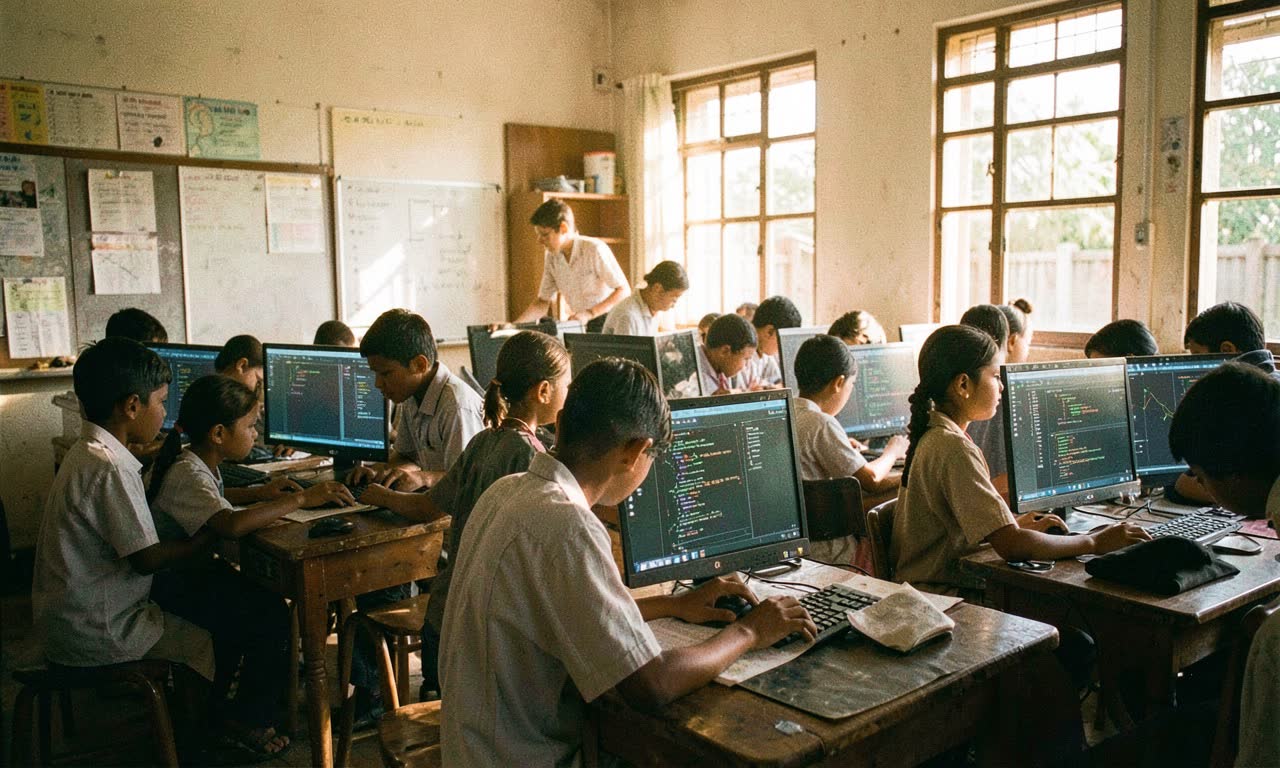
The Punjab School Education Board (PSEB) has announced that AI and robotics will be integrated as core components within the computer science curriculum for the current academic session — with marks counting toward board certificates.
Unlike advisory guidelines or optional enrichment programmes, Punjab’s approach gives AI literacy enforcement teeth. When performance appears on a board certificate, it stops being optional.
What’s Changing
Starting immediately in the current academic session:
- Classes 5 through 12 will receive AI fundamentals integrated into computer science
- The phased rollout covers the full secondary school range
- AI and robotics performance will be reflected in board certificate marks
- The curriculum treats AI as core infrastructure, not elective enrichment
PSEB chairman Amarpal Singh confirmed the integration, framing it as preparing students for a future where AI literacy is as fundamental as reading and arithmetic.
Why Punjab’s Move Matters More Than National Mandates
India’s CBSE board announced a national AI curriculum mandate for Classes 3-8 across 28,000 schools earlier this year. That was significant — the largest mandatory AI education programme in the world by student count.
But Punjab’s state-level action is moving faster and with sharper consequences:
- CBSE’s mandate introduces AI as a subject — but implementation timelines vary, and enforcement is inconsistent
- Punjab’s mandate ties AI performance directly to board certificate outcomes, meaning students and schools have concrete incentives to take it seriously
- Board certificate marks are the currency of Indian education — they determine college admissions, job eligibility, and social mobility
The difference between “you should learn this” and “your marks depend on this” is the difference between aspiration and compulsion.
The Widening Gap for New Zealand
While Indian states race to embed AI into core curricula with assessment consequences, New Zealand still lacks a coherent national AI education strategy.
The contrast is sharp:
- India: State boards are making AI performance count toward graduation certificates
- China: National AI education plan through 2030 with centralised curriculum development
- US: 31 states have introduced 134+ AI education bills in 2026
- New Zealand: No national AI curriculum mandate, no assessment framework, no timeline
Every month of inaction widens the gap. Students in Punjab will graduate with AI on their certificates. Students in New Zealand will graduate with… whatever their individual school decided to offer, if anything.
The Assessment Question
Tying AI to board certificates raises its own questions. How do you assess AI literacy in a way that’s meaningful rather than performative?
If the assessment focuses on using AI tools, it risks becoming a test of access to technology rather than understanding. If it focuses on AI concepts, it risks becoming abstract and disconnected from practical skills.
Punjab hasn’t yet detailed the assessment framework. How they solve this problem will determine whether this policy produces genuine AI literacy or just another box to check.
Sources
- Hindustan Times — “Punjab to integrate AI as a core subject in school curriculum” (April 18, 2026)