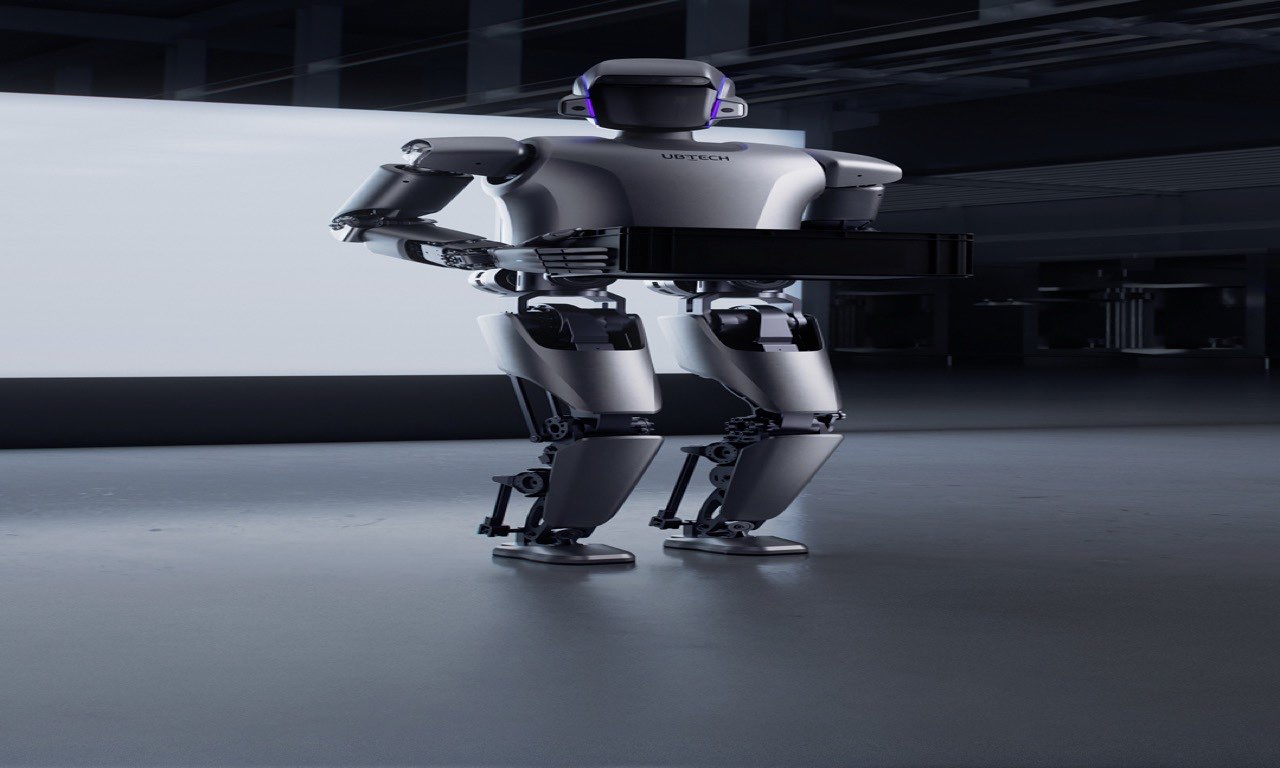
UBTech Robotics
China's humanoid leader. Walker series robots, $1B in funding, and an $18M talent war chest.
Key Specs
At a glance.
Latest Developments
Where the company stands in 2026.
UBTech signed a strategic cooperation agreement with FAW-Volkswagen to develop and test humanoid robots for factory logistics and smart manufacturing — extending the Qingdao quality-inspection work into demonstration sites, no order volume or timetable announced, per Tech Republic, Interesting Engineering and Gasgoo. Same week it signed Xiamen C&D as a sales-channel and leasing partner for government halls, shopping complexes and industrial parks, per The AI Insider.
A $440M robotics localization project in Kazakhstan is advancing with UBTECH as the Chinese partner — announced at the Kazakhstan–China Investment Forum in Almaty, covering local manufacturing, R&D and programming jobs, per Astana Times. Same week, trade press reported the first UWORLD U1 consumer deliveries exiting the factory even as 36Kr flagged conflicting delivery-status claims around the U1 launch.
UBTECH opened a Liuzhou "super smart factory" built with Siemens — billed as the world's first humanoid plant designed for 10,000+ units a year, with a target takt time of one robot every 10 minutes, per Global Times, Interesting Engineering and Seoul Economic Daily. It builds Walker S and Cruzr series on a flexible mixed line with a digital-twin "smart brain"; shares rose ~3% on the Hong Kong exchange the next trading day.
Interim results show H1 2026 revenue of ¥1.269B, up 104% year-on-year, with the humanoid segment at ¥590M (+1,445%) — 16,123 humanoid units moved, 921 of them full-size — according to Gasgoo and NewsCase. First consumer deliveries of the UWORLD U1 companion humanoid (13,361 pre-orders) began in China mid-September, per SCMP.
Airbus ordered Walker S2 humanoids for aircraft manufacturing and shares surged as much as 8% in Hong Kong to their highest since October, per Bloomberg — UBTech also signed a Texas Instruments supply deal around the same time. Airbus had been testing Walker S2s on its production lines since December, and the order was an early proof point for Chinese industrial humanoids selling into Western aerospace. The company targeted 10,000+ Walker units in 2026.
Invested $18M in AI scientist and humanoid robot talent acquisition. Aggressive recruitment campaign.
Walker S1 in industrial deployment. Among top-funded humanoid startups globally with ~$1B raised.
China's humanoid leader. Part of the Chinese humanoid startup wave targeting IPO and global expansion.
Overview
UBTech Robotics, based in Shenzhen, is China's leading humanoid robotics company. With approximately $1 billion in funding, it ranks among the top-funded humanoid startups globally and is a key player in China's push to dominate the humanoid robotics industry.
The Walker series is UBTech's flagship humanoid platform. The latest iteration, the Walker S1, is designed for industrial and service applications — from manufacturing to customer service environments.
UBTech made headlines in 2026 by investing $18 million in an aggressive talent acquisition campaign, targeting AI scientists and robotics engineers. The move signals that China's humanoid companies are not just building hardware — they're competing fiercely for the AI talent that makes the robots smart.
The Robot
The Walker S1 is UBTech's most advanced humanoid, designed for industrial deployment. The Walker series has evolved through multiple iterations, each improving on the previous generation's mobility, dexterity, and AI capabilities.
UBTech also produces education and service robots, but the Walker series is its flagship — the product that positions UBTech as a serious competitor to Tesla, Figure, and other global humanoid leaders.
Funding & Backers
UBTech has raised approximately $1 billion, placing it in the top tier of humanoid startups globally. The funding supports Walker series development, AI research, and the aggressive talent acquisition strategy.
The $18M talent investment is notable. UBTech is not just building robots — it's buying the brains to make them smart. The talent war in humanoid robotics is as fierce as the hardware race.
Deployment
UBTech's Walker series robots are deployed across industrial and service environments in China. The company's Shenzhen base gives it access to China's manufacturing ecosystem and the country's aggressive robotics deployment targets.
As China pushes to deploy humanoid robots at scale across manufacturing, logistics, and service industries, UBTech is positioned as a domestic champion with both the funding and the government support to compete globally.
Timeline
Focus Areas
Industrial Manufacturing
Walker S1 deployed in Chinese factories. Manufacturing is the primary use case.
Service Robotics
UBTech's education and service robot heritage gives it a consumer-facing dimension most industrial humanoid companies lack.
Talent Acquisition
$18M invested in AI scientists and robotics engineers. The talent war is as important as the hardware race.
China Champion
Backed by funding and government support. Positioned as China's domestic humanoid leader.
Why It Matters
UBTech is China's most serious humanoid contender. With $1B in funding, the Walker S1 in industrial deployment, and an $18M talent war chest, the company has the resources to compete with any US or European humanoid startup.
The question for UBTech is whether it can translate domestic dominance into global success. China's humanoid companies are rushing to IPO — UBTech's next move will signal whether it's building for the long term or cashing in on the boom.
China's humanoid champion isn't just building robots — it's buying the brains to run them.