While India mandates AI classes for eight-year-olds and China centralizes its national AI curriculum, Latin America and the Caribbean are trying something distinctly different: cooperation over mandate.
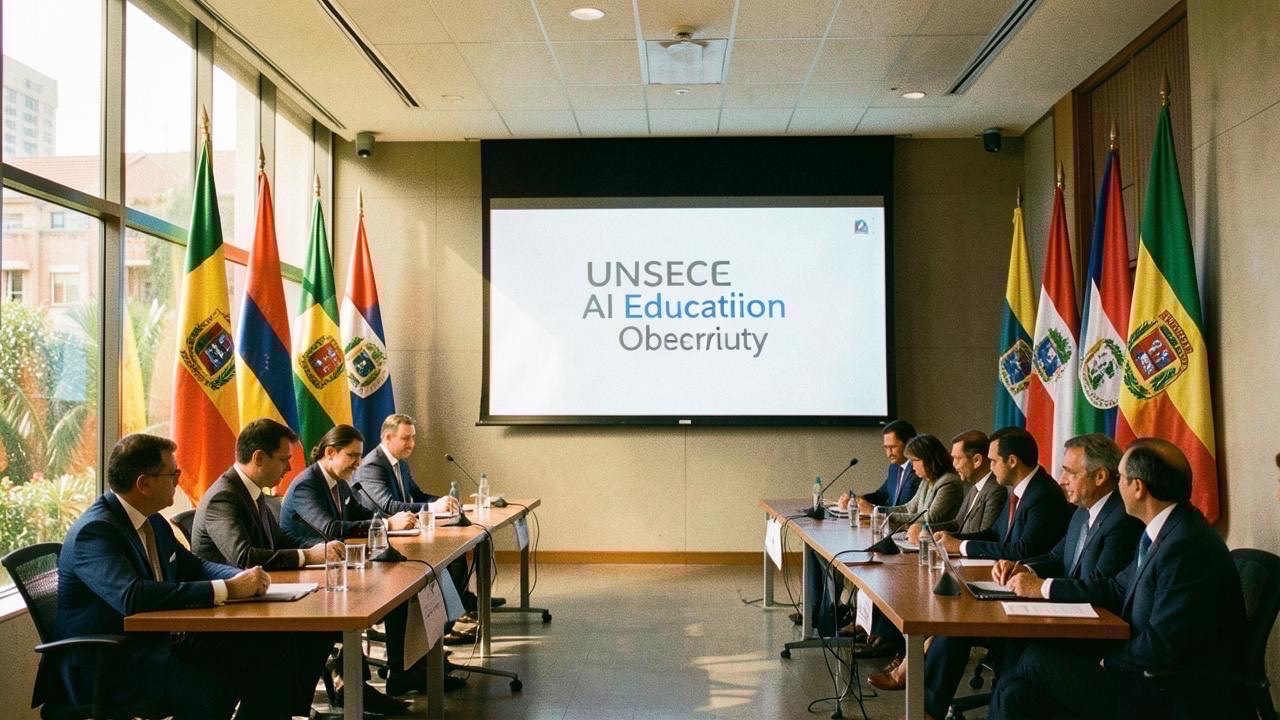
UNESCO officially launched the Observatory on Artificial Intelligence in Education for Latin America and the Caribbean on April 14, 2026, at ECLAC headquarters in Santiago, Chile. The platform is designed to help 33 countries in the region coordinate how they integrate AI into their education systems — without replicating the top-down approaches taking hold elsewhere.
A Third Model for AI Education
The global landscape for AI in education is splitting into three distinct models:
- China’s centralized approach — a national AI curriculum mandate rolled out from the top down
- The US state-by-state patchwork — each state deciding its own path, creating deep inequality between districts
- Latin America’s cooperative model — a regional observatory that shares evidence, builds capacity, and coordinates policy across national borders
This third model matters because Latin America and the Caribbean face challenges that neither the US nor China confront at scale: wildly unequal internet access, underfunded public education systems, languages beyond Spanish and Portuguese, and economies where teacher salaries often cannot compete with private-sector tech jobs.
A one-size-fits-all mandate from a capital city would collapse under those conditions. The observatory approach — research, capacity building, and shared roadmaps — is built for that reality.
What the Observatory Actually Does
The platform has three core components:
- Research and Policy — comparative analyses across countries, identifying what works and what creates risk
- Capacity Development — training and support for ministries and educators who are designing AI strategies from scratch
- Innovation and Regional Collaboration — pilot programs, shared frameworks, and technical assistance across borders
The idea is not to impose a single curriculum. It is to give countries that lack Stanford-level research budgets or Beijing-level central planning the tools to make informed decisions — and to do it together rather than in isolation.
Who’s Behind It
The observatory brings together a broad coalition:
- UNESCO — leading the initiative through its Regional Office in Santiago
- CAF (Development Bank of Latin America and the Caribbean) — financing and development expertise
- CENIA (National Centre for Artificial Intelligence of Chile) — regional AI research capacity
- CETIC.br (Brazil) — data and evidence on information society trends
- ECLAC — the UN economic commission hosting the launch and providing policy frameworks
- Tec de Monterrey (Mexico) — academic research and innovation
- ProFuturo — digital education experience in vulnerable communities
- Fundación Ceibal (Uruguay) — one of the world’s longest-running one-to-one device programs
- IRCAI (International Research Centre on AI) — global AI governance expertise
Harvard University and the UN’s Independent International Scientific Panel on AI are also listed as partners. The Organization of Ibero-American States for Education, Science and Culture (OEI) is participating as well.
That breadth of partners signals something important: this is not just a UN talking shop. It includes development banks, national AI centers, universities, and organizations that have spent decades working on digital inclusion in the region.
Why This Matters for the Region
Latin America and the Caribbean have roughly 600 million people across countries with vastly different education systems. Brazil’s public university network looks nothing like Haiti’s primary schools. Mexico’s tech sector operates on a different planet from Paraguay’s.
The risk without coordination is the same one playing out in the US: AI tools flood into classrooms through private vendors before teachers or policymakers can evaluate them, and the communities with the least resources get the worst outcomes.
The observatory’s explicit goal — stated in UNESCO’s launch announcement — is to ensure AI “helps strengthen education systems without deepening existing inequalities.” That framing is deliberate. In a region where inequality is the defining challenge, AI in education could go either way: it could be a leveller or an accelerator of division.
A 2026–2029 Roadmap
The launch event was not just a ribbon-cutting. UNESCO is pushing for concrete commitments from strategic partners around a shared roadmap for 2026–2029. That means pilot experiences, national strategy templates, and regulatory frameworks that countries can adapt rather than build from zero.
The observatory is also positioned within the 2030 Agenda for Sustainable Development, specifically SDG 4 on inclusive and equitable quality education. Whether it delivers on that promise depends on funding, political will across 33 sovereign governments, and whether the research actually reaches the teachers who need it.
The Bigger Picture
The AI education race is often framed as US versus China. But for most of the world’s students, neither model applies. Latin America’s cooperative approach — imperfect, slow, and dependent on multilateral goodwill — may be closer to what actually works in regions where centralized mandates hit the reality of scarce resources and fragmented systems.
The observatory launches into a crowded field of AI education initiatives. What makes it different is the starting assumption: no single country in the region has all the answers, and the cost of getting AI education wrong is not just wasted money — it’s deepened inequality for a generation of students already starting behind.
SOURCES
- UNESCO — Launch of the Observatory on Artificial Intelligence in Education for Latin America and the Caribbean (April 14, 2026)
- ECLAC — 2026 Forum of the Countries of Latin America and the Caribbean on Sustainable Development