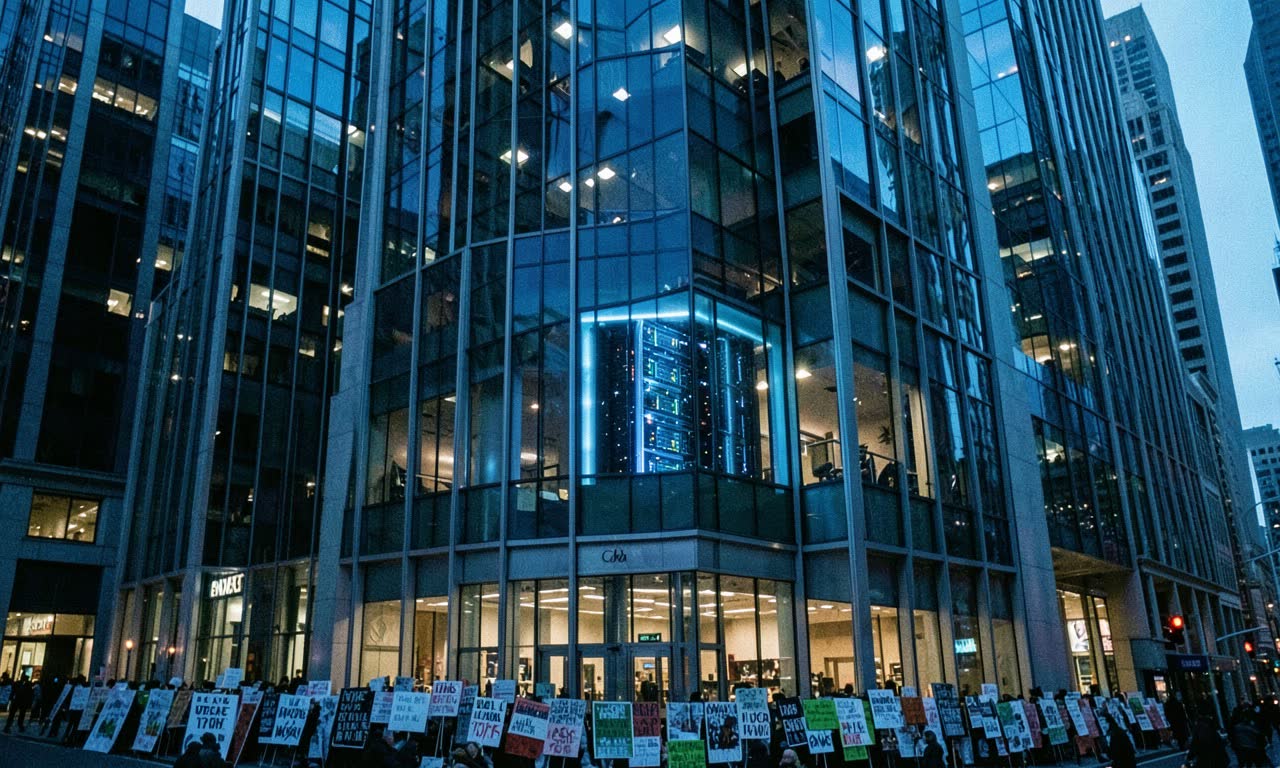
Six of Wall Street’s biggest banks — JPMorgan Chase, Citigroup, Bank of America, Goldman Sachs, Morgan Stanley, and Wells Fargo — collectively eliminated roughly 15,000 positions in Q1 2026. Their combined net income for the same quarter: $47 billion, up 18% year-over-year.
When we first reported this story in mid-April, the tally was 5,000 jobs across three banks. Two weeks later, the real number is three times that — and all six major banks are now named.
The disconnect between record profitability and accelerating job cuts is no accident — it is the AI layoff trap playing out in real time, and Wall Street is now its most visible stage.
The Numbers
Wells Fargo led the carnage with approximately 4,200 job cuts — the single largest reduction among the six banks. CEO Charlie Scharf was blunt: AI enables the bank to do things “much more efficiently than humans,” and he expects headcount to keep falling.
Bank of America shed 1,000 positions through what CEO Brian Moynihan called AI-driven “attrition by eliminating work and applying technology” — a remarkable shift from his earlier assurances that AI wouldn’t threaten jobs. Moynihan now says AI opens “places to go we haven’t gone” for further efficiency gains.
Citigroup, already midway through a plan to eliminate 20,000 roles, cut scores of employees from its own “AI Champions and Accelerators” program — the very team tasked with bringing AI into the bank. Over 80% of Citi’s 224,000 employees now use internal AI tools for legal reviews, account approvals, and risk assessments.
JPMorgan Chase, Goldman Sachs, and Morgan Stanley rounded out the total. All cited AI automation in back-office compliance, paperwork processing, and front-office deal-making as key to workforce reductions amid soaring earnings.
This is not a story about struggling companies trimming fat to survive. This is about profitable companies replacing humans with algorithms because they can — and because their competitors are doing the same thing.
CEOs Say the Quiet Part Loud
What makes this moment different from past rounds of financial-sector layoffs is that executives are no longer disguising the cause.
Moynihan at Bank of America explicitly credited AI for shrinking headcount. Scharf at Wells Fargo said the quiet part loud: AI does things “much more efficiently than humans.” Citi’s Jane Fraser is overseeing a 20,000-person reduction powered by tools from Anthropic, Google, Microsoft, and OpenAI. JPMorgan’s Jamie Dimon has reportedly instructed managers to stop hiring, planning for an AI-constrained workforce going forward.
Even the banks’ own AI champions aren’t safe — Citi cut employees from the team specifically tasked with driving AI adoption. The revolution is eating its revolutionaries.
This transparency is itself a signal. When CEOs stop hedging about AI displacement, it means the shift has moved from experiment to strategy. The pilot programs are over. The rollouts have begun.
Why It Matters Beyond Finance
The Wall Street cuts matter because they prove the AI layoff trap is no longer confined to tech companies.
When Meta eliminates 8,000 positions or Amazon cuts 30,000 corporate roles, it is easy to dismiss as Silicon Valley disruption. When Snap lays off 1,000 while AI writes 65% of its code, the pattern is clear. But when six traditional banks — institutions built on relationships, trust, and human judgment — cut 15,000 jobs while printing $47 billion in profit, the pattern becomes impossible to ignore.
Finance was supposed to be one of the sectors where human judgment remained irreplaceable. If AI can eat into back-office banking operations, few industries are safe.
The Demand Collapse Risk
Here is the structural problem: banks are cutting the same consumers whose spending drives the revenue they depend on.
Every operations worker laid off is a mortgage payment that might be missed, a credit card balance that goes unpaid, a discretionary purchase that does not happen. Multiply that across every sector now automating at speed — retail, logistics, healthcare, tech — and you get a demand collapse that no amount of cost-cutting can offset.
A UPenn and Boston University study published earlier this month formalized this as the AI Layoff Trap: a Prisoner’s Dilemma where no single company can afford to stop automating, even as the collective result threatens everyone’s bottom line.
The banks’ Q1 numbers illustrate the trap in motion. Record profits today. The demand destruction is still compounding.
What Comes Next
Wall Street’s AI-driven cuts are likely to accelerate. Morgan Stanley forecasts that more than 200,000 European banking jobs could disappear by 2030 due to AI. JPMorgan, Goldman Sachs, and Morgan Stanley have all announced major AI investments in the past year. If the efficiency gains are this visible after one quarter, the compounding effects over two to three years will reshape the entire industry.
The question is whether regulators or policymakers will respond. The automation tax proposed by UPenn and BU researchers remains the most concrete policy intervention on the table — a Pigouvian tax designed to correct the structural distortion where firms can’t afford not to automate even as the collective result threatens the economy. But with banks posting record profits while cutting jobs, the political pressure to act is building.
The New Zealand Angle
No major NZ bank has announced AI-driven job cuts yet — but the direction is clear. ANZ is cutting 3,500 jobs group-wide (primarily in Australia), and a KPMG report shows NZ banks are deploying AI across home lending, fraud detection, and back-office operations, with CEOs citing efficiency as the top driver. The Reserve Bank of New Zealand published its own analysis in February 2026, finding that professional, managerial, and administrative roles — the exact categories Wall Street is automating — face the highest AI exposure in the NZ labour market.
The signal from Wall Street is a preview. NZ’s big four banks employ roughly 30,000 people in roles that look increasingly automatable. When, not if.
For workers — in finance and beyond — the message from Q1 2026 is clear: AI displacement is not coming. It is here. And the companies doing it are making more money than ever.
SOURCES
- New York Times (April 21, 2026) - AI Job Cuts Hit Wall Street
- Yahoo Finance - Bank of America CEO on AI-driven attrition
- 4Corner Resources - Wall Street AI Job Cuts 2026
- Orange County Register - Wall Street Banks Cut 5,000 Jobs
- Axios - AI Jobs Goldman Sachs, Morgan Stanley
- TechCrunch - European Banks Plan to Cut 200,000 Jobs
- KPMG NZ - Navigating Tomorrow 2025
- Reserve Bank of NZ - AI and Robotics Exposure in the NZ Labour Market