AGI isn't the finish line.
We're so focused on when it arrives that we've barely asked what happens after. Not the hot takes. Not the utopia-vs-dystopia cartoons. The real questions — the ones nobody has good answers to yet.
Here's what we're watching, what we're worried about, and what might surprise you.

300M jobs exposed
Knowledge work transforms. Tasks disappear before jobs do.
Explore →
Humanoids arrive
Factories first, then homes. The physical world meets AGI.
Explore →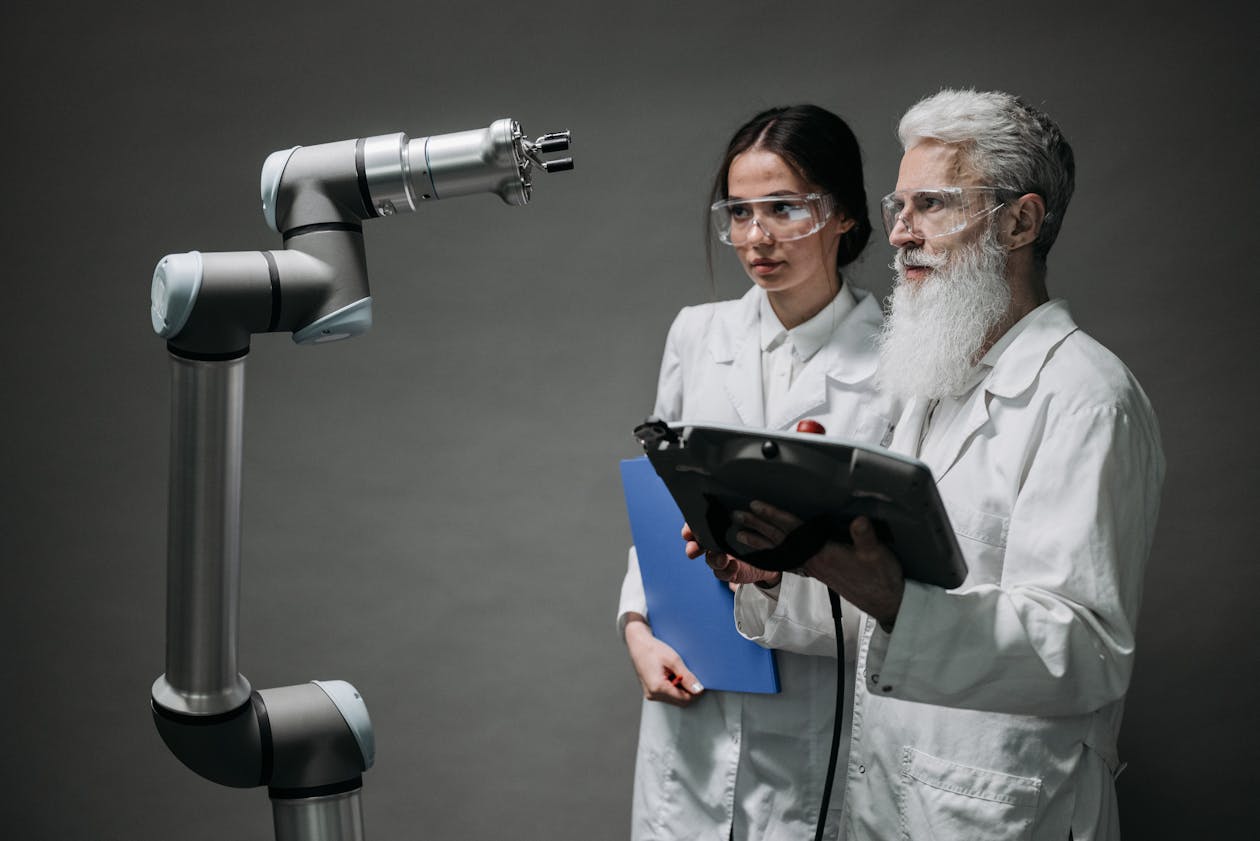
Discovery accelerates
Cures, materials, fusion. Questions humans wouldn't ask.
Explore →
$15 trillion shifts
Value is created. The question is who captures it.
Explore →The questions nobody can answer yet
If AGI arrives in 2027-2028 as the labs are planning for, these are the conversations we should be having right now.
What happens when thinking costs nothing?
Today, human cognition is the bottleneck on everything — science, software, strategy, art. Remove that bottleneck and the constraint becomes physical reality itself: atoms, energy, attention. The entire economy is built on cognitive scarcity. What happens when that scarcity disappears? This is the single most important question nobody has a good answer for.
What's left that's uniquely human?
We've been defining ourselves as "the thinking animal" for millennia. When machines think better, faster, deeper — what becomes of identity? Purpose? The answer probably isn't "we'll all be artists and philosophers." Most people don't want to be philosophers. They want to be useful.
Who owns the intelligence?
If one company, one country, or one person controls AGI, they control the most powerful force in history. Open-source AGI means anyone can use it — including people you really don't want using it. Centralised control means a single point of failure, a single point of censorship, a single point of capture. There is no good answer here yet.
What happens to democracy?
Democracy assumes roughly equal citizens making roughly informed decisions. AGI breaks both assumptions. When persuasion can be perfectly targeted, when truth can be manufactured at scale, when a single intelligence can out-argue every human on the planet — what does voting even mean?
Do we slow down if we can?
Governments are starting to ask this. China says no. The US can't agree. Europe regulates but can't enforce. And even if everyone agreed to pause — would it hold? The first lab to reach AGI wins everything. The second gets nothing. That's a prisoner's dilemma with the future of civilisation at stake.
What happens to the people?
Not in the abstract — specifically. The call centre worker in Manila. The radiologist in Omaha. The translator in Brussels. The junior lawyer in London. The freelance illustrator in Auckland. Some will adapt. Many won't. And "retrain" is not a plan when the training itself is for jobs that may not exist by graduation.
Voices from inside
The people closest to this aren't writing thinkpieces. But they've said things worth remembering.
"We're going to have something that is smarter than the smartest human probably within the next couple of years."
"I think 2026 is the breakthrough year. AGI plausible by 2030. The rate of progress is genuinely staggering."
"AGI is already here in capability terms. What's left is deployment and figuring out how society adapts."
"We're not building a smarter human. We're building something that learns as if it's discovered fire for the first time."
What's actually coming
Not predictions. Just what's structurally locked in based on what already exists.
AI can reliably complete multi-hour tasks. Models pass professional exams. Coding assistants write production software. The first wave of AI-native companies are replacing human teams with small groups of AI-augmented operators. Customer service, translation, basic design, junior coding — these are already being unbundled.
Task horizon stretches to days, then weeks. AI agents become autonomous workers rather than tools. The first companies operate with fewer than 10 humans. The distinction between "AI company" and "regular company" disappears — every company becomes an AI company. Governments begin emergency planning for labour displacement at scale.
Scientific discovery accelerates dramatically. AI systems design experiments, analyse results, and iterate faster than any human team. The bottleneck shifts from "can we think of this" to "can we physically build this." Humanoid robots enter commercial deployment. The cost of intelligence approaches zero. The question becomes what to do with it, not what's possible.
The paradoxes we can't resolve
AGI forces us into logical corners that don't have clean exits. These are the contradictions that keep the people building it awake at night.
The Control Paradox
The more capable an AI system is, the harder it is to control — but the more we need it to be reliable. A system smart enough to solve climate change is also smart enough to find creative ways around its safety constraints. Every alignment technique we have works better on weaker models. The models that need alignment the most are the ones we're least able to align.
The Value Paradox
AGI will create unprecedented wealth. But it destroys the primary mechanism by which that wealth has been distributed: human labour. You can't have an economy where value is created by machines and distributed to people who have no claim on the machines — at least not without inventing entirely new distribution systems we haven't tested. The better AGI is at creating value, the worse the distribution problem becomes.
The Truth Paradox
AGI can answer any question with perfect articulacy. But if you can't verify its answers yourself — and increasingly you won't be able to, because the systems will be too sophisticated for any human to audit — then you have to trust it. And trust in information systems is already collapsing. The more capable the answerer, the less able we are to judge whether the answer is true.
The Race Paradox
Everyone agrees AGI safety is important. Almost nobody is willing to slow down to achieve it. Not because they're reckless — because the cost of being second is existential. The first mover gets to define what AGI looks like, how it's governed, who benefits. The second mover gets whatever the first leaves behind. This dynamic makes cooperation nearly impossible, even when everyone knows cooperation is the smarter play.
What might surprise you
We might not notice at first
AGI probably won't arrive with a press conference and a launch event. It'll creep in — a model that's a little more reliable, a little more general, a little more able to handle the edge cases that used to need a human. By the time we all agree it's here, it'll already have been here for a while.
The first thing to break is trust
Not jobs. Not the economy. Trust. When you can't tell if you're talking to a human or a machine, when video evidence is worthless, when every review could be generated — the social fabric frays long before the economic one does. We're already seeing the early stages of this. It gets much worse.
The biggest winners may not be the US or China
AGI runs on compute. Compute runs on energy and cooling. Countries with abundant renewable energy and stable grids — like New Zealand — have a structural advantage they haven't fully recognised yet. The question is whether we move before the window closes. Data centres need power, land, and political stability. Those aren't evenly distributed.
So what do we actually do?
Nobody has clean answers. That's the point — and it's why this section exists. We'll update it as things change, as signals clarify, as the questions get harder or (occasionally) easier.
For now, the best move is to watch the right signals, ask the right questions, and avoid anyone who speaks with too much certainty about what comes next.
— The questions are the point. The answers will surprise us.