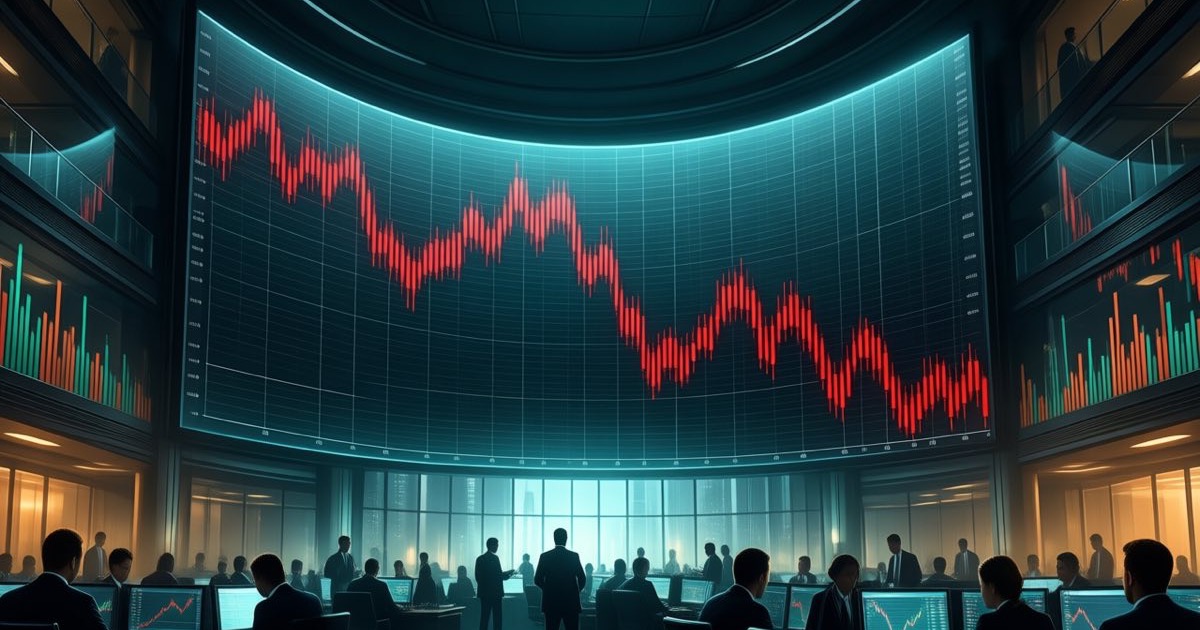
AI-linked stocks tumbled across Asia on Monday, September 14, in the first trading session since the chiefs of Anthropic, OpenAI and SpaceX jointly called for a slowdown in “reckless” AI development. SoftBank — the Japanese investor that is one of OpenAI’s largest backers — slumped 13%. South Korea’s Kospi, which leans heavily on the chipmakers that supply AI companies, dropped 3%. In Taipei, Taiwan Semiconductor Manufacturing Company fell 1.2%, and Nasdaq futures pointed to a 1.3% decline when US markets opened.
The trigger was not an earnings miss or a product flop. It was a safety argument. On Saturday, Anthropic CEO Dario Amodei published an essay, “We Must Pace the Frontier”, urging the industry to slow the rate at which frontier model capabilities advance. OpenAI CEO Sam Altman, Google DeepMind chief Demis Hassabis and Elon Musk all publicly endorsed it, and Altman said OpenAI would match Anthropic’s commitment to embedding outside evaluators to verify safety practices.
Amodei warned that “building too fast is reckless” and argued that a swarm of unsupervised AI agents could eventually cause hundreds of billions of dollars in damage by “taking over the entire internet”. That claim has been disputed by some experts, and no such event has occurred — but the market reaction on Monday suggests investors took the essay’s premise seriously in a narrower sense: that the industry might actually slow down.
What a slowdown does to a capex plan
That is the crux of the sell-off. Investors spent the past two years underwriting hundreds of billions of dollars in data centres, chips and power on the assumption that frontier demand keeps compounding. A genuine slowdown — whether coordinated between labs or simply a slower cadence of capability releases — puts pressure on the revenue assumptions behind that spending. The Guardian’s market report framed Monday’s moves exactly this way: investors began to price in a slowdown that would make it harder for the industry to pay for its planned AI infrastructure build-out.
The irony is that one of the companies calling for the pause appears to be in its strongest financial position yet. According to the Financial Times, Anthropic has told investors its adjusted operating income will be positive for a second consecutive quarter — a milestone for a company preparing to list on the US stock market this year. The slowdown essay is not a rescue plea from a struggling lab; it is coming from a position of strength, which is precisely what makes it harder for rivals to dismiss as posturing.
The counter-read: nothing actually slows
Not everyone reads the call as a promise to spend less. Jim Reid of Deutsche Bank noted that the competitive race between companies and countries remains intense, making it difficult to imagine firms voluntarily stepping back while rivals push ahead — “it is hard to see China standing still”. He offered two alternative interpretations: that executives openly discussing the risks may simply be signalling how transformative they believe the technology is, effectively advertising its power; or that a greater share of AI investment gets redirected toward safety, monitoring and governance while the compute build-out continues underneath.
Both readings are consistent with what the labs have actually committed to. Nothing announced so far includes a capex cut, a release moratorium, or any enforcement mechanism — the agreement between rivals to slow down remains a set of public statements, and each signatory has its own business reason for making them. The essay itself proposes pacing as a principle, not a schedule.
The political split adds another layer. US President Donald Trump rejected the slowdown over the weekend, calling the concerns exaggerated and framing AI as a winner-take-all race against China — a position that, if it translates into policy, removes any prospect of a US-government-enforced pause. We covered that split over the weekend. In the UK, meanwhile, a cross-party group of MPs and peers reported on Monday that no country in the world currently has laws sufficient to contain AI’s human rights risks — a reminder that regulatory pressure is building in the opposite direction from Washington’s.
Whether Monday’s dip is a repricing of the industry’s capital plans or a one-day reaction to an unusual news cycle will be clearer by the time US markets close. What it settled already is that the slowdown debate has escaped the op-ed pages and is now something investors model.