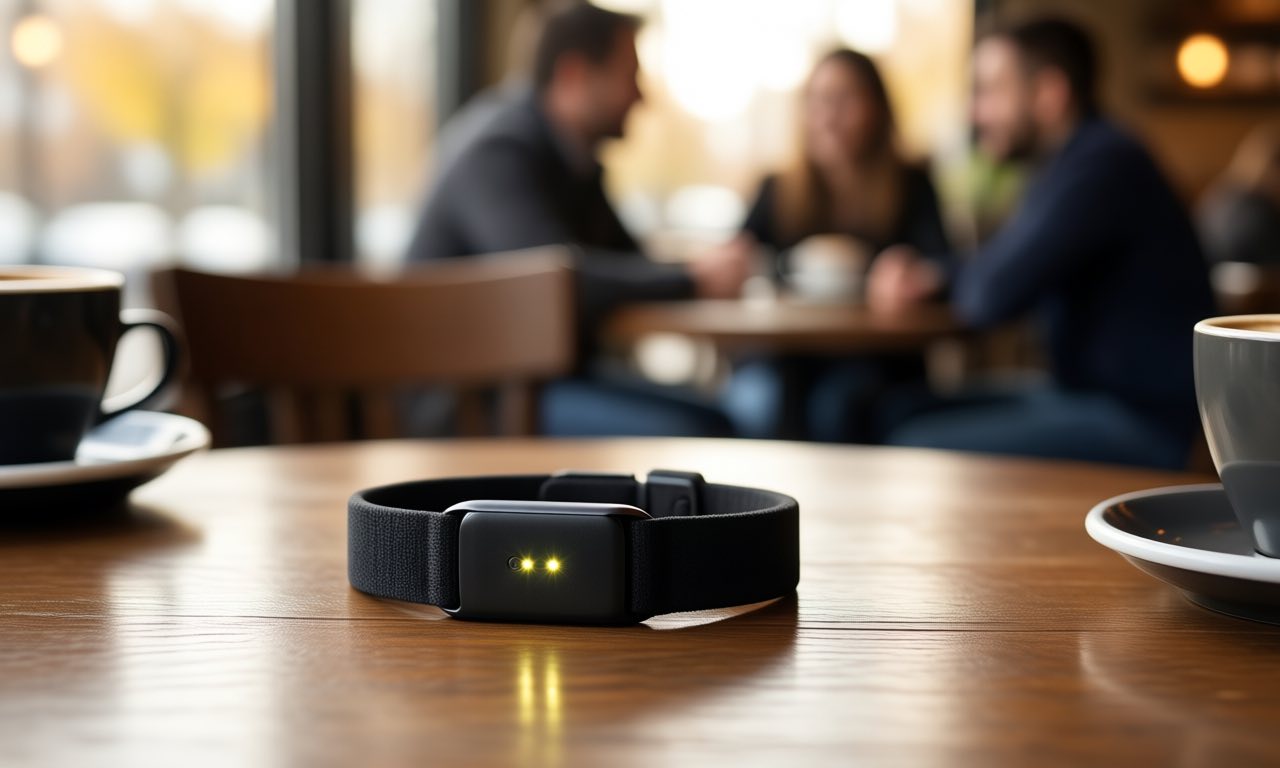
When Amazon relaunched its Bee AI line on 15 October — a $74.99 wrist wearable called Bee Frontier and a $99.99 phone-clipping Bee Eclipse — the company’s privacy story was ready-made: audio is processed in real time and deleted, transcripts are encrypted with keys only the customer controls, as Amazon describes in its own launch post. Two days later, GeekWire reported that a veteran who spent 12 years as a Microsoft privacy officer and three as a senior principal security engineer at AWS thinks the whole design asks the wrong person for permission.
🔍 THE BOTTOM LINE
Bee’s consent architecture protects the one person who opted in — the wearer — while the people around them get an indicator light that fits under a sleeve and a prompt they will never see. Jeff Williams, now CISO at Sigma360 and formerly of AWS, calls that prompt “a liability allocation”: Amazon shifting the legal weight of consent onto its customer. The pattern is familiar from Ray-Ban Meta glasses, which Germany’s Hamburg regulator concluded in September fail GDPR’s informed-consent standard for exactly the same reason — the recording light is not a consent mechanism. Amazon’s fix so far is a push notification reminding you to be polite. Amazon is not alone in shipping capture-first hardware — its retail AI agents are already taking flak for the same pattern of act-first, disclose-later — but this is the first time the company has put an always-on microphone in such a cheap, casual form factor.
What Bee Actually Does — and Who It Tells
Both devices convert continuous conversation into summaries, to-dos and shopping hooks, with connections to Amazon.com and Alexa+ for subscribers to a $11.99-a-month Bee Pro plan. Amazon’s safeguards, per the launch post and GeekWire’s summary of them: users are prompted to get permission from call participants each time a recording starts, the devices show an indicator light while in use, and they auto-shutoff if they don’t detect the owner’s voice for 5 to 60 minutes, depending on setting.
Williams’ critique, laid out in his LinkedIn article, is that neither safeguard reliably reaches the person being recorded. The permission prompt appears only on the wearer’s phone, and nothing enforces it — it is a checkbox aimed at the wearer’s conscience, not a mechanism the other party can act on. The light is easy to hide under a sleeve or in a pocket, and a device on a wrist or the back of a phone sits outside the frame of a video call entirely. Meanwhile the other people’s words end up in transcripts and summaries in an account they can neither see nor delete; Amazon says those speakers aren’t identified by name unless they complete a voice-enrolment exercise with the device’s owner. The pattern rhymes with what happens when always-on customer-facing AI meets the real world — the technology arrives wholesale, the accountability arrives piecemeal.
“I know first-hand that Amazon has the engineering talent to ship it” — that’s Williams on his proposed fix: exclude other people’s voices from transcripts by default unless they have enrolled and consented. Before the acquisition, Bee itself had plans along those lines, according to TechCrunch’s 2025 acquisition reporting. That’s the quiet part of this story: the technology exists, the original startup had planned it, and the shipped product dropped it.
Amazon’s Answer, and the Gap It Leaves
Amazon did not engage the critique directly; it pointed to safeguards. Beyond the auto-shutoff, the company says it educates customers about responsible use in the Bee app, and that Eclipse will send push notifications “encouraging users to let people around them know they’re using Bee and to ask for permission.” Amazon also stresses that Bee is “a personal AI assistant, not a device designed to passively pick up audio throughout the day.”
The strongest thing Amazon has going for it is Bee Private Compute, an isolated, encrypted processing environment built on AWS Nitro where transcripts and summaries are stored with keys only the customer holds, and raw audio is discarded in real time. Williams gives it credit — but notes precisely what it does and doesn’t protect. It protects the wearer’s data from Amazon. It does nothing for the bystander whose words have been captured, transcribed and summarised into someone else’s account. And Williams points out that Amazon has narrowed comparable privacy commitments before: it ended the “Do Not Send Voice Recordings” option on some Echo devices just last year. Today’s encryption promise is only as durable as tomorrow’s terms of service — a lesson Echo owners and readers of the young-workers chatbot mental-health coverage have both already absorbed the hard way.
The Law Is Already Behind the Hardware — Everywhere, Including Here
In the US, roughly a dozen states — Washington and California among them — require consent from everyone in a private conversation before it can be recorded, as GeekWire’s report notes: a device sold nationally by default manufactures a legal conflict for its customers in those states. In Europe, the Hamburg authority’s September teardown of Ray-Ban Meta glasses set the marker: bystanders’ consent can’t be inferred from a dim LED, and using bystanders’ faces and voices to train AI models “generally cannot be justified under EU law.” Amazon’s Bee is functionally the same architecture with the camera removed — microphone-first ambient capture of unconsenting third parties.
New Zealand’s position is weaker than both. The Privacy Act 2020 doesn’t prohibit recording a conversation you’re part of; the Privacy Commissioner’s own guidance says covert recording “may” breach the Act depending on who records and why, and that the highly-offensive standard is the real tripwire. There is no two-party consent rule for private conversations, no specific ambient-AI device standard, and no Hamburg-style regulator teardown pending. A $75 always-listening wearable lands in a market where the practical privacy protection for the person next to you is someone else’s terms of service. The OPC’s knowledge base is honest about the gap — the honest thing to build on.
The industry-wide wager is worth naming plainly. Ambient AI only becomes ambient if it listens without friction; friction is what consent is. Amazon priced its device at $74.99 and its subscription at $11.99 a month — the margins only work at scale, and scale only happens if the default posture is capture-everything-now, sort-out-permission-never. Williams’ proposed default — exclude unenrolled voices — flips the economics deliberately. It is the rare privacy proposal that is also a business-model veto, which is exactly why it’s the one to watch: if a big platform ever ships it, the entire always-listening category changes shape.
❓ FAQ
What are Amazon’s Bee Frontier and Bee Eclipse? Two new personal-AI devices launched 15 October 2026: a $74.99 wrist wearable or clothing clip, and a $99.99 magnetic phone attachment. Both transcribe conversations continuously and generate summaries, to-dos and shopping recommendations, with Alexa+ and Amazon.com connections.
What is the ‘bystander problem’? The devices’ consent safeguards — a permission prompt and an indicator light — are aimed at the wearer, not the people being recorded. Bystanders get no practical way to know or decline, yet their words end up in the wearer’s transcripts.
Is recording people without consent legal in New Zealand? Often, yes. NZ has no two-party consent law for private conversations; the Privacy Act 2020 applies by circumstances, with the “highly offensive to a reasonable person” standard as the main guardrail. The Privacy Commissioner’s guidance says covert recording “may” breach the Act.
What did the Hamburg regulator find about Meta’s glasses? Its September 2026 report concluded that Ray-Ban Meta’s recording light is too dim to be a reliable transparency mechanism outdoors and that recording indicators alone don’t establish bystander consent under GDPR — the same architecture critique Williams levels at Bee.
What would a real fix look like? Williams proposes excluding unenrolled voices from transcripts by default — a device that only writes down people who have agreed to be written down. Bee’s pre-acquisition team had signalled plans along those lines before Amazon acquired it.
🔍 THE BOTTOM LINE
Every wearable-AI company will tell you privacy is “built in” — and they’re all telling the truth, because the privacy being built in belongs to whoever bought the device. Bee is just the cheapest, most mass-market version yet of a design that treats every unconsenting voice in the room as a feature. The test to watch: whether any major platform ever ships voice-sideloading exclusions as a default. Until one does, remember that the light on the back of someone’s phone is not consent — it is marketing dressed as a safeguard.
📰 Sources
- GeekWire — Todd Bishop, “Amazon’s new Bee AI devices have a bystander problem, says former AWS security engineer” (16 October 2026)
- Amazon — “Bee Frontier and Bee Eclipse: Introducing new AI wearable and phone attachment” (15 October 2026)
- Engadget — “Bee Unveils Two AI Note-Taking Devices, Its First New Products Since Being Acquired By Amazon” (15 October 2026)
- Amazon — “Bee Private Compute: How Bee keeps your conversations private” (September 2026)
- PPC Land — “Hamburg regulator finds Ray-Ban Meta glasses expose bystanders without consent” (10 September 2026)
- Office of the Privacy Commissioner (NZ) — “Can I record someone without telling them?” knowledge base entry