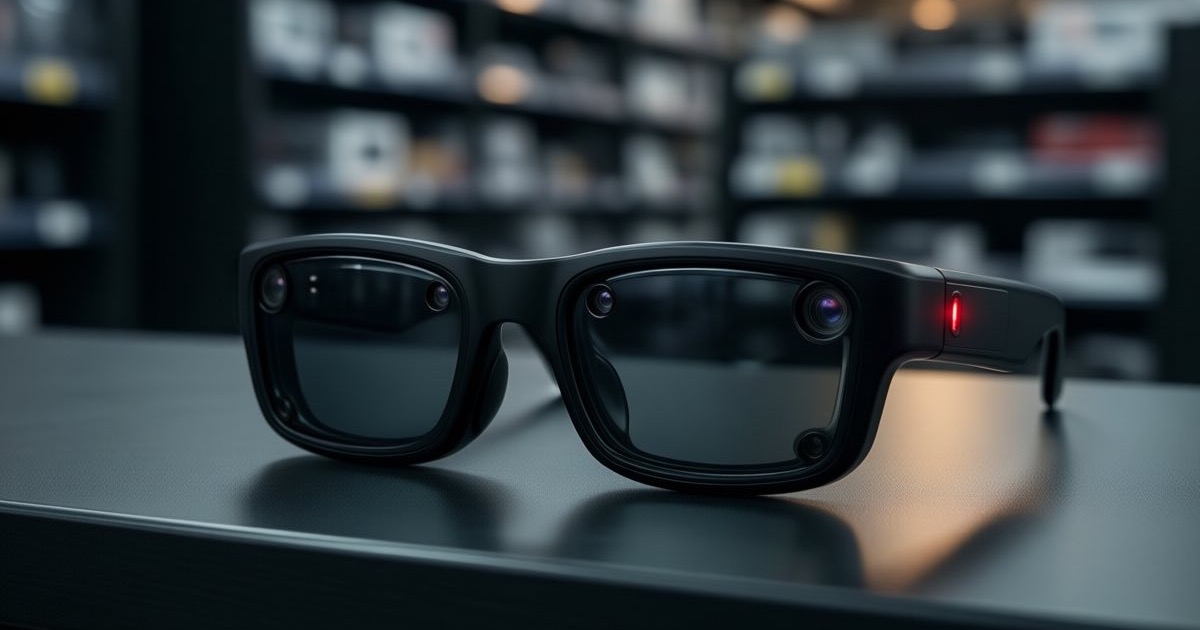
Australia’s privacy regulator has opened a formal investigation into Shenzhen Qingcheng Future Technology, the China-based company behind the HeyCyan app that powers Kmart’s $89 Anko smart glasses, after the company failed to respond to the regulator’s preliminary inquiries. The Office of the Australian Information Commissioner (OAIC) announced the investigation on Wednesday (NZ time) in a media release and a companion blog post from Privacy Commissioner Carly Kind, who wrote that her office has “no assurance” the company protects Australians’ personal data as the Privacy Act requires.
The investigation follows months of public backlash against cheap camera glasses sold through mainstream retailers. Guardian Australia reported in August that Kmart had sold out of the Anko-branded glasses — a discount version of Meta’s Ray-Ban camera glasses — prompting viral outrage, a 55,000-signature GetUp petition, and local bans at swimming pools and other public spaces. Kmart has since removed the product from its website.
Who is being investigated — and who is not
The target is narrow. Shenzhen Qingcheng makes the HeyCyan software used in the Anko glasses and in low-cost smart glasses sold through Big W Marketplace, Amazon and others. According to the OAIC’s release, the company was one of five entities — alongside Kmart, BDI Technology, Meta and Google — that received preliminary inquiries from 12 August 2026, asking how the glasses record, who has access to the data and where it is stored. Shenzhen Qingcheng was the only one that did not respond, and it is the only entity now under formal investigation. Kind has said the probe will use “the full range of the OAIC’s powers”, including compulsory information-gathering notices.
ABC News, which revealed more than a dozen security flaws in the HeyCyan app last month, reports that the privacy commissioner is now urging retailers to reconsider selling the product while the investigation runs. Kind’s blog post also sets out a structural gap: under Australia’s Privacy Act, retailers who merely sell the hardware and never collect personal information may carry no privacy obligations at all — the software provider that collects the data is the entity the law reaches. The government’s proposed privacy reforms would broaden the definition of personal information and replace the “reasonably necessary” collection test with a “fair and reasonable” one, which Kind expects to strengthen oversight of surveillance wearables.
Why the cheap end of the market is the soft spot
Industry analysis from SmartCompany frames the investigation as a warning to Australian small businesses stocking the devices; for our purposes it points at something larger. An $89 pair of glasses with no subscription, no brand accountability and a software provider on another continent is a privacy incident waiting for a jurisdiction. The premium incumbents — Meta’s Ray-Ban line, Google’s planned glasses — operate inside regimes where regulators can at least reach them; New Zealand consumers sitting just beneath Australia’s regulatory umbrella are being sold, at volume, a product whose software maker will not answer the mail.
The pattern isn’t new: cheap lookalike hardware has always trailed flagship devices past the regulatory guardrails. What is new is that camera-invisible wearables crossed the price floor at which mainstream families impulse-buy them — Kmart shoppers aren’t reading security audits, and neither, evidently, was the retailer in August. New Zealand has no equivalent of the OAIC probing this category, and our Privacy Act carries the same hardware-vendor gap Kind describes across the Tasman; nothing in the current framework requires an importer or retailer to know what the bundled app does with a stranger’s face. Watch the Norway ban model, where the government is asking parliament for a temporary stop on camera glasses in parks, beaches and schools while permanent rules are designed — Australia’s federal government is weighing its own restriction on smart glasses in public offices, and if that lands, the trans-Tasman gap stops mattering, because the products stop being sold here too.
The glasses were a bargain; the app behind them, by the regulator’s account, could not be paid to answer questions. That asymmetry — hardware cheap, software unaccountable — is the actual product.
As of publication, Shenzhen Qingcheng has not publicly responded to the investigation. Corrections and updates will be noted here.