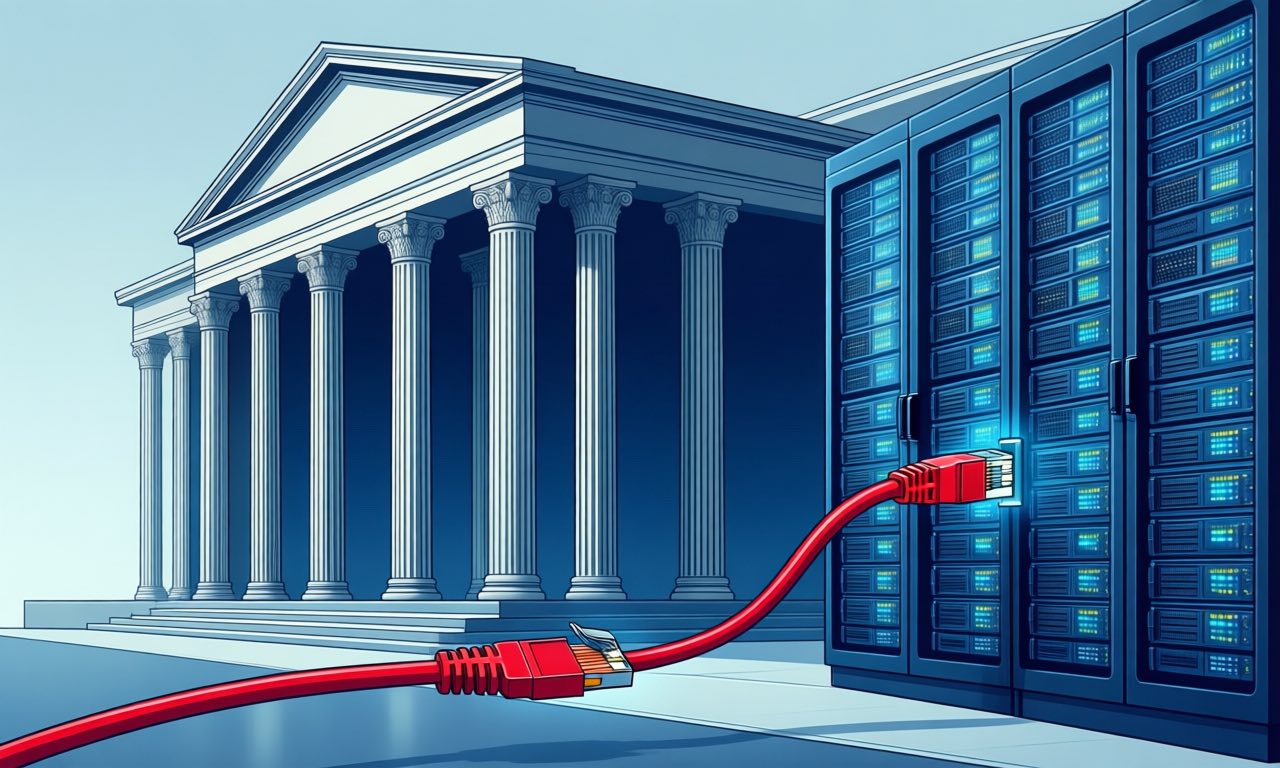
The Department of Homeland Security has ordered every US federal civilian agency to remove DeepSeek products from their IT systems and barred future purchases, according to a notice filed Monday and scheduled for Federal Register publication on Tuesday. The order was signed under the Federal Acquisition Supply Chain Security Act of 2018, after a review by the Federal Acquisition Security Council.
Signed by Homeland Security Secretary Markwayne Mullin on 26 June, the exclusion has been in effect internally for nearly four months — Monday’s filing makes it public and binding across the civilian executive branch. It covers all products and services from Hangzhou DeepSeek Artificial Intelligence Co., Ltd and affiliated entities, and — critically — it reaches third-party products built using DeepSeek implementations. A vendor that merely built its tooling on DeepSeek’s open-weight models is potentially in scope.
Why the government says it did it
The Secretary’s letter, quoted by CyberScoop, cites what Mullin called “multiple threat vectors”: DeepSeek’s models store data on servers in China, where national security laws give Beijing wide latitude to demand access; models hosted by the company collect personally identifiable information and trace users’ “digital fingerprints”; and the ordinary prompt-and-response cycle “may result in the transfer of sensitive data” to the Chinese government.
“The transfer of the aforementioned information to the [People’s Republic of China], either independently or in combination with publicly available data, could produce actionable intelligence on U.S. persons and/or government programs,” Mullin wrote.
The order arrives with unusual timing. DeepSeek’s open-weight models are currently the core of Huawei’s challenge to Nvidia, and the company spent October shipping agent-runtime work that put pressure on Western coding tools. Cutting US civilian agencies off from the most popular Chinese open-weight model is, in practical terms, a bid to wall off one customer class from that price pressure.
The pattern: device bans vs supply-chain exclusion
This is not the first US restriction on DeepSeek — but the previous ones were smaller in kind. Since early 2025, states and individual agencies banned DeepSeek on government devices; Congress considered the No DeepSeek on Government Devices Act. Monday’s order is different in mechanism: it uses procurement law (FASCSA) rather than device policy, which means it excludes the company from the federal supply chain entirely and binds third-party integrators too.
Australia took the device-ban path with DeepSeek in February 2025, as Bloomberg’s earlier coverage recorded; the US has now moved to the stronger instrument. New Zealand has, so far, no equivalent public restriction on Chinese AI models in government systems — a gap worth watching as allied procurement regimes tighten.
What it does not do
The order binds civilian executive branch agencies only. Defence and intelligence systems sit outside this instrument, and nothing in it restricts private companies, universities, or individual developers from using DeepSeek’s open weights — the models remain freely downloadable. Quartz notes the administration is targeting a company whose low-cost open-weight models have been putting “mounting competitive pressure on Silicon Valley developers,” per Bloomberg. Anthropic separately named DeepSeek among five Chinese labs it accused of distilling its models, an allegation the company rejected.
Our take: the third-party reach is the part that will bite. A procurement exclusion that follows the model rather than the vendor is a template — expect other open-weight Chinese labs with US government sales channels to be read through the same lens. For NZ, where public agencies are actively experimenting with cheap open-weight models, the US order is a live test of whether procurement-level exclusions become the allied norm.
As of publication, DeepSeek has not publicly responded to the order.
Sources: Quartz · CyberScoop · The420 · Federal Register public inspection 2026-21447