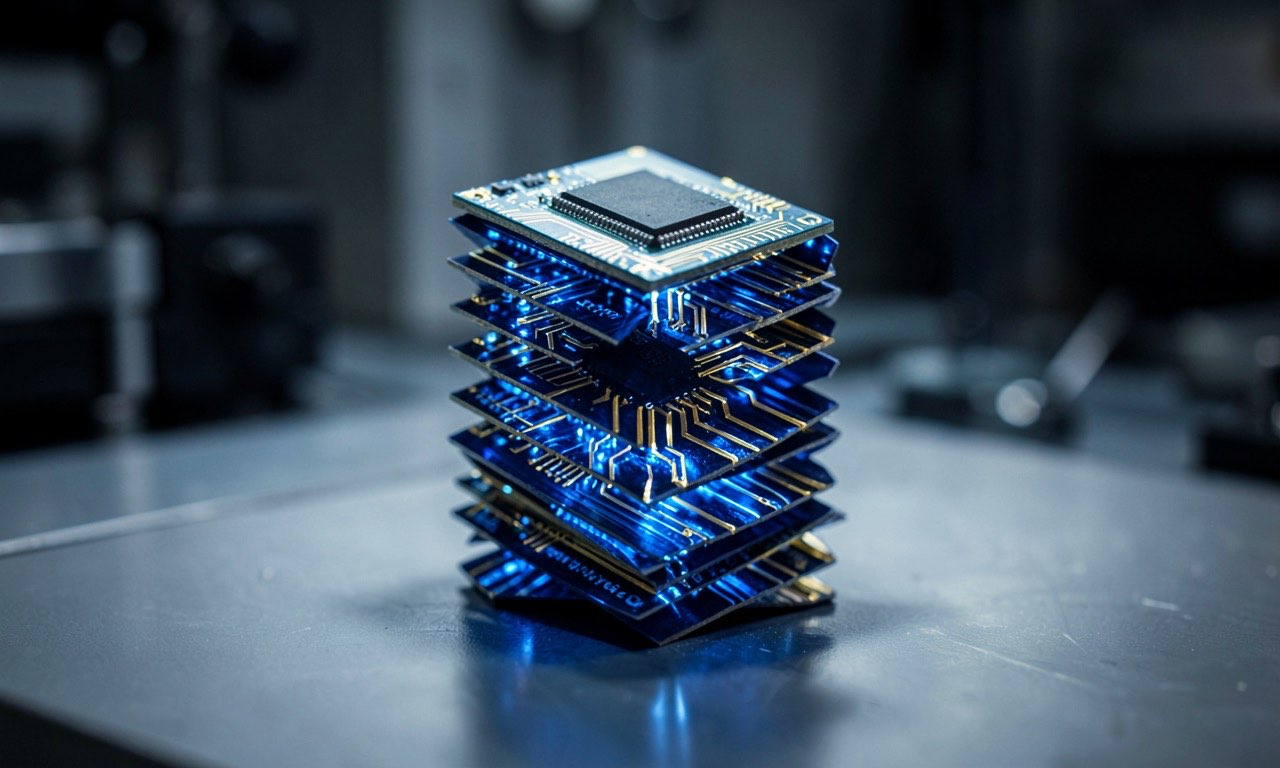
DeepSeek, the Chinese AI lab whose open-weights models have already matched GPT-5.5 on benchmarks, is now designing its own silicon. According to Reuters reporting confirmed by Ars Technica, the startup has spent roughly a year meeting with hardware partners and hiring chip engineers for a custom inference chip programme — one designed to sever its dependence on both Nvidia (blocked by US export controls) and Huawei (which controls roughly half of China’s domestic data-centre chip market).
🔍 THE BOTTOM LINE: This isn’t a side project. DeepSeek is replicating the same vertical-integration strategy that OpenAI, Anthropic, and now Microsoft are pursuing in the US — but under constraints that make it existential. If DeepSeek can inference on its own silicon, US export controls lose their teeth entirely. The geopolitical AI map just fractured a little further.
Why DeepSeek Needs Its Own Chips
The US export control regime has spent two years trying to bottle up Chinese AI progress by cutting off access to advanced Nvidia GPUs. The Anthropic Fable export control saga showed how aggressively the Commerce Department is willing to weaponise chip access — and DeepSeek sits squarely in the crosshairs.
DeepSeek currently relies on a mix of Nvidia chips (smuggled through Singapore-based front companies in cases that are now being prosecuted) and Huawei’s Ascend series. The Huawei dependency is politically fraught — it means DeepSeek’s entire inference pipeline depends on a company the US has spent years trying to cripple. Building its own chips gives DeepSeek a third path: complete silicon sovereignty.
Reuters reports the focus is on inference chips, not training chips. That’s a critical distinction. Training frontier models still requires massive compute clusters, but inference — actually running the model in production — is where the cost and volume lives. A custom inference chip could let DeepSeek deploy its models at a fraction of current costs while sidestepping every export control on the books.
The Same Playbook OpenAI and Anthropic Are Running
DeepSeek isn’t alone in this pivot. OpenAI and Broadcom recently announced “Jalapeño”, their first custom inference chip. Anthropic has been quietly exploring custom silicon as well. The Nvidia Kyber rack delay to 2028 has made the entire industry nervous about relying on a single supplier.
The difference is urgency. US companies can buy Nvidia chips; they just want to reduce margins. DeepSeek cannot buy Nvidia chips legally. Its chip programme isn’t about cost optimisation — it’s about survival under sanctions.
China’s Chip Ecosystem Is Already Moving
DeepSeek isn’t even the first mover in China. Alibaba and Baidu have been developing their own AI silicon for years. Huawei’s Ascend 910C has already powered DeepSeek V4 Pro post-training, proving the domestic alternative can work — but DeepSeek clearly doesn’t want to be permanently dependent on Huawei any more than it wants to depend on Nvidia.
The Chinese government has poured billions into semiconductor self-sufficiency through its Big Fund, which valued DeepSeek at $4.5 billion in earlier funding rounds. That backing comes with an implicit expectation: build Chinese silicon, not just Chinese models.
The NZ Angle
New Zealand’s AI sector is almost entirely built on cloud APIs from US frontier labs. If DeepSeek’s chip independence play succeeds, it accelerates a bifurcated AI world: a US-aligned stack (Nvidia + OpenAI/Anthropic) and a China-aligned stack (domestic silicon + DeepSeek/Huawei). For NZ, that means the open-weights models from DeepSeek — which are already priced 75% below frontier competitors — become even cheaper to run if DeepSeek doesn’t have to pay Nvidia’s margins. But it also means the geopolitical fault lines run straight through any company using both ecosystems.
What Could Go Wrong
DeepSeek has no track record in chip design. The company is an AI lab, not a semiconductor firm. Designing competitive inference chips requires not just engineering talent but fabrication partnerships — and China’s foundries are still generations behind TSMC. The Apple-TSMC capacity squeeze shows even Apple struggles to secure advanced node capacity. DeepSeek will likely need to use mature nodes, which means lower performance and higher power consumption.
There’s also the question of whether US intelligence agencies will treat DeepSeek’s chip programme as a sanctions evasion vector. If so, the Commerce Department could extend controls to cover the design tools and IP that DeepSeek would need to acquire.
❓ FAQ
How soon could DeepSeek have working chips? Reuters suggests the programme has been running for about a year, but chip design cycles typically run 18-24 months from specification to first silicon. Even on an aggressive timeline, DeepSeek is unlikely to have production chips before mid-2027.
Would custom inference chips make DeepSeek models cheaper? Potentially much cheaper. Inference accounts for the majority of AI operating costs. A custom chip optimised for DeepSeek’s specific model architecture could deliver significant efficiency gains — the same logic driving OpenAI’s Jalapeño project.
Does this mean export controls have failed? Not yet — but it suggests they’re accelerating the very independence they were designed to prevent. The US chip ban has given every Chinese AI company a strategic reason to build domestic alternatives. Whether that’s a failure depends on your time horizon.
What does this mean for Nvidia? Nvidia loses the Chinese market almost entirely — but it was already losing it to export controls. The bigger risk is that DeepSeek’s chip designs, if successful, could be licensed or copied by other Chinese companies, creating a domestic alternative to Nvidia’s entire inference product line.
🔍 THE BOTTOM LINE: DeepSeek designing its own chips is the logical endpoint of US export control policy. You can restrict what someone buys, but you can’t stop them from learning to build it themselves. The question is no longer whether China will develop indigenous AI silicon — it’s how fast, and what happens to the global chip market when they do.