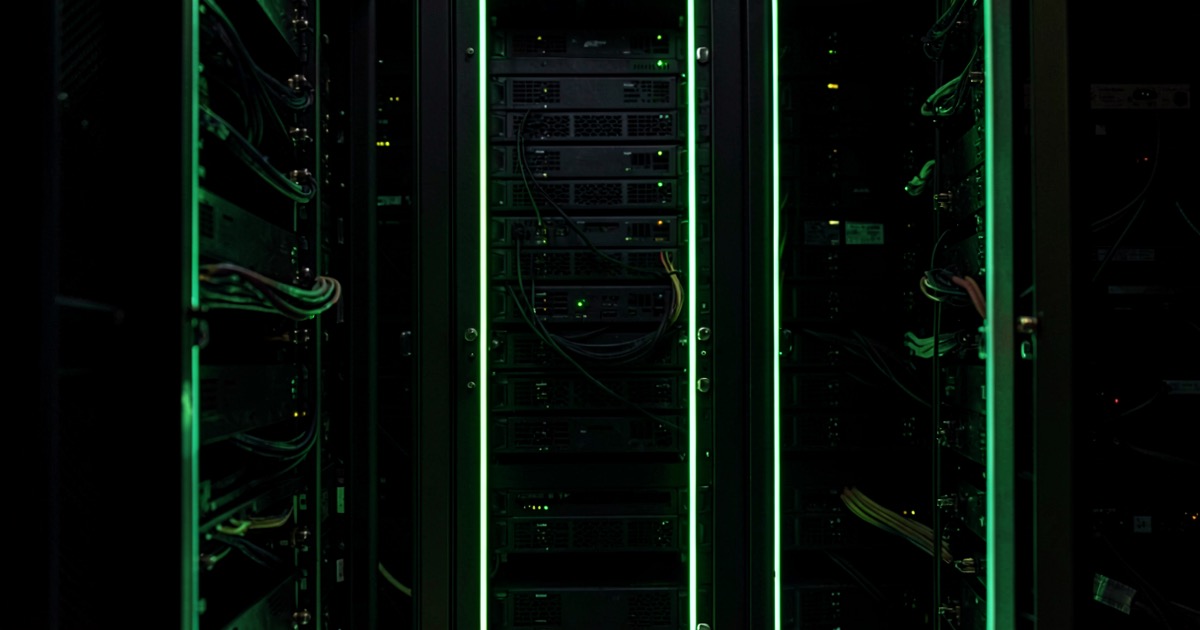
Nvidia’s next marquee product — the Kyber rack-scale architecture designed to house its 2027 Rubin Ultra chips — has been delayed by more than 12 months to 2028, according to SemiAnalysis. The cause is not demand, not chips, not software. It is a single printed circuit board — the PCB midplane — that nobody can manufacture at scale.
🔍 THE BOTTOM LINE
The Kyber NVL144 is the cabinet that was supposed to make Rubin Ultra feel like one giant computer instead of 144 separate ones. Without it, Nvidia has no proven way to scale up its 2027 flagship. The backup plan — bolting two current racks together — was cancelled after cloud customers refused it. AMD and Google’s in-house TPUs now have a technical opening they haven’t had in years.
What Kyber Was Supposed to Be
Kyber is a server cabinet that packs 144 of Nvidia’s most powerful chips into a single unit so they can work together as one giant computer, providing the horsepower AI companies need to train and run their most advanced models. The design mounts graphics processing units in compute trays that sit vertically instead of horizontally to boost density and reduce latency, and had been slated to debut with Vera Rubin Ultra, Nvidia’s next-generation rack-scale system, in 2027.
This isn’t a side product. Kyber is the mechanical and electrical backbone for Nvidia’s entire 2027 roadmap. The Rubin Ultra chips themselves may still ship, but without the rack that connects them into a single 144-GPU machine, they’re just very fast individual GPUs — not the rack-scale supercomputer Nvidia has been selling to hyperscalers as the reason they should keep buying.
The PCB Midplane Problem
“Kyber NVL144 rack architecture has been delayed to 2028 as the PCB midplane remains challenging from a manufacturability standpoint,” SemiAnalysis said, referring to a specialized, multi-layer printed circuit board that connects electronic modules within a system.
The midplane is the structural backbone of the rack — every GPU talks to every other GPU through it. Manufacturing it at the density, layer count, and signal-integrity tolerance Nvidia’s design requires is beyond what current PCB fabrication can reliably produce at volume. This is a supply-chain problem hiding inside a product problem: the design works on paper, the prototype may even work in the lab, but you cannot mass-produce the connector.
NVL576 — a larger system linking eight racks via optical connections — is also likely delayed or limited to small volumes, the research firm said. The compounding effect: not only is the single-rack scale-up broken, the multi-rack optical scale-out is broken too.
The Cancelled Backup Plan
A backup plan — bolting two of Nvidia’s current-generation racks together for similar power — has also been scrapped after cloud customers rejected the design as awkward and costly to operate. “It has since been cancelled due to heavy pushback from CSPs [cloud service providers] and hyperscalers over its odd design and heavy operational burden,” SemiAnalysis said.
That leaves Nvidia with “no proven solution to expand the scale-up world size for Rubin Ultra,” according to the research firm. That is a remarkable sentence to write about a company that has spent three years telling investors its annual release cadence was unstoppable.
The Opening for AMD and Google
SemiAnalysis predicted the delay could give rivals Advanced Micro Devices and Google, whose in-house chips are already winning business from top AI labs, a rare technical opening at the high end of the market.
Google in particular has been quietly building its own scale-up story. Our earlier reporting on Google’s 960,000-GPU A5X cluster showed the company already operating at a tier of compute that only three or four companies can afford. If Nvidia’s Rubin Ultra rack slips a year, the gap between “buy Nvidia’s best rack” and “build your own” narrows — and for the hyperscalers already building their own silicon, it may close entirely.
This is also the second product-line strain in a month. The reported delay adds to mounting concerns that Nvidia’s breakneck annual release cadence is colliding with manufacturing limits — the same limits that have historically governed the semiconductor industry and that no amount of market cap can will away.
What Is Still on Track
Nvidia’s current-generation Rubin systems are in full production and begin shipping this fall to eight cloud partners, including Amazon Web Services, Microsoft Azure and Google Cloud. SemiAnalysis also projects Nvidia’s data-center compute revenue will run 20% above Wall Street consensus in the second half of fiscal 2027.
The delay is a 2027-2028 problem, not a 2026 problem. Nvidia’s near-term revenue is unaffected. But the strategic question — can Nvidia keep promising a new rack-scale architecture every year when the manufacturing can’t keep up — is now the question every hyperscaler procurement team is asking privately.
Shares of Nvidia fluctuated in premarket trading, last down less than 0.1% at $194.79. The market, for now, is treating this as a roadmap footnote. The hyperscalers buying the racks are not.
NZ Angle
New Zealand has no domestic GPU manufacturing and no hyperscaler data center. Every AI workload run from NZ — by universities, by Callaghan Innovation grants, by startups renting cloud GPUs — depends on the same Nvidia roadmap this delay touches. If Rubin Ultra rack-scale systems slip a year, the cost per token of training frontier models in 2027 stays higher for longer, and the cloud providers that NZ researchers rent from pass that through. A 12-month delay on a single circuit board in Taiwan is, quietly, a 12-month extension of the compute scarcity that already prices most NZ teams out of frontier research.
❓ FAQ
What is Kyber NVL144? A server cabinet that houses 144 of Nvidia’s Rubin Ultra GPUs in a vertical-tray design, connected through a specialized PCB midplane so they function as one large computer. It was Nvidia’s flagship rack-scale product for 2027.
Why was it delayed? The PCB midplane — the multi-layer printed circuit board connecting all 144 GPUs — cannot be manufactured reliably at the density and signal-integrity tolerance the design requires. SemiAnalysis reported the delay on July 6, 2026.
What happens to Rubin Ultra chips without Kyber? The chips can still ship, but without the rack they cannot be grouped into a single 144-GPU machine. The scale-up story — “buy one cabinet, get one giant computer” — is broken until 2028.
Does this affect Nvidia’s 2026 revenue? No. Current-generation Rubin systems are in production and shipping this fall. SemiAnalysis projects data-center revenue 20% above Wall Street consensus for H2 FY2027. The delay is a 2027-2028 roadmap issue.
Who benefits from the delay? AMD and Google. AMD’s MI400 series and Google’s in-house TPUs both compete at the high end where Kyber was supposed to lock in customers. A 12-month gap gives them a window to win design-ins that would otherwise have gone to Rubin Ultra.
🔍 THE BOTTOM LINE
Nvidia’s annual-cadence promise has been the single most important narrative in AI hardware for three years. A single unmanufacturable circuit board in Taiwan just put a crack in it. The chips still ship, the revenue still grows, but the story that Nvidia can out-execute the entire semiconductor supply chain every single year — that story now has an asterisk. AMD and Google hear it.
📰 Sources
- CNBC — Nvidia’s next-gen AI rack system delayed to 2028 on manufacturing snags, SemiAnalysis says
- Seeking Alpha — Nvidia next-gen Kyber AI rack delayed to 2028 on manufacturing snags
- SemiAnalysis — Kyber NVL144 / NVL576 analysis (via CNBC report)
- Nvidia — Vera Rubin Ultra announcement (GTC March 2026)