Google DeepMind has released Gemini Robotics-ER 1.6, an upgraded embodied reasoning model for robots that brings significant improvements in visual understanding, spatial reasoning, and human safety detection. The model is available immediately on Google AI Studio and the Gemini API.
The release represents the latest step in DeepMind’s push to bridge the gap between language model intelligence and physical world execution — a challenge that has proven far harder than generating text or code.
What’s New in 1.6
The upgrade targets four specific capabilities that have limited real-world robot deployment:
Object pinpointing in cluttered scenes. Previous models struggled to identify and precisely locate objects when they were partially obscured or surrounded by similar items. ER 1.6 uses enhanced visual-spatial reasoning to isolate targets even in dense, disorganized environments — think a robot arm reaching for a specific component in a bin of nearly identical parts.
Task completion detection with multi-view reasoning. Rather than relying on a single camera angle to determine whether a task is finished, ER 1.6 synthesizes information from multiple viewpoints. A robot can assess whether a bolt is fully tightened or a surface is properly cleaned by reasoning across perspectives — a capability that closely mirrors how humans verify their own work.
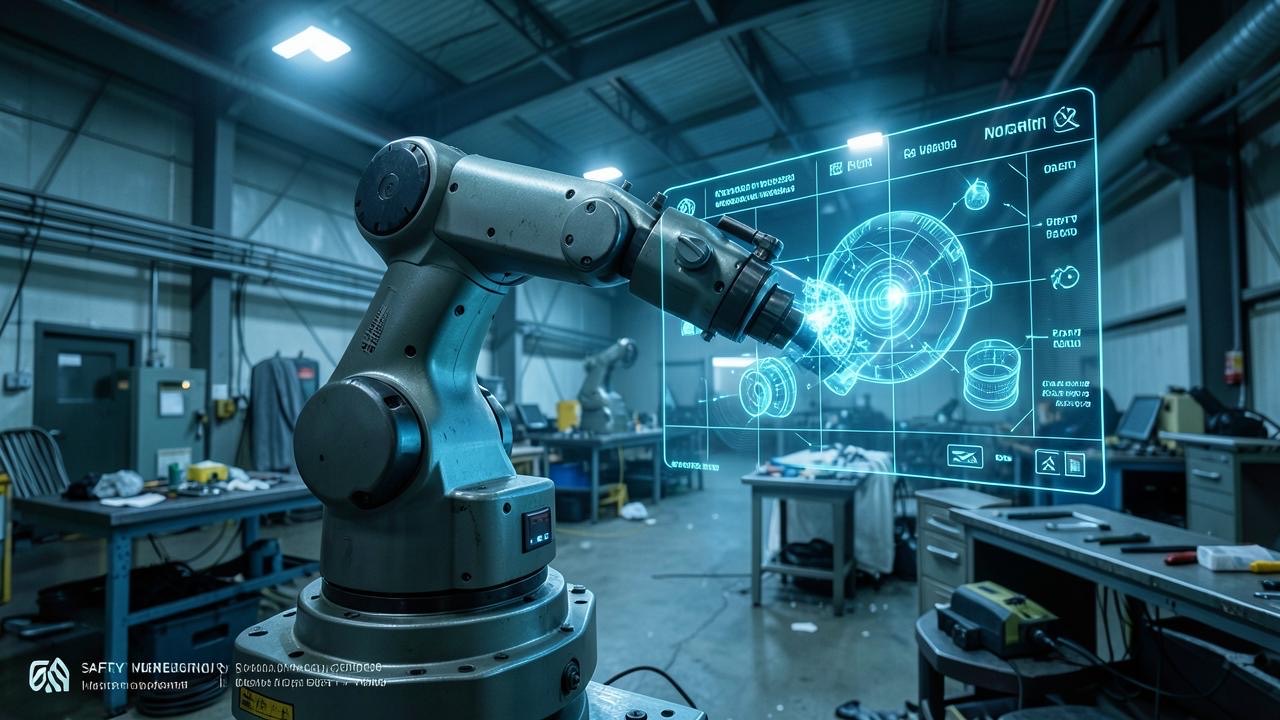
Instrument reading with sub-tick accuracy. For industrial inspection, the model can read analog gauges, dials, and displays with precision beyond the smallest marking. This enables robots to perform quality checks on equipment that was previously only readable by trained human inspectors.
10% improvement in human injury risk detection. The safety upgrade means the model is significantly better at identifying situations where a robot’s actions could harm a nearby person — detecting human body parts, predicting collision paths, and triggering safety stops faster.
Why Embodied AI Matters Beyond Chatbots
The robotics-ER line represents a fundamentally different paradigm from the chatbot AI that dominates public attention. Language models operate in a world where errors are words on a screen. Embodied AI operates in a world where errors are physical consequences — damaged products, broken equipment, injured people.
Gemini Robotics-ER 1.6’s safety improvements reflect this reality directly. A 10% improvement in injury risk detection isn’t an abstract benchmark improvement — it’s a concrete reduction in the probability that a robot fails to recognize a human hand in its workspace and causes harm.
The industrial inspection capabilities are similarly grounded. Being able to read instruments with sub-tick accuracy means robots can take over routine monitoring of infrastructure — power plant gauges, pipeline pressure readings, manufacturing equipment health — that currently requires human rounds. The labor savings are real, but so is the consistency improvement: robots don’t get tired, distracted, or complacent.
The Competitive Landscape in Embodied AI
DeepMind’s release comes amid intensifying competition in embodied AI:
- Physical Intelligence, backed by OpenAI, released its π0 model for general-purpose robot control in late 2025
- Figure AI has been demonstrating humanoid robots with increasingly sophisticated manipulation
- Tesla’s Optimus program continues to push toward production-ready humanoid robots, though timelines remain uncertain
- NVIDIA’s Project GR00T provides the simulation infrastructure many of these models train on
DeepMind’s advantage is integration. Gemini Robotics-ER sits within the broader Gemini ecosystem, meaning it can leverage the same foundation model capabilities that power Google’s language and vision products. The embodied reasoning model isn’t starting from scratch — it inherits the general intelligence that Gemini has developed across text, images, and code, then specializes it for physical interaction.
What This Means for Industrial Automation
The practical impact of ER 1.6 falls most heavily on manufacturing and infrastructure inspection:
- Quality control automation becomes more reliable when robots can verify their own work through multi-view reasoning
- Predictive maintenance improves when robots can read instruments more precisely than humans and do it continuously rather than on scheduled rounds
- Human-robot collaboration becomes safer when the model better understands where humans are and what they might do next
The model is available now through Google AI Studio and the Gemini API, which means deployment timelines are measured in weeks rather than months. For industrial operators already in the Google ecosystem, the upgrade path is straightforward.
SOURCES
- Google DeepMind