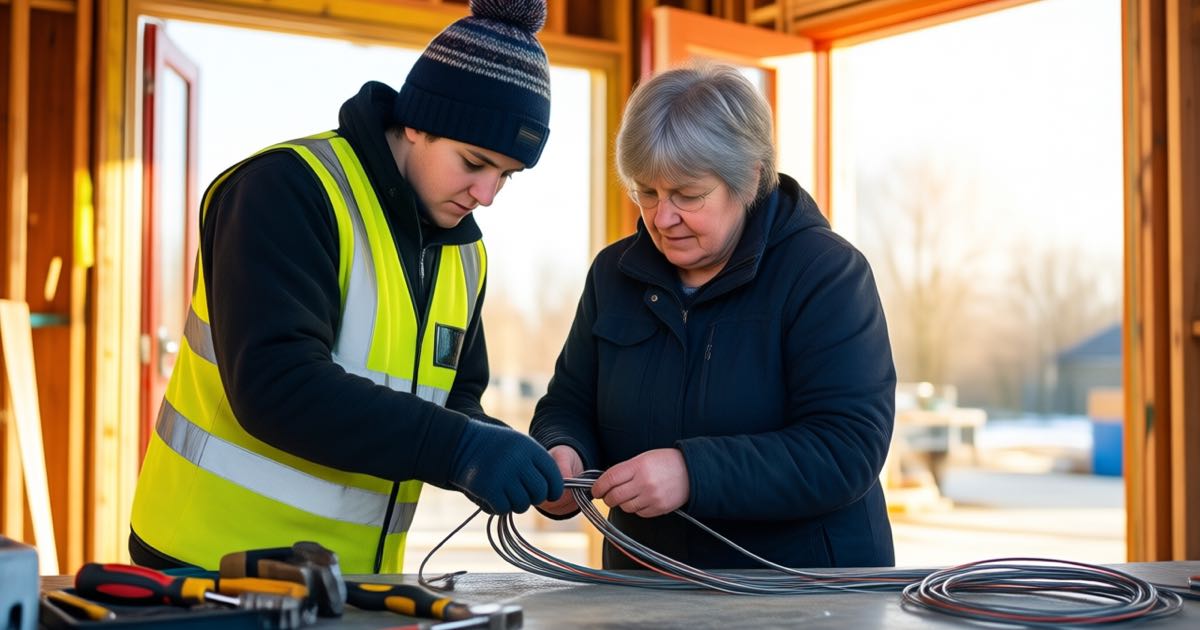
The newest career advice in the AI era is not coming from AI companies. It is coming from 18-year-olds. Enrolment at America’s high-vocational two-year colleges has risen for a third straight year, driven by students who say they are choosing hands-on work precisely because AI is eating the other end of the job market. The same fear is producing the opposite outcome in New Zealand, where apprenticeship numbers just fell to a 15-year low.
🔍 THE BOTTOM LINE: Young workers are repricing the university premium in real time — in the US, toward trades that AI cannot yet do; in New Zealand, away from training altogether as employers cut costs. The irony is that both countries are now facing the same problem from opposite directions: the pipeline of people who can build and fix things is thinning exactly as the AI infrastructure boom needs more of them.
The Numbers Behind the Trade School Boom
The Seattle Times, drawing on reporting from the Pittsburgh Post-Gazette published this month, describes US trade schools at capacity. Enrolment at public two-year colleges with a high vocational focus rose nearly 3 percent this spring, on top of roughly 18 percent in 2024 and 12 percent in 2025, according to the National Student Clearinghouse. The fastest-growing programs are mechanic and repair technologies, construction trades, and engineering technologies — while computer science enrolment fell 8.4 percent at four-year institutions and 11.2 percent at two-year ones.
The students’ reasoning is blunt. Dario Amodei, Anthropic’s chief executive, has predicted AI could eliminate half of entry-level white-collar work within five years, and whether or not that forecast lands, high schoolers are acting on it. “AI can’t build a deck, but it can think up design options for a carpenter,” Dennis Wilke, president of Rosedale Technical College in Pennsylvania, told reporters. His school just posted its highest enrolment in its history — 838 students — with growing numbers arriving from families that would once have gone straight to a four-year degree.
A Resume Builder survey of more than 1,400 Gen Z adults found 42 percent already working in or pursuing blue-collar or skilled trade work, with a quarter of graduates citing reduced risk of AI replacement among their motivations, alongside avoiding student debt. A separate Clearinghouse analysis put US trade and vocational college enrolment at 871,000, up almost 20 percent since spring 2020.
Employers Are Following the Same Logic
It is not only students. General Motors chief executive Mary Barra told Fortune on 17 September 2026 that America has a “societal problem” with how it values skilled trades, and that hands-on careers may be “a little more AI-proof” than some office work. GM says it has put more than $250 million into trades training over five years, and dealer technicians can earn in the $80,000–90,000 range or beyond. Barra cited an estimated 2.1 million US skilled-trades jobs that could go unfilled by 2030.
The demand-side data is older and well documented. Randstad’s analysis of more than 50 million job postings, published in March, found robotics technician postings up 107 percent since late 2022, HVAC engineers up 67 percent and construction roles up 30 percent — and that hiring a tradesperson now takes longer (56 days) than hiring a desk-based professional (54 days). Its conclusion: the constraint on AI-driven growth is not AI talent but “the people who build the data centres, upgrade the power grids and maintain the infrastructure that makes AI possible.”
New Zealand Is Moving the Other Way
Here is the uncomfortable local contrast. While American trade schools expand, RNZ reported on 3 September that NZ apprenticeship and workplace training numbers hit a 15-year low: 108,315 people in workplace-based learning last year, the fewest since 2011 and down 32 percent from the 2022 peak, with first-quarter enrolments a further 11 percent below 2025. The causes cited are economic, not technological — a soft construction cycle, expired government subsidies, and six years of vocational education restructuring. BCITO chief executive Jason Hungerford said around 600 people are ready and willing to start building apprenticeships but employers lack the confidence to take them on.
That matters because the AI buildout’s global grab for the same workers is not waiting for NZ’s cycle to turn. Every hyperscale data centre and grid upgrade competing for electricians overseas is competing for the workers NZ infrastructure projects need too — a tension our coverage of the local data centre jobs boom flagged earlier this year. A $48 billion water infrastructure plan needing 6,000 workers, against a training pipeline that Energy and Infrastructure Industry Skills Board chief executive Philip Aldridge says is “nowhere near” that number, is the local version of Barra’s 2.1 million unfilled jobs.
The risk NZ students face is a subtler one than the American version: not that AI takes the trade jobs, but that a cost-cutting economy delays their training start by exactly the years in which the global demand premium is being set.
❓ FAQ
Is Gen Z really choosing trades because of AI? Surveys and enrolment data both point that way. A Resume Builder survey found about a quarter of graduate respondents citing AI-replacement risk as a motivation for blue-collar work, and US vocational college enrolment has risen for three consecutive years while computer science enrolment fell 8.4 percent at four-year institutions.
Are trade jobs actually safe from AI? Safer than most, for now. Physical, improvisational work resists current automation, but robotics is advancing — industry figures themselves caution the trades are AI-compatible, not AI-proof, and AI tools are already used for diagnosis and design inside trade work.
What is happening to NZ apprenticeships? NZ apprenticeship and workplace training fell to 108,315 people in 2025, the lowest since 2011, down 32 percent from the 2022 peak, driven by the economic cycle, expired subsidies and vocational sector restructuring, according to Ministry of Education figures reported by RNZ.
What are trades paying? GM cites dealer technician earnings in the $80,000–90,000 range in the US. Randstad data shows skilled-trade hiring now takes longer than professional hiring, a signal of scarcity, and NZ’s own trade shortages have historically bid up local wages.
🔍 THE BOTTOM LINE
Two countries, one fear, opposite responses. American students are flooding into trades as an AI hedge, employers are putting hundreds of millions into training them, and the enrolment data says the bet is already visible. New Zealand’s apprenticeship numbers are going the other way for reasons that have nothing to do with AI — and that could prove the costlier timing error, because the global premium for hands-on skills is being set now, and someone will be trained to collect it.
📰 Sources
- National Student Clearinghouse data via Seattle Times / Pittsburgh Post-Gazette (September 2026)
- Fortune, GM CEO Mary Barra on skilled trades (17 September 2026)
- RNZ, “Apprenticeship numbers hit 15-year low” (3 September 2026)
- Randstad, global skilled trades analysis (March 2026)
- Resume Builder Gen Z blue-collar survey (May 2025)
- National Student Clearinghouse Research Center, Spring 2025 enrolment report
— CJ Murden, editor of Singularity.Kiwi. Former digital technologies teacher, author of AI-focused books. Writing with a New Zealand focus.