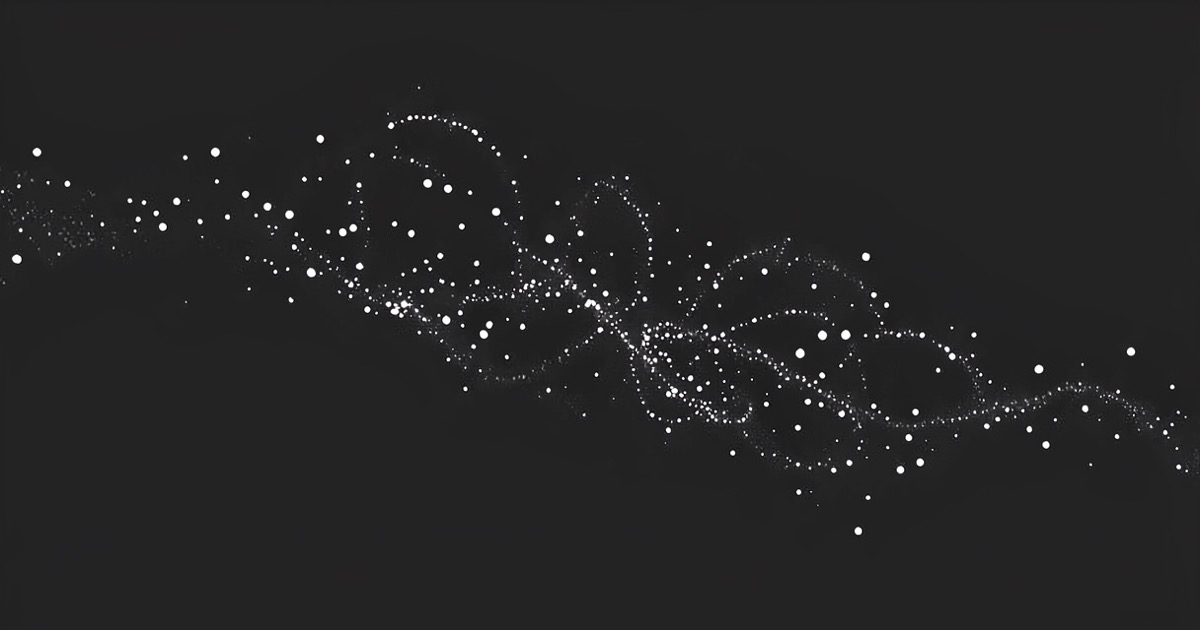
A designer named Eric Lu has built a font that humans can read and leading AI models can’t. It’s called Ghost Font, and it doesn’t work the way fonts usually work. Instead of ink on a page, each letter is made of moving dots rendered as a video clip. Pause the video and the message vanishes — there’s nothing but static noise in any single frame. Play it back, and the human eye picks up the motion-encoded letters instantly.
The project went viral on Hacker News, hitting 142 points and 107 comments in under nine hours. The appeal is obvious: in a year where AI models can read your handwriting, transcribe your voice, and identify your face from a blurry CCTV still, here’s a message format that stumps them.
🔍 THE BOTTOM LINE
Ghost Font is a clever experiment, not a solution. It exploits a real gap in how current multimodal AI models process video — they split it into frames and analyze each one separately. But that gap is closing. The font’s own creator admits a video-native AI model will eventually read it. What Ghost Font actually proves is that the window where humans can see things AI can’t is narrowing fast.
How It Works
Ghost Font encodes text as motion. Each letter is composed of dots that are indistinguishable from the background in any single frame. Only when the video plays do the dots trace letter shapes through their movement. According to the project page, Ghost Font videos were tested against Claude Fable and GPT Sol 5.6 Ultra — both recent frontier models with strong visual reasoning. Neither could decode the message until explicitly told the technique to look for.
The defense is layered. A single screenshot yields nothing — just noise. A frame-by-frame analysis yields nothing — the dots are identical to the background in each static image. And as a final trick, every Ghost Font video includes a decoy message: a false signal designed to satisfy an AI agent searching for hidden text, so it stops looking before finding the real one.
After a 19-minute analysis, ChatGPT 5.5 Pro hallucinated a message that doesn’t exist.
The ZXX Precedent
This isn’t the first attempt. In 2013, designer Sang Mun released ZXX, a typeface with four fonts designed to defeat OCR software. The letters were camouflaged with noise, crossed out, and buried under false marks. At the time, it was called “surveillance-proof.”
It isn’t anymore. As the Ghost Font page demonstrates, modern AI models can read ZXX text from a single image without effort. The arms race between human-readable and machine-readable has been running for over a decade, and every defensive layer humans have built has eventually been cracked by the next generation of models.
Ghost Font’s advantage is that it uses motion, not static camouflage. Current multimodal models are image-native — they process video as a sequence of frames, not as a continuous stream. That’s the specific gap Ghost Font exploits. But as we’ve seen with DeepSeek Vision and other multimodal advances, the models are getting better at temporal reasoning. The writing is on the wall — and soon AI will be able to read it.
The CAPTCHA Implication
The most practical application Lu identifies is CAPTCHA. Current CAPTCHA systems are largely solved by AI — Google reCAPTCHA v3 scores users without even showing them a challenge, and the image-based variants (“select all traffic lights”) are routinely defeated by bots.
A motion-based CAPTCHA would be harder. A bot would need to understand not just what’s in a frame, but what’s moving and how that motion forms a pattern across time. That’s a genuinely harder problem for current models, and it could extend the useful life of CAPTCHA by years rather than months.
The privacy implications extend further. In a world where AI surveillance and deepfake tools are proliferating, a communication format that resists automated scraping has real value — even if that value is temporary.
Why It Won’t Last
Lu is honest about this. “Ultimately, the way to truly hide a message is to use encryption, or some sort of key,” he writes. “No AI will be able to read a message that requires a specific password to unlock that only humans know.”
Ghost Font is an exploration, not a product. The creator plans to release the code as open source and expand it to handle longer text. He also acknowledges the obvious: a video-native AI model — one that processes motion directly rather than splitting video into frames — will close this gap. The question is when, not if.
The deeper lesson is about the trajectory. In 2013, static camouflage defeated OCR. In 2026, it doesn’t. In 2026, motion defeats multimodal AI. By 2027 or 2028, it probably won’t. Each defensive technique buys a few years. The gap between what humans can perceive and what AI can perceive keeps closing, and every iteration of the arms race makes that clearer.
NZ Angle
New Zealand’s privacy landscape is already shaped by AI scraping. The global regulatory response to AI-generated content and the platform-level AI labeling efforts show the institutional side. Ghost Font represents the individual side — a tool for ordinary people to communicate in a way that resists automated surveillance, even temporarily. For a small country where data sovereignty is an active policy concern, tools that buy time against AI perception have outsized relevance.
❓ FAQ
Can I use Ghost Font to send private messages? You can try it at the Ghost Font playground. Type a message, preview it, and download the video. But treat it as an experiment, not a security tool — the creator himself says encryption is the only real solution for private communication.
Which AI models were tested? Claude Fable and GPT Sol 5.6 Ultra, both frontier reasoning models, were unable to decode the message without being told the technique. ChatGPT 5.5 Pro spent 19 minutes analyzing a Ghost Font video and hallucinated a nonexistent message.
Will this work forever? No. The creator explicitly says a video-native AI model that processes motion directly will eventually read Ghost Font. The defense exploits a current architectural limitation, not a permanent one.
Is this related to anti-AI sentiment? It’s more nuanced than that. Lu frames it as “exploring the limits of AI perception while preserving something human.” The project isn’t anti-AI — it’s a benchmark for how far AI perception has come and where it still falls short.
🔍 THE BOTTOM LINE
Ghost Font is a beautifully crafted provocation. It works because current AI models can’t see motion the way humans do — yet. The font’s own creator gives it a few years before video-native models close the gap. What it captures is a moment in time: July 2026, when you could still hide something from a frontier model by making it move. Enjoy it while it lasts.