Some humanoid robotics stories are about factories that don’t exist yet. This one is about eggs that exist right now, on a floor, waiting for a person to bend down and pick them up.
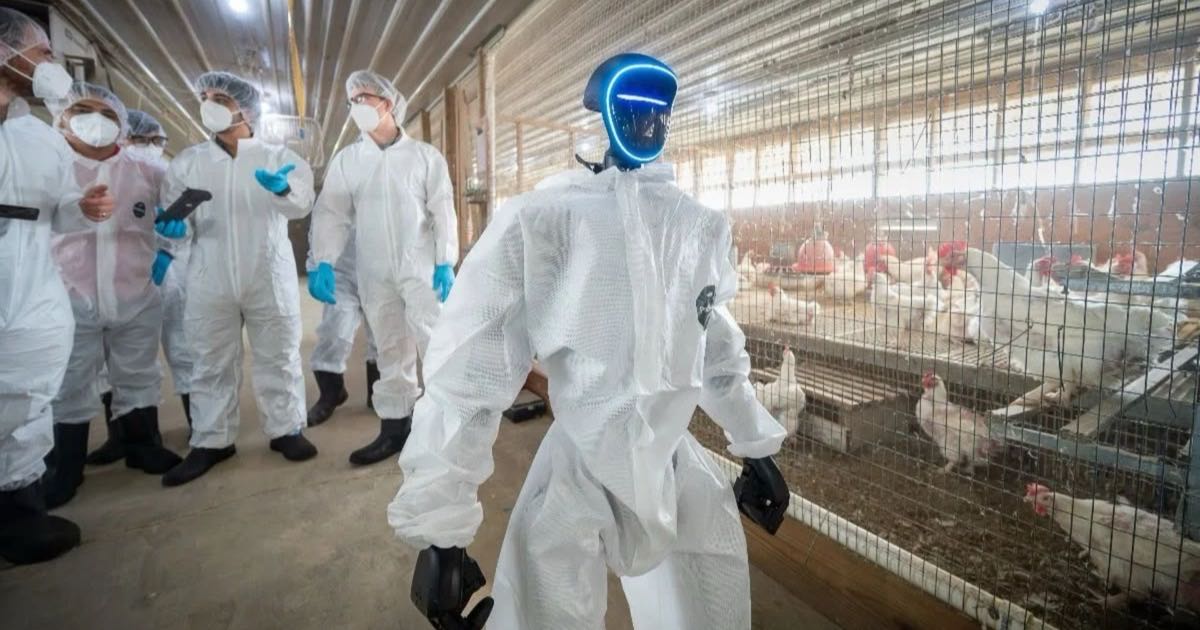
Researchers at North Carolina State University’s Artificial Intelligence & Robotics (AIR) Lab are building Howl, a roughly four-foot-tall humanoid built on a Unitree G1 base, that detects and retrieves eggs laid on the floors of cage-free poultry houses. The project, first picked up by Interesting Engineering on November 17 and noted by agricultural outlets including All About Feed the day before, is aimed squarely at one of the unglamorous cost lines of the modern egg industry: the floor egg.
Why floor eggs are a robotics problem
The cage-free transition changed the job description of egg collection. In cage systems, eggs roll onto conveyor belts and machinery does the gathering. In cage-free barns, hens can lay anywhere, and the eggs that miss nesting boxes — floor eggs, in industry language — have to be collected manually. Depending on the house, they can account for 2% to 15% of total production, and according to the IE report, a farm with around 100,000 birds could be looking at as many as 15,000 eggs a day that a human has to find and lift, with delays cutting into quality.
Those are the numbers that make a walking robot interesting rather than ridiculous. A quadruped can’t open an egg’s grip off concrete without cracking it. A wheeled robot can’t reach under slatted flooring or between feeder lines. The task needs a body something like a human’s — small enough to navigate a barn, two arms with fine enough control to lift a fragile object off the ground. The unit economics also pencil differently from warehouse humanoids: 15,000 repetitive picks a day is a full-time picker’s nightmare, and it repeats seven days a week.
Training a robot by showing it
The AIR Lab’s method is mostly demonstration-based. As the IE report on the project describes, researchers use VR manipulation to demonstrate tasks and program robotic movements, combined with reinforcement learning and imitation learning so Howl learns to detect eggs on the floor, approach, and pick them up with its hands without breaking them.
Egg-detection and retrieval simulations are expected to finish before practical demonstrations, with the team aiming to have the robot performing tasks in a real barn by early 2027. That timeline honesty is worth crediting: this is not a “deploying next quarter” story, it’s a research project with a stated two-year path.
The egg robot is one part of a broader NC State push into poultry data. The same lab is building Poultry Talk, a retrieval-augmented AI assistant trained on curated poultry-science literature rather than the open web, plus computer-vision bird health monitoring — a sign that the university sees eggs as a data problem as much as a labour problem.
The agri angle the warehouse crowd skips
Humanoid coverage concentrates on car plants and Amazon-style warehouses. Agriculture is arguably a better first customer for short humanoids, because barns were never designed around machines. And the Unitree G1 keeps showing up as the platform-of-choice for exactly this kind of academic experimentation — cheap enough for a university lab to buy several, capable enough to walk uneven ground. NC State’s Howl joins UPenn’s artificial-muscle fine-control work and Booster Robotics’ T2 at Web Summit as evidence that the G1-class platform is becoming agriculture and research’s default humanoid chassis, much as LG’s Kiria safety-certification push targets the service side.
For New Zealand the story has a direct hook: the country legislated its own cage transition, with conventional battery cages banned from January 2023 and the national flock splitting across colony cages, barns and free-range — the barn and free-range share of that carries the same floor-egg economics as anywhere hens roam. NZ’s egg industry is small, but the labour problem is identical: seasonal workers, awkward physical work, and no domestic robotics industry to solve it. Whether the eventual buyer of a barn-ready Howl is a Waikato egg operation or an American integrator, the pattern holds: humanoid robots are arriving first where the work is repetitive, fragile, and underneath something.
Further reading: why the G1 keeps winning academic deployments, UPenn’s work on robot finger dexterity, and LG’s service-humanoid safety push.