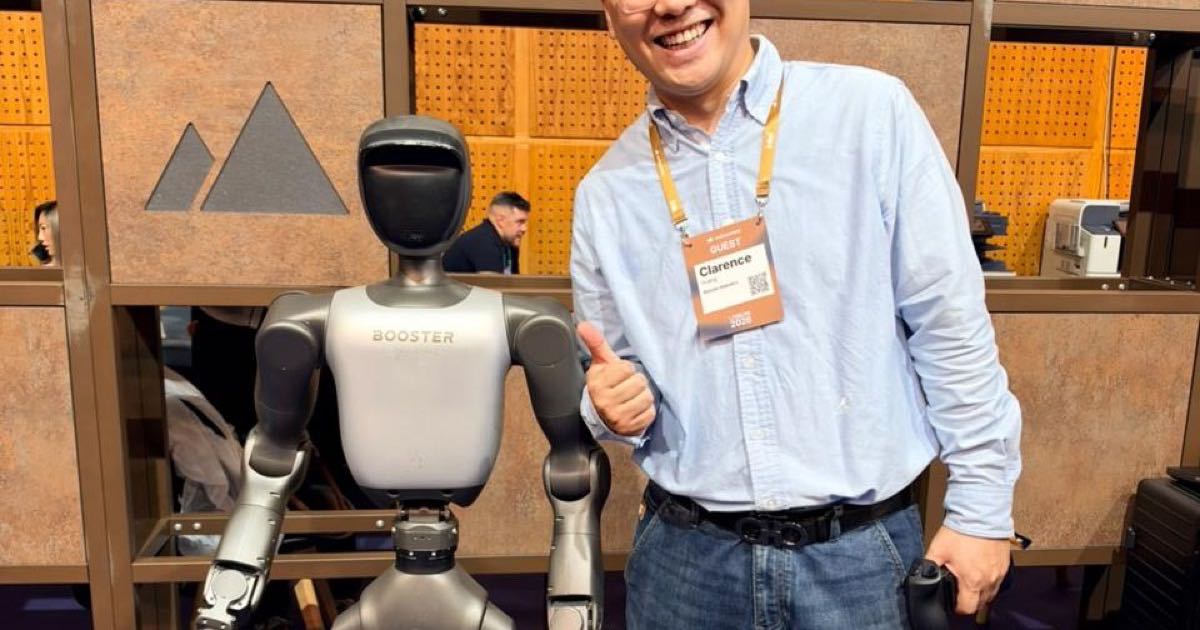
A useful tell in robotics right now: ask a humanoid founder who their customer is. The companies chasing Figure and Tesla Optimus usually describe an industry — logistics, manufacturing, home help, someday. Booster Robotics’ CEO Clarence Huang describes a developer. “We provide a very open platform,” he told Forbes’ John Koetsier at Web Summit in Lisbon last week. “We give full access to APIs and SDK.”
The pitch, in Huang’s own telling, is “like Android in mobile phones, but for humanoid robots” — Booster sells the body, the runtime and the toolchain, and the customer supplies whatever intelligence runs on top. It is the picks-and-shovels version of the humanoid boom, and it comes from one of the more credentialed hardware teams in China: the company was founded about three years ago by people out of Tsinghua University’s humanoid robotics research program, which claims roughly two decades of bipedal experience.
The T2, as shown at Web Summit
The Web Summit 2026 conference ran November 9-12 in Lisbon, and the T2 on Huang’s stand is Booster’s current flagship. The specs, corroborated across Forbes’ show report, independent humanoid spec trackers and launch coverage: 1.4 metres tall, about 42 kg, 31 degrees of freedom (six joints per leg, seven per arm, three in the waist, two in the head), 10 kg combined arm payload, and 140 Nm peak joint torque — enough, per the company’s launch coverage, to kick a football hard enough to damage a wall.
Three details stand out for anyone scoring the platform pitch:
Swappable hands. Third-party end effectors — standard grippers or 6-DoF dexterous hands — interchange on the same arm. A robot that treats its own hands as an SDK target is a robot that means the developer-pitch seriously.
Runs while charging. The ~2-hour battery is hot-swappable in the sense that matters: the robot can keep standing and working through a magnetic charging connection. Huang’s pitch to buyers is “a full eight-hour shift” at a fixed workstation — the robot works, tops up, works. That is the least sexy and most commercially important number in the spec sheet, because shift continuity is the difference between a pilot and a purchase.
The compute is NVIDIA’s Jetson Thor T5000. The Professional Edition ships with the full-fat module — up to 2,070 TFLOPS of FP4 sparse compute onboard, per Huang, which is enough to run perception, multimodal understanding, task planning and whole-body control in a real-time loop on-device. As the company put it in its T2 launch materials: “2070 TFLOPS is not the goal in itself, what matters is that this compute enables visual perception, multimodal understanding, task planning, and whole-body control to run in a real-time closed loop on-device. In short, the robot no longer executes isolated actions, since it perceives, judges, and acts continuously.”
The software layer is Booster Studio, launched in June, which runs the same codebase in simulation and on the real hardware with AI-assisted code generation — the standard sim-to-real promise, this time from the platform vendor rather than the robot-owner.
Why “body without brain” sells in 2026
The geopolitical context is doing real work in this pitch. The United States has already moved against Chinese robots on security grounds — the FCC adopted import restrictions on certain Chinese-made robotic devices this year over data and “robot spy” concerns, a story we covered when the ban landed. Forbes frames the T2’s body-only pitch as a direct read of that market: a buyer who loads their own model onto Booster’s open platform gets the compute and the chassis without the embedded-AI exposure that comes with a closed stack from a company Beijing could lean on.
Whether that logic survives contact with procurement is another matter — the same regulators who worry about embedded AI do not obviously want NVIDIA’s fastest edge module sitting in a networked foreign robot either. But the positioning is smart either way: Booster is not competing with whoever wins the “robot brains” race. It is selling to them.
Booster is not competing with whoever wins the “robot brains” race. It is selling to them — and it is not the only one: NVIDIA has been pushing hard in the other direction lately, shipping smaller Thor modules like the T3000 for half the power, while Hong Kong’s D-Robotics banked $400M to be the picks-and-shovels vendor selling chips and software to rival Chinese robot makers. There is room in this market for more than one farmer’s catalogue.
As for whether the humanoids themselves are ready — the training-data bottleneck that SuperMimic’s 1000x collapse claims to fix, and LG’s recent humanoid safety-certification work with Kiria, are both aimed at the gap between a working demo and a deployable product. Booster’s answer is to make that someone else’s problem: the platform sells today, the brains keep improving on top of it. The Android comparison is doing a lot of work — but on hardware evidence alone, the T2 is the most credible claim on the position yet. A 31-DoF body with swappable hands and a hot-swap work charger costs less to develop against than a closed $100k machine, and unlike most of the 470 other humanoid models, it is genuinely available.
For New Zealand, the platform-not-product framing is the first humanoid pitch that maps onto how a small economy would actually buy robots. Nobody here is ordering 10,000 integrated Optimus units; a research lab or an agri-tech integrator ordering a 1.4m open body, writing its own task logic, and bolting on a local end effector is a plausible first customer — exactly the buyer Booster is courting. The open-platform model also lowers the trust barrier that has been the real blocker for Chinese hardware in Western procurement: auditable APIs beat opaque stacks in any security review, even if the review’s conclusion ends up being “not yet,” as the US import-restriction debates already show.
The irony worth holding onto: Booster is a Chinese company whose flagship product runs what is effectively an American supercomputer. China is spending billions on domestic robot silicon — D-Robotics’ Sunrise S600, which counts Booster as a named customer, is one such bet — and Booster still ships the Thor T5000 because developers want proven compute today. The humanoid industry’s supply chain is genuinely global, genuinely interdependent, and genuinely one export-control headline away from awkward. Booster’s entire strategy is to be the part that survives all of it: the body everyone can build on.