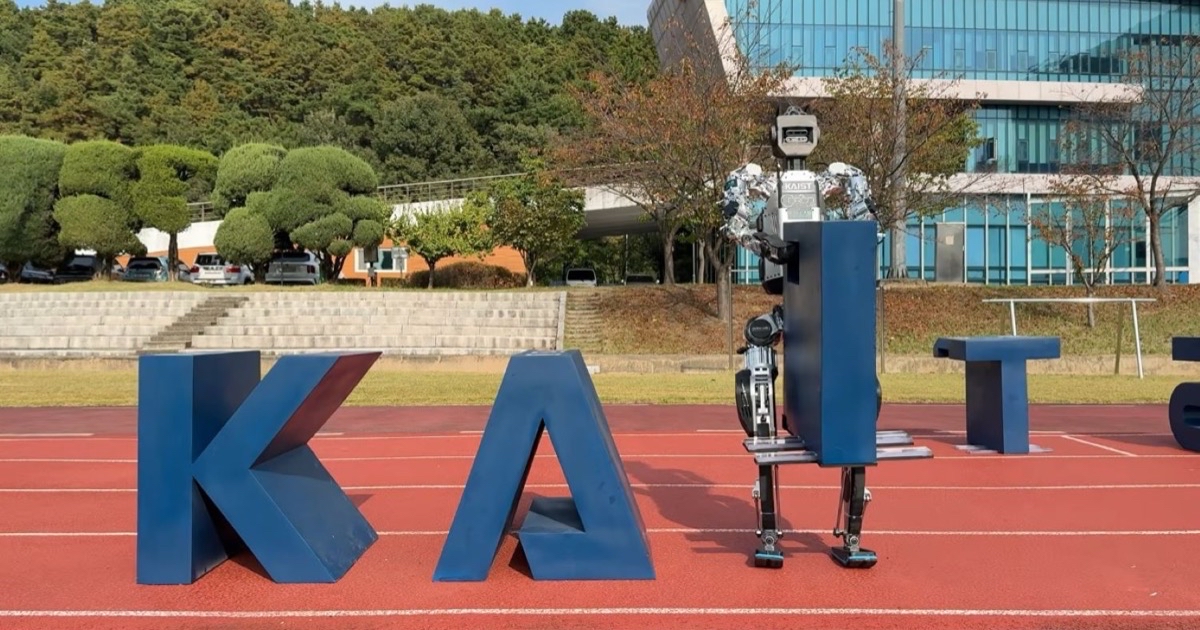
KAIST has published a demonstration that quietly resets one of humanoid robotics’ most-misused numbers. Its Humanoid v0.9 pushes loads up to 35 kilograms (77.2 lb) while walking and lifts roughly 20 kilograms (44.1 lb) on the move — and the lab is scrupulous about which is which.
🔍 THE BOTTOM LINE
The interesting part of this demo is not the 35 kg — it is the honesty about the difference between pushing and lifting. Pushed loads lean on friction with the ground; lifted loads hang entirely off the robot. A field that has learned to distrust press-release kilogram claims now has a research lab drawing exactly the distinction the hype usually elides, and the method underneath (whole-body RL with onboard vision) is the real story.
What the video actually shows
KAIST released the footage on 19 October under the title “Whole-Body Locomanipulation with KAIST Humanoid v0.9,” and Gadget Review’s write-up walks through what is on screen: the robot strolls across the campus track shoving big blue letter blocks — the KAIST sign itself among them — maintaining gait while its upper body does the work. Onboard vision handles object detection and adjustment in real time. No external cameras, no mocap suit, no crane cables.
The technical label matters. Whole-body locomanipulation means legs, torso and arms are coordinated simultaneously while forces flow back from the manipulated object into the robot’s own balance loop. Push a heavy box and the reaction force travels through your arms into your spine into your feet — every step has to re-solve stability with a moving external load in the loop. That coupling is what separates this from a bipedal walking demo with the arms parked.
How it was trained — and what is not disclosed
According to Humanoids Daily, the control stack pairs deep reinforcement learning with learning from human demonstrations, and the vision system lets the policy adjust movements mid-task. The exact division of labour between the RL policy and the demonstration data is not fully detailed in available reporting — worth flagging, because “RL plus demos” describes a family of very different training pipelines.
Context for the platform: v0.9 is the same humanoid that previously demonstrated high-speed running and a Moonwalk-style gait — lower-body agility showcases. This demo extends the platform into visually guided object handling, which is arguably the more commercially relevant half of the stack. A robot that can run but not touch anything is a camera on legs.
The kilogram problem in humanoid demos
Here is the angle our own coverage keeps circling: payload claims have become the least comparable number in the industry. Specs conflate dynamic push force, static hold strength, payload at full extension, and what gets dropped over a long shift. The global shipment race is already moving past 22,000 units in six months, and most of those robots are still searching for the work they will actually do — which makes honest capability accounting, of the kind this KAIST demo practises, worth more than another headline number.
Pushing is genuinely useful — warehouse logistics, sheet materials, wheeled carts. It is also cheaper to claim. A 35 kg pushing demo sells a press cycle; a 20 kg lifting demo while maintaining gait is the harder engineering problem, and KAIST did the harder one at the same time as the easier one. Interesting Engineering’s coverage leads with pushing and buries the distinction — precisely the reading habit we should all be untraining.
Why labs like KAIST matter more than spec sheets
The research-lab demo occupies a useful position in the hype pipeline: no product to sell, no pre-order page to feed, therefore no incentive to blur push into lift. That is exactly why this video is worth a slot on a site that spends most of its humanoid coverage on the commercial race — Chinese factories, IPO filings, warehouse pilots. For readers calibrating what “35 kg” means next time a startup flashes it, this demo is a calibration point delivered by one of the groups least tempted to inflate it.
The work pairs naturally with the other end of the manipulation stack: Kyutai’s REKI gave robots a working memory in just 2.4 billion parameters, and Faraday Future’s $2,490 FF Nova tried to undercut the humanoid price floor. Brains getting smaller and cheaper here; bodies getting honest about numbers there. Both ends are needed for the third one — robots that actually do the work.
❓ FAQ
What did the KAIST robot actually do? At the 19 October demo it pushed loads up to 35 kg (77.2 lb) while walking and lifted up to about 20 kg (44.1 lb), coordinating balance through its whole body using onboard vision and deep-RL policies with human-demonstration learning, as reported by Gadget Review.
Why is pushing easier than lifting? A pushed object is partly supported by the ground through friction — the robot supplies only force. A lifted object is supported entirely by the robot against gravity. They are different problems wearing the same number.
Is 35 kg a lot for a humanoid? For context, an average adult comfortably pushes well above that; many industrial robots lift far more. The milestone is doing it while walking, on onboard vision, with balance maintained — not the raw figure.
Did KAIST release full technical details? Not yet beyond the video. The precise split between RL and human-demonstration learning has not been fully documented in available reporting; a paper or longer technical release may follow.
🔍 THE BOTTOM LINE
Treat every humanoid payload number with a two-question audit: pushed or lifted, and while doing what else? This KAIST demo passes both — which, ironically, is what makes its smaller lifting figure more impressive than most of its competitors’ bigger ones.
📰 Sources
- Gadget Review
- Humanoids Daily
- Interesting Engineering
- KAIST DRCD Lab video