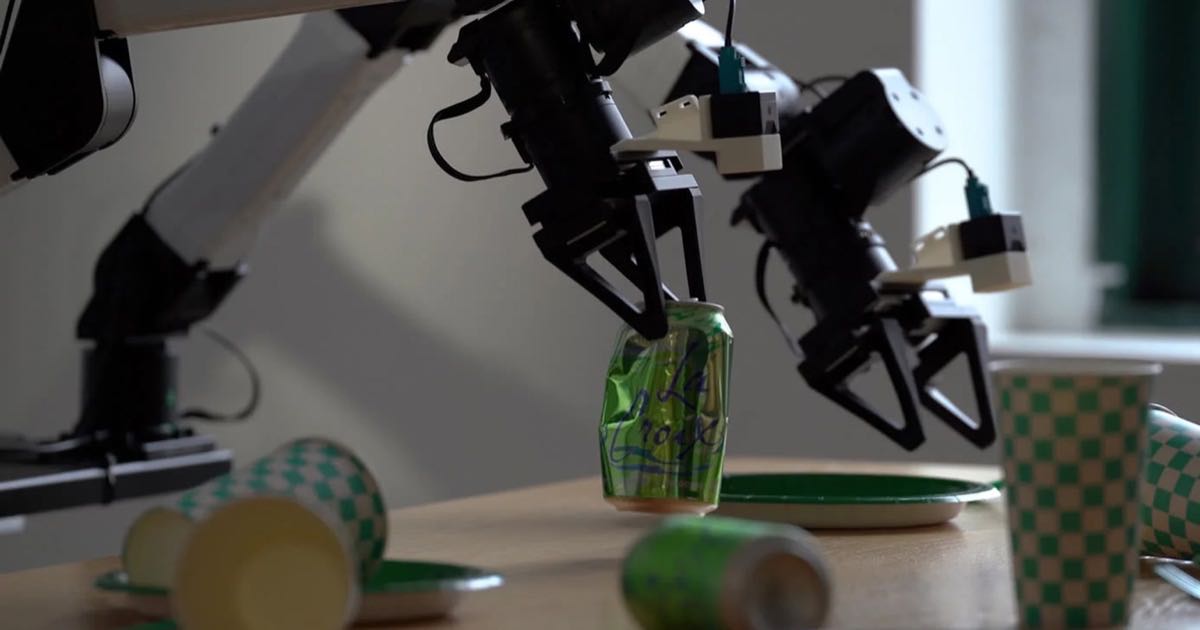
French open-weights lab Kyutai, working with Inria and École des Ponts, has released REKI, a 2.4-billion-parameter vision-language-action (VLA) model for robot manipulation with a genuinely different take on robot memory — and they have put the whole thing out in the open: weights, code, training pipeline, and deployment stack.
The headline claim from the paper on arXiv is a new “Pareto frontier between performance and model size”: pretrained entirely on public data, REKI scores highest among comparably sized models on LIBERO-Plus, a benchmark that deliberately stresses manipulation policies with perturbed cameras, lighting, and layouts, and on the RoboTwin and RoboCasa365 suites it is beaten only by models roughly twice its size. The numbers on the released LIBERO checkpoint are strong — a 97.6% mean success rate across the four LIBERO suites and 90.4% overall under LIBERO-Plus perturbations.
Memory is the actual story, though, because it attacks the most common failure mode in robot manipulation. VLA models typically decide each moment from a narrow observation window; when a robot revisits an earlier step — putting a tool down, returning to a part — it can oscillate between poses because nothing in the current frame tells it where it has been. REKI’s answer is memory that lives in the action expert rather than the language backbone: 32 learned register tokens per frame cross-attend the encoded prompt and camera views, and crucially self-attend earlier frames’ registers, so each action carries a compressed trace of recent history. The team reports this makes pose oscillations “about four times rarer” in simulation and on a real arm. On a finetuned UR5 arm, three thousand training steps — about an hour on 50 demonstrations per task — got the policy running on real hardware, with inference on a single H100.
Everything is downloadable: base and finetuned checkpoints on Hugging Face under CC BY-NC-SA 4.0, code under MIT on GitHub, with the full stack from data curation through training to deployment included. The backbone is a Qwen3.5-2B vision-language model; on top of it a 200M-parameter expert generates action chunks in ten Euler steps via flow matching. Early coverage by hermes-ai.net framed it as a 2.4B robot brain beating models twice its size, which is roughly right, with one honest caveat the team states themselves: the benchmarks are simulation, and the released LIBERO card notes there is no real-robot or safety evaluation beyond the single-arm UR5 demos.
Here is why that matters more than another leaderboard shuffle. The VLA race has mostly been a scale race — bigger backbones, more data, more GPUs, with the working assumption that robot intelligence arrives by brute force. REKI is a data point for the opposite bet: that architecture tricks (register tokens as cheap memory; virtual training data doing the heavy lifting elsewhere) can buy reliability at a size a university lab or a startup can actually run. A 2.4B model on one GPU is the difference between robotics research gated on capital and robotics research gated on ideas. It also fits the broader open-weights current on this site — a fully open-source humanoid arriving ahead of the corporate ones — and lands in the same week a major robotics company went public, testing whether the market funds hardware-first players while the software layer keeps getting cheaper.
The NC licence on the weights (non-commercial) tempers the celebration: labs can build on REKI, most companies cannot ship it. But for a field where the frontier keeps being privatised, a public-data model that matches the big boys — with the oscillation fix documented and reproducible — is the kind of release worth more than its benchmark table. The Pareto frontier framing is the right one: it is not claiming to be the best robot brain in the world, only the best at its size, and at this size that is enough to matter.
Sources