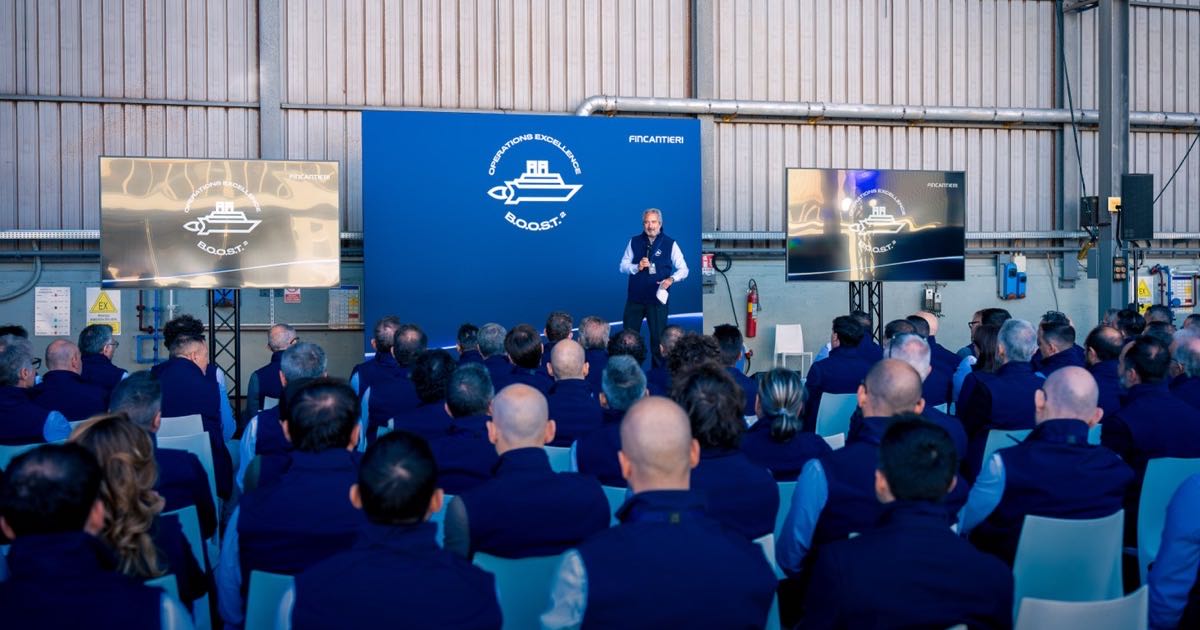
Italian shipbuilding giant Fincantieri has flipped its robotics program from experiment to rollout. The company’s BOOST² — “The Shipyard of the Future” initiative, carrying almost US$100 million in investment through its 2026–2030 industrial plan, has entered a new phase presented this week at the Castellammare di Stabia shipyard, and the shift is explicit: less technology scouting, more industrial deployment at scale across the group’s entire yard network.
The scale of what is being coordinated is easy to miss. Per MarineLink, BOOST² has engaged more than 450 employees across 13 Fincantieri shipyards over three years — facilities in Italy and Romania, plus the company’s US yards including Marinette Marine in Wisconsin, where the US Navy’s frigates get built. At the Castellammare event, the company showed technologies already running in production alongside systems still in validation. The tech stack is broad: collaborative robotics designed to assist workers on complex tasks like welding and block assembly, digital twins managing yard assets and production flow, smart supply chains, additive manufacturing, and automated industrial equipment.
Fincantieri’s CEO Pierroberto Folgiero put the thesis in one line worth quoting: “The next frontier of industrial competitiveness is bringing artificial intelligence into the physical world, integrating it with robotics and the expertise of our manufacturing workforce.” His follow-up — the challenge now is to “accelerate their industrialization and adoption at scale, transforming innovation into productivity, safety and quality” — reads like an executive telling his own organisation that the demo era is over.
Now the part that is ours, not the press release’s.
The interesting thing about shipyards as a physical-AI proving ground is that they are the opposite of the environment where robots shine. Automotive assembly is fixed-rate, structured, and repetitive — perfect for automation, which is why car plants went dark decades ago. Shipyards build one-off megaprojects: curved hulls measured in metres, cramped blocks, tolerances fought for rather than given. If collaborative robots earn their keep here, working beside humans whose jobs become supervising and installing the machines, that is a much stronger signal than another car-factory win. Europe’s shipyards also face a compounding labour squeeze — Fincantieri has for years run hiring programs to replace a retiring workforce — so the automation push is as much about capacity economics as innovation theatre, and the company’s defence-linked order book (it builds naval vessels) makes throughput a strategic number, not just a commercial one. And note the money: almost $100 million across five years and 13 yards is old-economy money, spread thin and ROI-driven — nothing like the sums moving through AI datacentre builds, which tells you the real pace of industrial adoption. Small, staged, accountably incremental.
Honesty note: this is a company-supplied announcement, recycled across maritime trade press (MarineLink, Maritime Executive, Shipping-Now all carry it), and the $100M figure comes from Fincantieri’s own industrial plan rather than an independent audit. That does not make it wrong — Fincantieri has a multi-year track record of shipping on the program — but the proof will be yard-floor deployment counts over the next two years, not launch events.
For New Zealand’s small advanced-manufacturing sector, the takeaway rhymes with what the site keeps finding: physical AI at scale looks less like a lights-out factory and more like pricing the value of a human workforce against the machine that supports it — and the yards that do it first will be the ones whose countries can still build things. That is worth watching from a country that used to.
Sources
- Fincantieri press release — Shipyard of the Future (14 Oct 2026)
- MarineLink — Shipyard of the Future will be Built on Robotics, AI (14 Oct 2026)
- The Maritime Executive — Fincantieri accelerates robotics and physical AI (17 Oct 2026)
- Shipping-Now — Shipyard of the Future will be Built on Robotics, AI