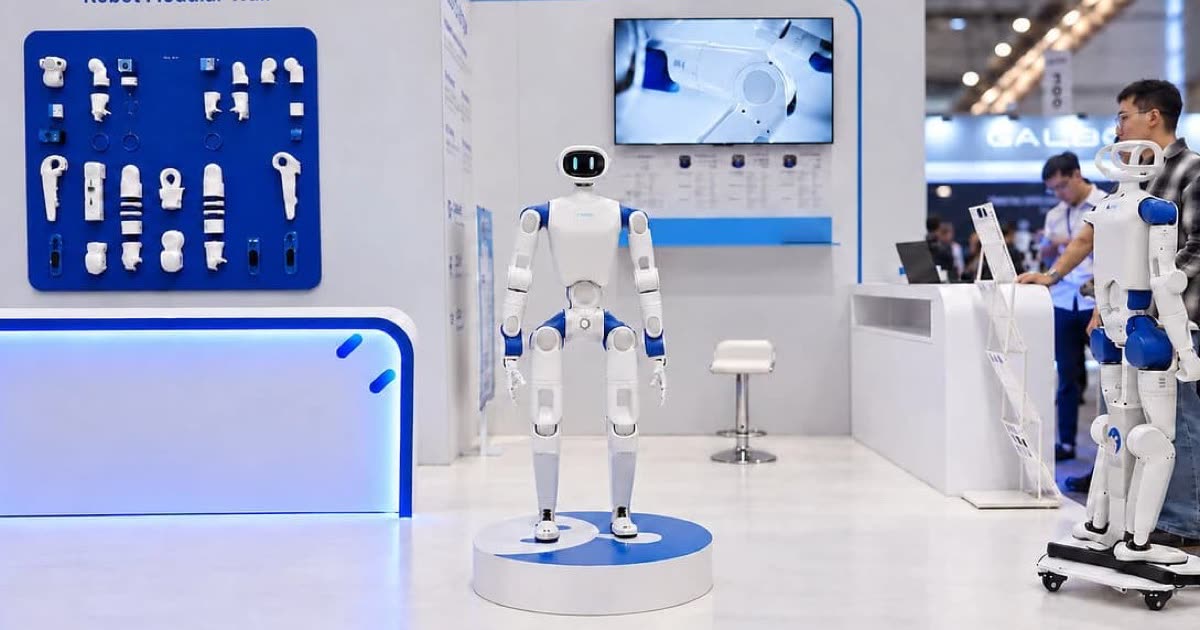
Most humanoid robot launches are showroom events — controlled lighting, choreographed loops, a rope between the audience and the machine. RoboParty’s debut of its RP1 humanoid at IROS 2026 in Pittsburgh on September 28 took the opposite approach: the booth sign said “Kick Me”, and visitors were invited to do exactly that. The robot, per the company’s October 3 announcement, adjusted its posture and recovered its balance each time, and kept doing so through a full day of push-and-shove traffic.
RoboParty, a robotics company founded by Yi Huang, is positioning RP1 (short for ROBOTO 01) as the world’s first “high-performance full-stack open-source” bipedal humanoid — a machine aimed not at warehouses or factory lines but at researchers, educators, robotics developers and embodied-AI teams. The announcement was picked up within a day by Humanoids Daily and RobotToday, both of which framed the launch the same way: interesting hardware, genuinely open plan, unproven release record.
🔍 THE BOTTOM LINE
RP1 is a bet that the next phase of humanoid robotics is infrastructural, not product-shaped — that someone will own the layer everyone builds on, the way Linux owns servers. RoboParty has the roadmap and the track record from its first open-source robot; what it doesn’t yet have is a released RP1 stack. Until that lands, “full-stack open source” is a promise with a Q4 deadline.
The “Kick Me” demo, and what it actually proves
The booth demonstration was the launch’s centre of gravity. Visitors directly applied external disturbances — pushes, kicks — and the company reports that RP1 “rapidly adjusted its posture and recovered its balance,” with the open interaction designed to show dynamic stability under real disturbances rather than a predefined motion loop. RobotToday’s independent summary of the launch noted the same demonstration as the robot’s headline capability.
It’s worth being precise about what that proves, because the demo genre has a long history. Balance recovery under repeated external perturbation is a genuine, meaningful benchmark — it’s the difference between a robot that can walk a choreographed path and one that can survive contact with a messy world. It is not, however, evidence of general usefulness, task competence, or reliability over time. Humanoids Daily’s write-up was careful on exactly this point, noting in its key takeaways that the full proposed stack is “not presented as available today,” and closing with the observation that for RP1, “the practical test will be whether outside teams can reproduce its demonstrated capabilities using the published designs, training resources and deployment tools.”
What’s actually open — and what isn’t yet
The honest structural story lives in the company’s own distinction between its two robots. In January 2026, RoboParty fully open-sourced its first humanoid, ROBOTO ORIGIN (RPO), which has since gathered more than 2,500 GitHub stars and inspired community builds and reproductions per the company’s announcement. That repository is live — mechanical and electronics designs, a ROS2 deployment framework, reinforcement-learning training code, simulation models and firmware. Humanoids Daily’s coverage noted that these resources are for ROBOTO ORIGIN, “rather than evidence that all equivalent RP1 materials have already been released.”
RP1’s own roadmap is still mostly prospective. The company plans to progressively release motion control, simulation environments, SDKs, training tools and the PartyOS development foundation; further roadmap details are promised for October, with broader hardware and software releases and a mass-production programme “later in Q4.” Pricing is undisclosed. The company’s stated philosophy is that humanoid robots shouldn’t be closed systems available only to a small group of well-funded teams — Huang’s quote in the release puts it plainly: “Humanoid robots should not be closed systems that only a small number of teams can build while everyone else can do little more than watch.”
Hardware claims, meanwhile, are company-reported rather than independently benchmarked: peak joint torque of up to 160 N·m, in-house “Romomo” actuator modules, and motion capability attributed to PartyOS and the UFO framework — “A General Unsupervised Reinforcement Learning Framework for Humanoid Control,” which trains low-level motion policies for skill transitions, disturbance recovery and fall recovery without relying entirely on predefined trajectories.
Why the open-source lane matters now
The timing isn’t accidental. The open-embodied-AI race has been accelerating all year, and mostly from China. AGIBOT opened ‘World 2026’, a large real-world training dataset for embodied AI; Unitree has been opening up its UnifoLM foundation-model work while its founder argues humanoids are two years from their ChatGPT moment. Boston Dynamics’ decision to strip Atlas’s hand down to four fingers showed the big incumbents are designing for manufacturability, not demos. RoboParty’s entry is the first full-stack attempt at hardware-plus-software openness in this lane — a different level of ambition than releasing a dataset or one software module.
RoboParty’s argument is the one open-source advocates always make: closed platforms plateau at the edge of what one company’s team can imagine. If RP1’s designs, training resources and deployment tools genuinely let a university lab or a two-person startup reproduce, modify and extend a full humanoid — hardware, actuators, motion control, training — the addressable population of humanoid builders stops being “whoever can afford a Unitree G1 plus an engineering team” and becomes “anyone who can operate a GitHub repo.”
The honest counterargument is also the obvious one: open-source humanoid projects have a habit of shipping repos that compile and robots that don’t, or robots that ship and repos that barely cover them. RoboParty’s RPO record is the strongest single piece of evidence that this team intends to follow through — it shipped a complete open humanoid stack and watched the community build on it. But RPO, by Humanoids Daily’s framing, is a prototype-class baseline; RP1 claims industrial-grade specs. Releasing a prototype stack and releasing a production stack are different promises, and only one of them has been kept so far.
❓ FAQ
What is RoboParty’s RP1? A bipedal humanoid robot unveiled at IROS 2026 in Pittsburgh on September 28, 2026, and billed by its maker as the first high-performance full-stack open-source humanoid. It is aimed at researchers, educators, robotics developers and embodied-AI teams rather than at commercial warehouse or factory deployment.
Is RP1 actually open source? Not fully yet. Its predecessor ROBOTO ORIGIN has been fully open-sourced since January 2026, with mechanical, electronics, firmware and training resources on GitHub. RP1’s motion control, simulation environments, SDKs, training tools and PartyOS foundation are planned for progressive release, with roadmap details promised in October and mass-production later in Q4 2026.
What can the RP1 robot do? Per the company’s IROS demonstration, RP1 recovered its balance when pushed and kicked by booth visitors, and demonstrated continuous motion, disturbance recovery and fall recovery. Company-reported specs include peak joint torque of up to 160 N·m. No independent benchmarking is available yet.
When can developers get RP1? RoboParty has promised further roadmap details in October 2026, broader hardware and software releases later in Q4, and a mass-production programme in the same quarter. Pricing has not been disclosed.
Why does open source matter for humanoids? Because reproducing, modifying and extending a robot platform is how research actually compounds — the way Linux, ROS and PyTorch each created ecosystems no single company could have built alone. If RP1’s full stack is genuinely released, it lowers the entry cost of humanoid research dramatically. The open-embodied-AI thread is already running — see our coverage of AGIBOT’s World 2026 dataset.
🔍 THE BOTTOM LINE
The RP1 launch is credible for one reason: RoboParty has already done this once. RPO shipped as a genuinely complete open-source humanoid at the start of 2026, community builds followed, and the company is now pitching the production-grade version of the same thesis. The part that should keep enthusiasm in check is the release sequencing — everything that makes RP1 “full-stack open source” is still ahead of the hardware, scheduled for a Q4 window the company hasn’t dated more precisely. Watch what actually lands in the repo through October. If the RP1 stack shows up the way the RPO stack did, this is the moment the open humanoid movement got its reference platform. If it slips, RP1 is a well-built robot with an open-source marketing wrapper.
📰 Sources
- PR Newswire — RoboParty Unveils RP1, a High-Performance Full-Stack Open-Source Humanoid Robot at IROS (October 3, 2026)
- Humanoids Daily — RoboParty Unveils RP1 Humanoid at IROS, Plans Broader Open-Source Release in Q4 (October 4, 2026)
- RobotToday — RoboParty Launches RP1 Humanoid at IROS, Plans Open-Source Resources for Q4 (October 4, 2026)
- ROBOTO ORIGIN GitHub repository (company materials)