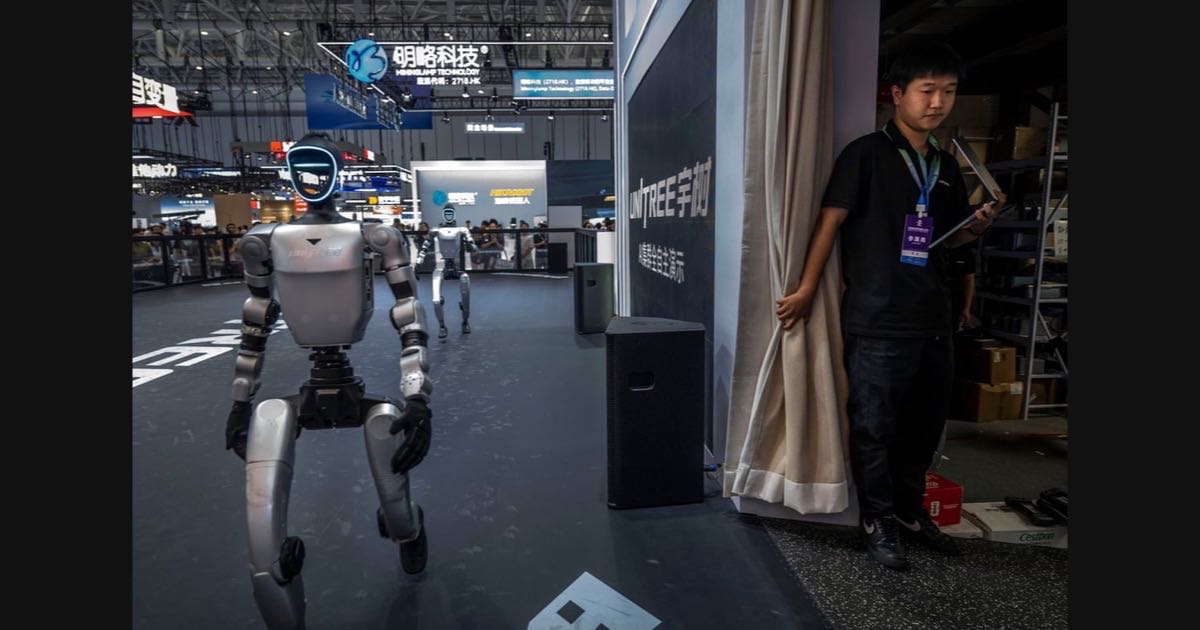
The world’s cheapest capable humanoid robots didn’t come from a strategy deck. According to extensive reporting by Beijing-based Caijing Magazine, they came from one man who decides the colours of materials, the lengths of individual screws, and whether an employee’s expense claim is worth more than 100 yuan — about $15.
The profile, “The King of Unitree,” was published on August 31 and translated into English by ChinaTalk on September 10; Ars Technica’s Jeremy Hsu pulled it together with the company’s financial context this week. Its subject, Wang Xingxing, founded the company whose $13,500 G1 and $4,900 R1 have done more than any other products to make walking robots affordable — and who became, per Ars, “phenomenally wealthy” when Unitree listed on the Shanghai Stock Exchange’s STAR Market on August 19.
Worth saying up front: Unitree pushed back on this reporting, telling other Chinese media outlets that Caijing’s feature contained substantial “misinformation” without specifying which claims it disputed. What follows is what Caijing’s interviews with employees and investors describe, per Ars Technica’s write-up.
Micromanagement as a design philosophy
The picture Caijing paints is of a founder whose obsessive control is indistinguishable from the product strategy. Wang — a hardware structural engineer by background — personally decides nearly every aspect of corporate strategy and product design. He posts in work chats at 2 or 3am, spends most of his time in the office including weekends, and cuts off employees mid-sentence when a conversation stops being about the business.
With no formal management structure, employees queue to get decisions past him. Every expense reimbursement over that 100-yuan threshold needs his personal sign-off. At 480-plus employees, per Rest of World, that’s a queue.
The incentive system, employees told Caijing, runs overwhelmingly on penalties rather than rewards — workers reportedly compare who receives less criticism, and Wang is said to have scored every senior executive a 1 on a scale of 0 to 1.5. One longtime employee claimed 2025 and 2026 saw “the highest attrition of core staff in Unitree’s history.”
What the cost-cutting bought — and what it cost
The engineering results are real and verifiable at retail: a baseline G1 humanoid for $13,500 and a consumer-oriented R1 at $4,900, prices that undercut Western alternatives by an order of magnitude and helped Chinese makers capture 97% of global humanoid shipments in the first half of 2026. Robotics hardware engineers told Caijing the cost advantage comes from design choices and structural engineering, not corners cut invisibly — Ars has separately documented the specific hardware decisions that make Unitree robots so cheap.
The tradeoff landed on quality control. Employees described an “extremely high” rate of returns for repairs in Unitree’s early years, though Caijing’s sources say that has since improved enough that the robots survive their six-month or one-year warranty periods without breaking down.
That detail — robots just good enough to outlast the warranty — is the single most revealing fact in the profile. It’s also the one that matters most as Unitree scales against rivals like AgiBot and UBTECH, because the founder-centric model that works at 200 people becomes a bottleneck at 480, and catastrophic at 4,800.
The AI turn
The other interesting reversal is intellectual. Wang has previously dismissed large world models as too compute-intensive for robots. Yet at the IPO, he described using large AI models as the foundation for a physical AI capable of “an autonomous loop of perception, decision, execution, evaluation, learning, and evolution,” according to Caijing.
Either the economics changed his mind or the market did; a listed company can’t pitch investors on being the world’s humanoid supplier while dismissing the AI stack the market assumes its robots will run. China’s regulators are meanwhile standardising embodied-AI training data nationwide — the NDAA data-standards push — which puts even a founder famously sceptical of big models on a path where big models are table stakes.
The honest reading of Caijing’s profile is that Unitree is a bet on one person’s taste and stamina, now with a public-market valuation attached and — if employees are right — a growing tail of departures behind it. Unitree says the portrait is misinformation. Both things can be checked over the next few years, in public, for the first time.