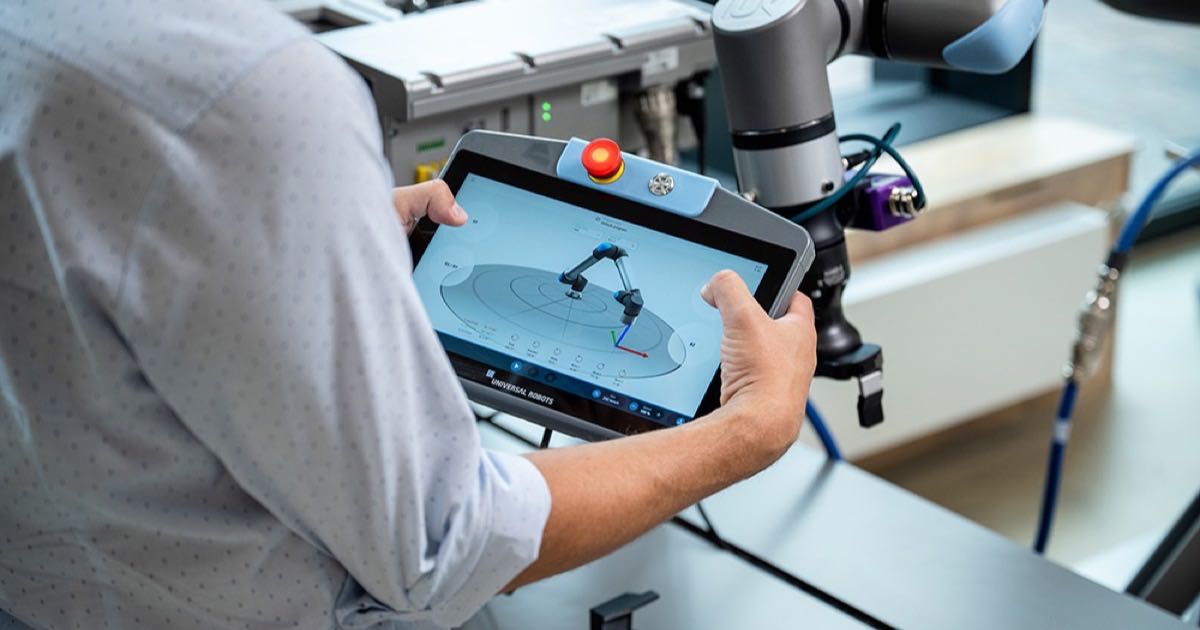
Universal Robots used the IMTS trade show in Chicago this week to launch Gen 7, the seventh-generation robotics platform from the company that effectively created the collaborative robot market. The Teradyne subsidiary didn’t just refresh a model — it re-engineered the control box, the teach pendant, and the tool flange, then wrapped the lot in PolyScope X, its newest robot operating system.
The pitch, delivered by Will Healy, director of product and industry marketing at Teradyne Robotics Group, is blunt: research is easy, deployment is the bottleneck.
“Our vision as a whole at the Teradyne Robotics Group is really to be this destination platform for physical AI,” Healy told The Robot Report at the show. “You can do research in a lab, but ultimately you have to deploy it. Our robots are absolutely uniquely suited to deploy for these companies that are trying to actually do AI in a factory.”
That’s the same bet Google is making with its Gemini-powered partnership with Fanuc — the idea that the value in factory AI sits in the last metre between a trained model and a moving arm. UR is arguing that metre is exactly what it already owns: a quarter-million installed cobots, and a safety architecture factory managers actually trust.
The numbers behind the rebuild
The centrepiece is the new CB7 core controller: 40% more compute in a 30% smaller footprint than the previous generation. That’s not vanity miniaturisation — the controller is built to talk to everything a modern plant runs: PLCs, HMIs, MES platforms, industrial PCs, and vision systems, through a managed Ethernet switch that lets IT teams route robot traffic where they want it. Connectivity that used to require external switches and a lot of arguing with the IT department is now a configuration screen on the robot.
Three new arms join the lineup alongside it, named for what they carry and how far they reach: the UR10g-1750, UR17g-1300, and UR18g-950. They’re noticeably larger than previous UR models, extending the e-Series and UR Series into payload territory the company historically ceded to industrial giants.
The subtler change is the tool flange. The new g-Series flange carries the vision and sensing that AI models need to run in real time, eliminating the cabling spaghetti that used to make camera-and-sensor integrations painful. UR’s argument is that physical AI dies in the wiring harness — so it deleted the harness.
Safety as the moat
The most quotable thing Healy said concerns what happens when an AI model issues a command the robot shouldn’t follow:
“The way we’ve built our stack, the way that the AI gives commands to the robot, still allows the robot safety controller the ownership over the robot and a decision whether to follow those instructions or not,” Healy said. “The robot will reject commands from the AI that don’t play nicely with the safety settings.”
In other words: the model proposes, the safety controller disposes. Gen 7’s architecture is PLd Category 3 certified under ISO 13849-1, the g-Series arms are TÜV-certified to ISO 10218-1 and UL 1740, and the platform carries IEC 62443-4-1 ML3 cybersecurity certification. PolyScope X brings open APIs and ROS 2 communication so programmers can run edge-AI applications — while the safety controller keeps veto power regardless of what the model wants.
That division of authority is what separates a deployable physical AI platform from a lab demo. It’s also the argument OpenAI and Google DeepMind are circling as they court robotics partners — both are racing to supply the intelligence layer, and UR is positioning itself as the body that intelligence lands in.
Why it matters
Teradyne’s recent earnings gave the company five consecutive quarters of growth, with AI adoption credited as a main driver — UR isn’t pitching physical AI from a position of weakness. And the cobot incumbent entering the AI era on its own terms is a structural threat to the wave of humanoid startups: the installed base, the integrator network, and the safety certifications don’t have to be built, only upgraded.
China’s humanoid makers are scaling volume fast — AgiBot alone shipped 8,400 units in the first half of 2026 — but their pitch is mostly price and new capability. UR’s counter is that the factory floor doesn’t need a new species of robot; it needs the robot it already trusts to run the AI it’s being sold. Gen 7 is that argument, rendered in aluminium.