If you want to know what’s different about the latest wave of warehouse robotics funding, skip the robot and look at the invoice. Boston-area startup Tutor Intelligence doesn’t sell machines and doesn’t run a conventional robots-as-a-service contract. Customers pay by the hour, or by the pick — the same way they’d pay a temp worker — with no upfront purchase and no long-term contract, while Tutor owns, deploys, and maintains the fleet. Andreessen Horowitz just led a $75 million Series B bet, announced Monday 2 November (US time), that this labour-style pricing is how general-purpose robots finally reach ordinary businesses.
The round, reported by The Robot Report and confirmed in a16z’s own announcement, takes Tutor to $117 million in total capital. Union Square Ventures and Neo — which led the Series A and seed rounds — came back in. Robrief’s coverage of the raise frames it the same way: robots rented out by the hour, not sold. Tutor spun out of MIT CSAIL in 2021 and is based in Watertown, Massachusetts. The announcement came Monday 2 November US time — early Tuesday New Zealand.
What the money is actually for
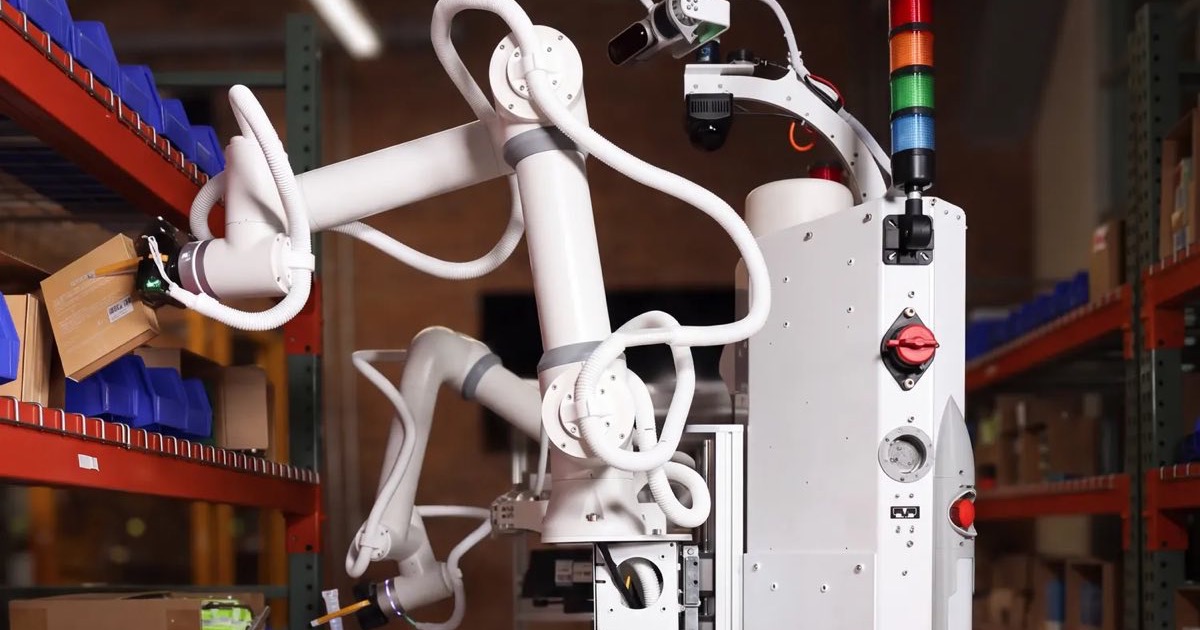
Tutor runs two robot models, both built and deployed from the United States. Sonny is a two-armed semi-humanoid for each-picking — grabbing individual items from bins and shelves. Cassie is a mobile manipulator that handles case picking and palletizing. Behind them sits what the company calls a Data Factory, opened earlier this year, which evaluates robot policies across 100 physical robots, and a fleet of internet-connected production robots supervised by remote human operators Tutor calls “tutors” — hence the name.
The growth numbers are the part worth lingering on, because they’re unusually specific for a funding release. According to Tutor’s figures cited by The Robot Report, twice as many Tutor robots are working in almost four times as many facilities as a year ago, the company is on track for more than 1,000 robots under contract by the end of 2027, and nearly a third of the organisations that received Tutor robots in the past twelve months were existing customers buying more. Repeat customers at a 33% rate is the single most convincing stat in the whole announcement — it suggests the hourly pricing works when billed against real completed work rather than promised.
“We can hardly build robots fast enough,” co-founder and CEO Josh Gruenstein said in the announcement — a claim that should be read as a funding pitch, but a funding pitch with purchase orders behind it.
Priced like labour, not like capital equipment
The strategic idea here isn’t the robots — it’s removing the capital-expenditure decision from the buyer entirely. A warehouse manager who would never get sign-off for a $200,000 automation system can justify an hourly line item that scales with throughput, and can walk away when volumes drop. Raghu Raghuram, a16z general partner and former VMware CEO, put the thesis in his investment note: “Deployment isn’t just the destination for robotics research — it’s how you overcome its limitations.”
That framing matters because it marks the second act of the RaaS wave. The first act — subscription contracts, per-site pilots, multiyear SLAs — ran into the same wall enterprise hardware always hits: a procurement process that stalls at the exact small and mid-sized businesses automation would help most. Billing by the hour or the pick is an attempt to collapse that purchase into an operating expense decision a shift supervisor can make.
The sceptical reading is equally simple: pay-by-the-hour only survives if utilisation stays high. Every idle, contracted hour is Tutor’s cost, not the customer’s, and warehouse demand is seasonal by nature. The model is a bet that Tutor’s fleet can stay busy across a portfolio of customers the way a labour-hire firm’s temp pool does — which is exactly why the 1,000-robot target for end-2027, rather than revenue per robot, is the number to watch. Tutor says the fleet already handles breakfast cereal, snacks, cosmetics and toys across some of the largest US manufacturing and logistics networks; whether a third robot repeats at that rate through a soft quarter is the real test.
The New Zealand angle
For a country with no volume warehouse-robotics industry and labour costs that make automation mathematically attractive, RaaS-adjacent models like this are the plausible entry point — New Zealand operators are never going to build robots, but hiring them by the hour for peak season is a decision a logistics manager can actually take to a board. The catch, as with every physical-AI service, is data residency and connectivity: the robots work locally, but the intelligence is trained abroad — which is precisely the dependency pattern New Zealand’s AI-in-government debate keeps circling. Warehouse automation priced like labour, trained on somebody else’s cloud, is coming either way — the interesting question is which economies will be running the Data Factories.
Tutor’s raise lands in the same week as Ultra Robotics’ $62M round for its OP-1 humanoid, another signal that warehouse automation capital is concentrating on flexible, learning-based machines rather than fixed arm cells — the pattern we tracked in Walmart’s warehouse robots hitting peak complexity and in AGIBOT’s push to make robot outputs a measurable productivity metric rather than a headcount story.