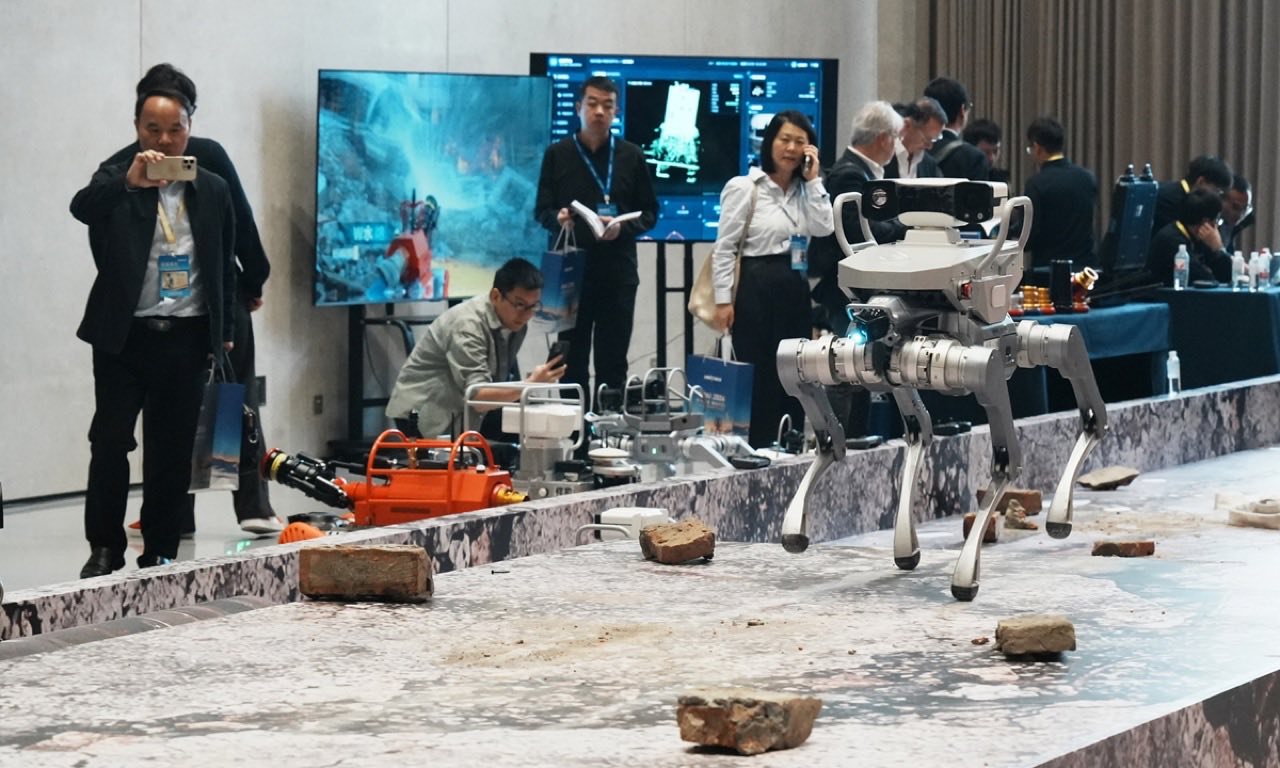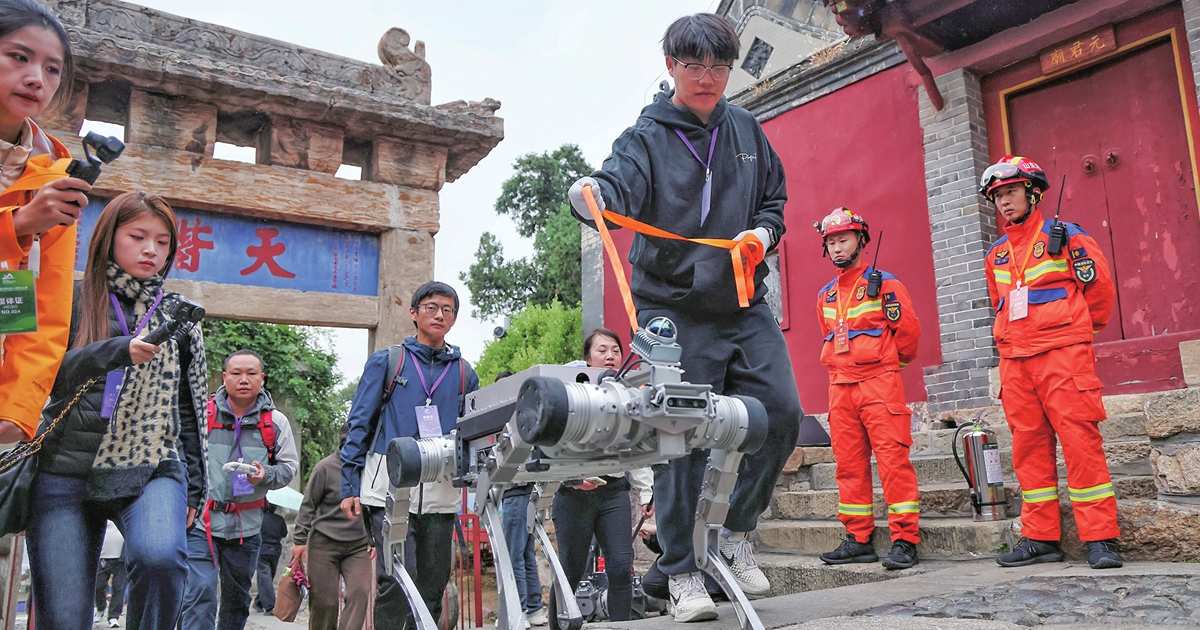
The next benchmark for legged robots wasn’t a lab test suite — it was 3,100 ancient stone steps on one of China’s holiest mountains, with a watermelon strapped on. On Monday 2 November, dozens of robots from around 90 teams raced up Mount Tai in Shandong province in the first CMG World Robot Mount Tai competition, a state-organised spectacle that doubled as the most public reliability test China’s robot industry has staged yet.
The numbers, as reported by CBS News carrying AFP’s report: over a 2.4-mile course with more than 1,970 feet of vertical gain, a quadruped made by Lingyi Technology — a subsidiary of industry giant Unitree — finished the four-legged speed category in 43 minutes and 41 seconds. Most tourists need at least two hours to climb the same route, according to CCTV footage cited in the report. The fastest humanoid, fielded by Beijing team Zhishen Lingyue, completed a shorter course in 27 minutes 26 seconds. Euronews also carried footage of the climb, and Global Times reported in late October that the qualifying phase had already drawn a large field to Tai’an.
Endurance tests, engineered for an audience
The race was organised by China Media Group, the state broadcaster, with cash prizes across four events: humanoid speed, legged speed, legged load-carrying, and all-terrain scouting. Organisers billed Mount Tai’s rugged terrain as a “natural extreme testing ground” for real-world robot use — and the terrain did not cooperate gently. One humanoid wearing a bandana collapsed on the cobbled route mid-race while engineers rushed in to repair it; another tumbled down a flight of stairs and came to rest beside a rubbish bin.
The load-carrying events were the more serious engineering statement. Robots were tasked with carrying fragile cargo — fresh eggs and watermelons — to the summit, which is a proxy for exactly the problem legged robots face in commercial deployments: not raw speed, but damage-free handling over uneven ground where a wheeled machine cannot go. A robot that can descend 3,100 worn steps without dropping cargo has demonstrated joint-level control, gait planning on irregular stone, and shock absorption that no static demo stage offers.
There is a second, harder-to-quantify function: the spectacle itself. A robot dog out-climbing tourists on a mountain every Chinese schoolchild knows is a national soft-power demonstration aimed well beyond the robotics industry — the same pattern we flagged when we covered the World Humanoid Robot Games in Beijing and, later, the gap between the Games’ spectacle and the industrial reality check. State staging turns benchmarks into broadcast content.
What the falls mean
The honest takeaway sits in both halves of the footage. The winning quadruped time — nearly an hour better than the average tourist — shows where legged robotics genuinely is: quadruped locomotion on irregular terrain is now a solved-enough problem to race on. The heap-on-the-cobbles humanoid shows where it still isn’t: bipedal balance recovery remains fragile, and the crash-prone runs happened exactly where the terrain was most human. That gap between the species is the state of the field, and it is why Unitree’s quadrupeds are shipping commercially while its humanoids remain mostly showcase products — as we noted when Unitree’s H2-X “kung fu guardian” robot launched and when the Hangzhou marathon put a humanoid on traffic duty.
For the wider world, the event matters less for the podium than for the dataset logic. Races like this generate exactly the varied-terrain locomotion data that simulation struggles to fake, and China’s robot ecosystem — with its state-backed events, dense supply chain, and Unitree’s pricing pressure — is currently the only place generating that data at festival scale. The falls are part of the product. Every humanoid that face-plants beside a rubbish bin on national television is a training example somebody’s model is now better for.