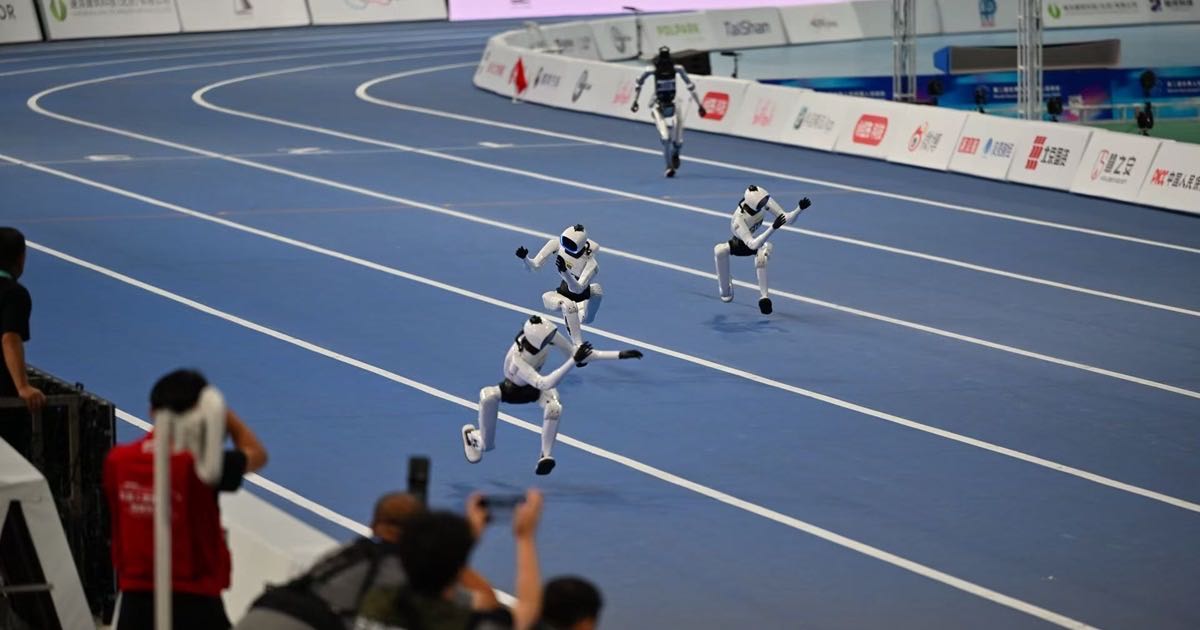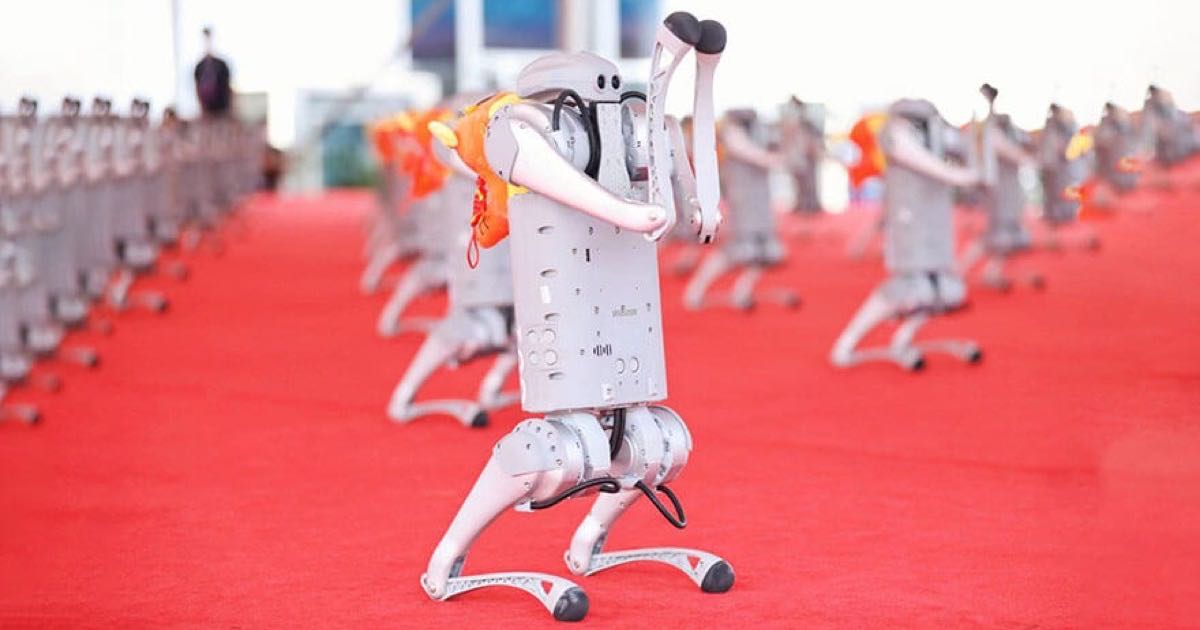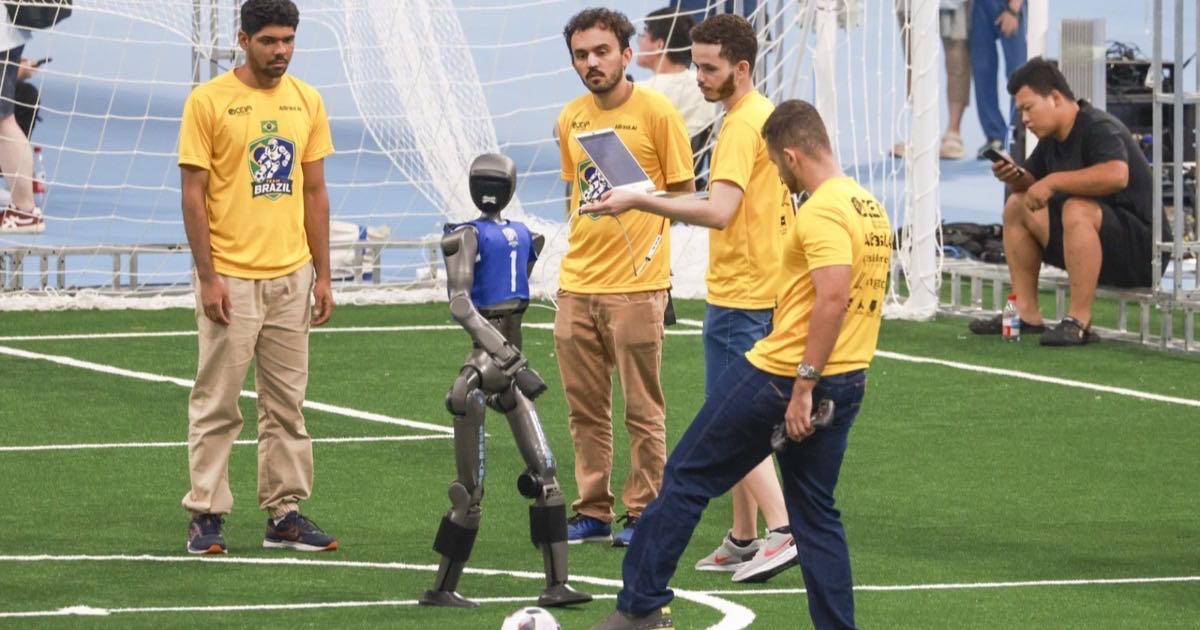
A humanoid robot thrashing on the floor like it is having a seizure. Another running headfirst into a wall and nearly splitting in half. These are the viral moments from Beijing this week, where the 2026 World Robot Conference and the second World Humanoid Robot Games have drawn hundreds of companies and thousands of robots to showcase the state of the art. The clips are funny. They are also the most honest thing the humanoid industry has shown the public in years.
The spectacle and the reality
At the World Robot Conference, which opened August 19, a humanoid robot lost control during a live demonstration after what CNBC TV18 reported was a remote-control failure. The robot fell onto its back and began rapidly moving its arms and legs across the exhibition floor. Several technicians rushed in but initially struggled to restrain the machine and manually switch it off. NDTV described the scene as resembling a human seizure.
Meanwhile, ahead of the World Humanoid Robot Games — which run August 22 to 26 — test footage of robots running into walls and falling during practice runs has been circulating widely. One clip shows a humanoid almost splitting itself in half after crashing headfirst into a barrier. Another shows a robot losing its balance during a walking test at the National Speed Skating Oval.
These are not obscure demo failures buried in a lab. They happened at the largest robotics event in China, in front of crowds, with cameras rolling.
What the Games are actually testing
The World Humanoid Robot Games have grown from 500 robots and 280 teams last year to 2,056 robots from 666 teams across 16 countries this year. The events are not just sports — robots compete in 51 categories including table tennis, weightlifting, tug-of-war, and breakdancing, alongside scenario-based tasks like assembling power tools, conducting fire rescues, and charging electric vehicles.
The rules distinguish between teleoperated and autonomous entries. Human operators are allowed in sporting events like long jump and kickboxing, but robots must act independently in breakdancing, cheerleading, and the 4x100-metre relay. Scenario-based events allow both modes, but teleoperated scores are halved. The structure is effectively a public benchmark — and the results are mixed.
Semafor made the point well: the clips of robots failing are “incredible content” but the Games also offer “an unvarnished look at the latest innovations in China’s humanoid industry — a public benchmark testing.” Western rivals often deride China’s flashy demos as preprogrammed theatre. They have a point. But the public nature of these failures is, paradoxically, a sign of an industry that is confident enough to be tested in the open.
The reliability gap
Here is what the viral clips actually reveal. A remote-control failure should not cause a robot to thrash uncontrollably on the floor. The fact that technicians could not immediately shut it down suggests the machine lacked a robust hardware kill switch — or that the switch was not accessible in the moment. A robot running into a wall during a walking test means its perception and navigation systems failed to detect and respond to an obvious obstacle.
These are not edge cases. They are the same reliability problems that the International Federation of Robotics flagged in its assessment of humanoid robots: cycle times, energy consumption, maintenance costs, safety, and productivity. The IFR’s position is that humanoids are more likely to complement existing industrial robots than replace them, because fixed robot arms remain faster, more precise, and more reliable for tasks that rarely change.
The academic consensus is similarly measured. An open debate at IROS 2025, summarised in Science Robotics, asked whether humanoids will replace the majority of human workers within 25 years. Before the debate, 80 per cent of the roughly 8,000 robotics experts who voted opposed the proposition. After the debate, that number rose to 90 per cent. The consensus: humanoids are more likely to assist, augment, and collaborate than to replace — at least within the next quarter century.
The investment paradox
What makes the viral failures jarring is the context. Unitree Robotics, one of the companies demonstrating robots at the conference, just IPO’d at a $53 billion valuation — about 210 times its 2025 revenue. Dealroom reports $8.7 billion in humanoid robotics venture funding through July 2026, nearly double the total for all of 2025.
Investors are pricing in a future where humanoids are reliable, useful, and cheap. The robots in Beijing this week are none of those things yet. That gap between valuation and capability is the real story behind the viral clips.
This is not a dismissal of the technology. The World Robot Conference featured 300 exhibitors and 150 product debuts. Some of the demonstrations — Unitree’s robots boxing and playing table tennis, for instance — are genuinely impressive. But a robot that can play table tennis and also runs into a wall during a walking test is a robot that is not ready for the factory floor, let alone the living room.
FAQ
What caused the robot to lose control at the World Robot Conference? Reports indicate a remote-control connection failure caused the robot to fall and thrash uncontrollably. Operators initially struggled to manually shut it off.
How many robots are competing in the World Humanoid Robot Games? 2,056 robots from 666 teams across 16 countries are competing in 51 events over five days in Beijing.
Do the viral failures mean humanoid robots are a failure? No. They show that the technology is still in a validation phase where public demonstrations expose real reliability gaps. The industry is well-funded and growing, but the gap between demo performance and real-world reliability remains significant.
Sources
- Mashable — Robots running into walls go viral ahead of 2026 World Humanoid Robot Games
- CNBC TV18 — Humanoid robot ‘throws a tantrum’ at Beijing conference after remote control fails
- NDTV — Robot malfunctions and suffers ‘seizure’ at China conference
- Semafor — China’s robot games offer look at latest innovations
- Donga Science — Experts see limited worker replacement by 2050