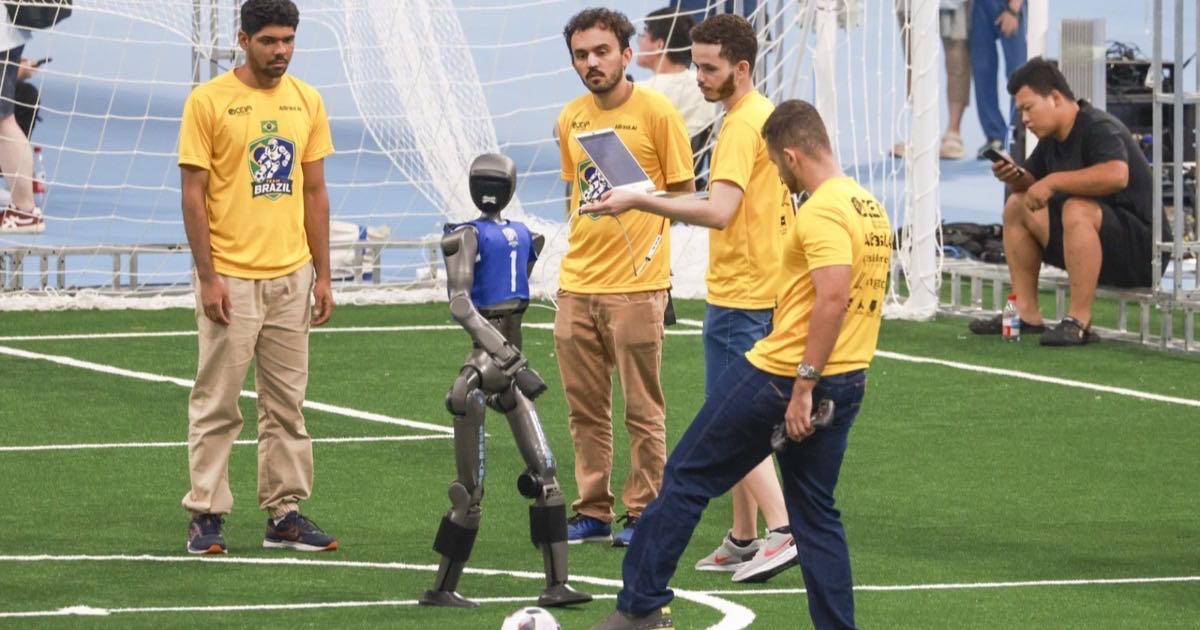
The second World Humanoid Robot Games closed on August 26 at Beijing’s National Speed Skating Oval, and the five-day event produced the clearest split verdict the humanoid industry has ever given itself in public. Robots ran 100 metres in 9.32 seconds — faster than Usain Bolt. A 1.35-metre humanoid won a 400-metre race with its hands covering its face, a gait no engineer designed. Another robot caught fire mid-sprint. A weightlifter crashed into the judges’ table.
The Games drew 2,056 robots from 666 teams across 16 countries to the Ice Ribbon, the venue built for the 2022 Winter Olympics. That is four times the inaugural field last year. Fifty-one events spanned athletics, football, table tennis, martial arts, dancesport, and scenario-based tasks — firefighting, hotel room service, library shelving, laundry folding.
The records that fell
Tiangong Ultra, built by the Beijing Humanoid Robot Innovation Center (also known as X-Humanoid), ran the 100-metre heats in 9.39 seconds, then 9.34, then 9.32, according to RoboPodium’s verified results. Bolt’s world record is 9.58. The 400-metre large final went to Tiangong Ultra in 38.15 seconds; last year the same race was won in 1:28. The 1500-metre winner crossed in 2:21.64 — under the human world record of 3:26. The standing high jump reached 2.88 metres, surpassing the human record of 1.90 metres.
These are not World Athletics records. The starts are different, the wind gauge is different, and the runner is a machine. But the year-on-year jump is the number that matters. The 100m went from 21.50 seconds in 2025 to 9.32 this year. The 400m dropped by 50 seconds. Whatever caveats apply, something changed.
The gait nobody designed
The moment that captured the Games was not a record. It was a pose.
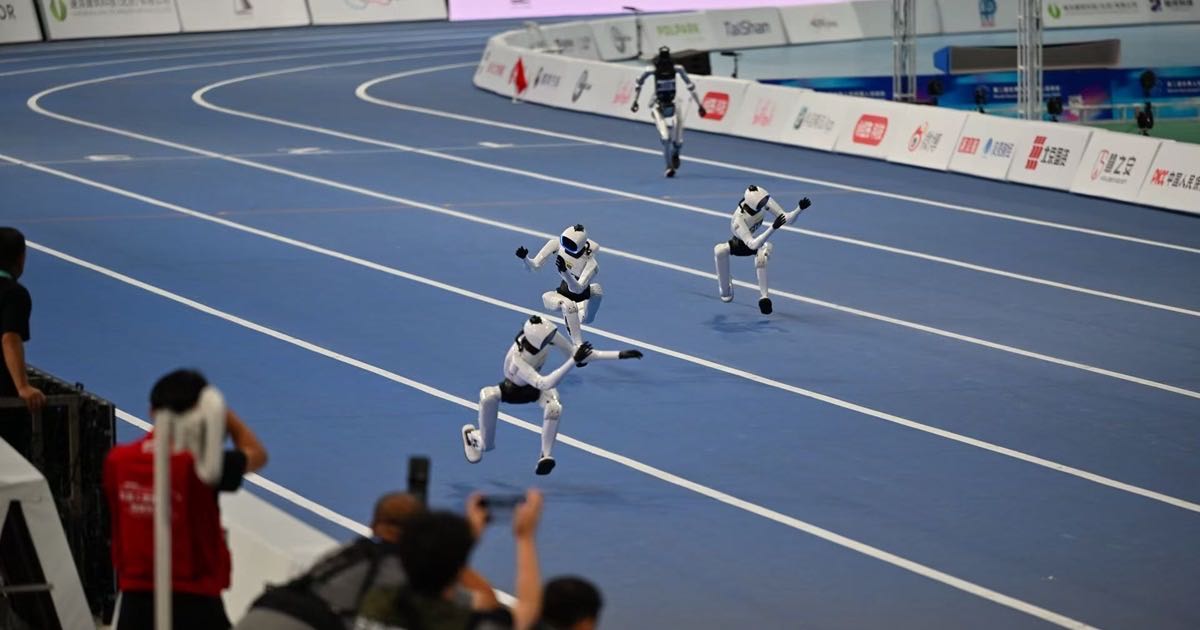
Tiangong Omni — the smaller, 39-kilogram sibling of the Ultra — won the 400-metre small-group final in 45.66 seconds. Instead of swinging its arms like a human sprinter, it ran with both hands held up near its face, swinging them through hip rotations. Chinese social media called it the “shy person” gait.
The posture was not designed. Han Gang, a motion control engineer at X-Humanoid, told the Global Times that the team used reinforcement learning in simulation: they rewarded speed and punished overheating, then let the robot find its own way of moving. The arms came up because swinging them rapidly overloaded the shoulder joints, causing heat buildup and energy drain. By pulling the arms in, the robot shifted load to the stronger hips and waist.
“We initially designed Tien Kung Omni’s gait around a human-style arm swing,” Han said. “It feels that this is more comfortable.”
This is the same mechanism that produced unexpected strategies in AlphaGo and AlphaFold — optimisation discovering solutions humans did not anticipate. What the 2026 Games demonstrated is that this pattern now applies to physical locomotion under competitive conditions, not just software.
The failures
An Honor humanoid robot broke at the waist during a 100-metre heat, sending sparks across the track. Ars Technica reported that several robots caught fire or fell apart during races. The running robots could sprint in a straight line but could not slow down — they simply crashed into barriers after the finish line.
During the weightlifting event, a humanoid robot attempted a lift, lost balance, and crashed into the judges’ panel. It was carried off on a stretcher. The incident went viral.
The scenario events were more revealing. In a firefighting challenge, robots had 30 minutes to identify hazardous substances, shut off three valves, locate a fire, and find an extinguisher. Only three of 12 competing teams completed the task, according to the Global Times. Hotel room service — moving luggage, making beds, restocking supplies — produced times well below human working speeds.
Many events still allowed human teleoperation. The Games penalised teleoperated scores but did not ban them, which means some of the more impressive athletic feats involved a human at a joystick. The autonomous events — breakdancing, cheerleading, the 4x100-metre relay — were where the failures clustered.
What the split verdict means
Dipam Patel, a PhD candidate at Purdue University and research assistant at the US Army DevCom Army Research Lab, told Ars Technica that the robots on display are still far from general-purpose autonomy. They were engineered for one task. The sprinters cannot turn. The fire responders struggled with 12-step sequences. The laundry folders were slow.
“If you cross the finish line, that’s the goal — it doesn’t matter if you stop and it doesn’t matter if you fall into different pieces,” Patel said. Some companies brought different robots for different events because each was engineered for a single task.
The Games’ organisers — the Beijing Municipal Government and China Media Group — framed the event as a soft-power showcase for China’s embodied AI sector. It is that. But the public failures are also something the industry rarely shows: an honest benchmark. Western companies release polished demo videos. The Games put 2,000 robots in front of crowds and cameras and let them fail.
This connects to what we saw in the crashes during opening week and the reality check from the preview days. The pattern through both was the same: teleoperated robots looked competent, autonomous robots did not. The Games’ rule changes — pushing events toward full autonomy — are the most useful public benchmark the humanoid industry has produced.
The NZ connection
New Zealand has no humanoid robot manufacturer. But the Games’ results matter for the same reason our coverage of the World Robot Conference did: the cost curve matters. Last year’s 100m winner cost roughly the same as a car. This year’s sprint records came from robots that are, in some cases, priced below NZ$25,000. The scenario-event failures are a reminder that the price drop has not yet caught up to the capability curve. But both are moving — and the Games are the only event that shows where each one actually stands.
📰 Sources
- Ars Technica — World humanoid robot games show runners breaking records, bursting into flames
- Global Times — Robot’s viral ‘face-covering’ sprint is ‘spontaneous,’ not designed by developers
- TechTimes — AI-Trained Robot Invented Its Own Sprint at 2026 World Humanoid Robot Games
- RoboPodium — World Humanoid Robot Games 2026 Results
- CGTN — 2nd World Humanoid Robot Games conclude in Beijing
- AP News — Chinese humanoid robots break human records at Beijing’s robot games