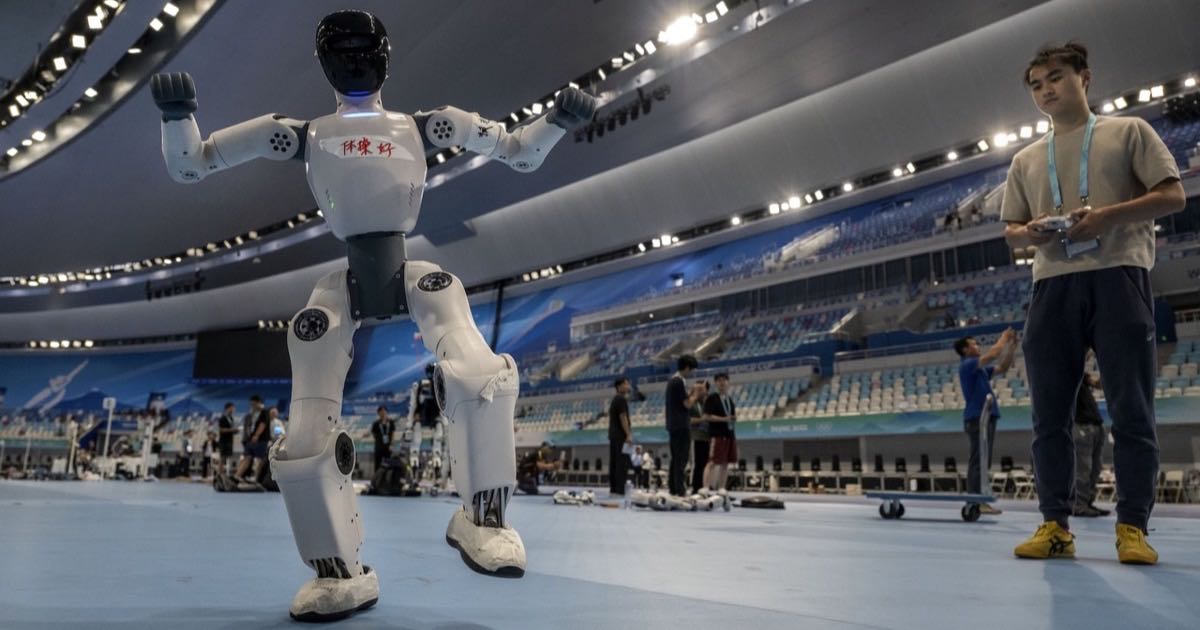
A humanoid robot toppled onto its back and began thrashing its limbs violently on the exhibition floor at Beijing’s 2026 World Robot Conference. Its remote-control connection had failed. Engineers rushed in but couldn’t immediately power it down. The video went viral — one commenter wrote, “And it looks like they can’t immediately just turn it off. What’s that about?”
The incident is funny. It’s also the most honest moment of the week.
What Actually Happened
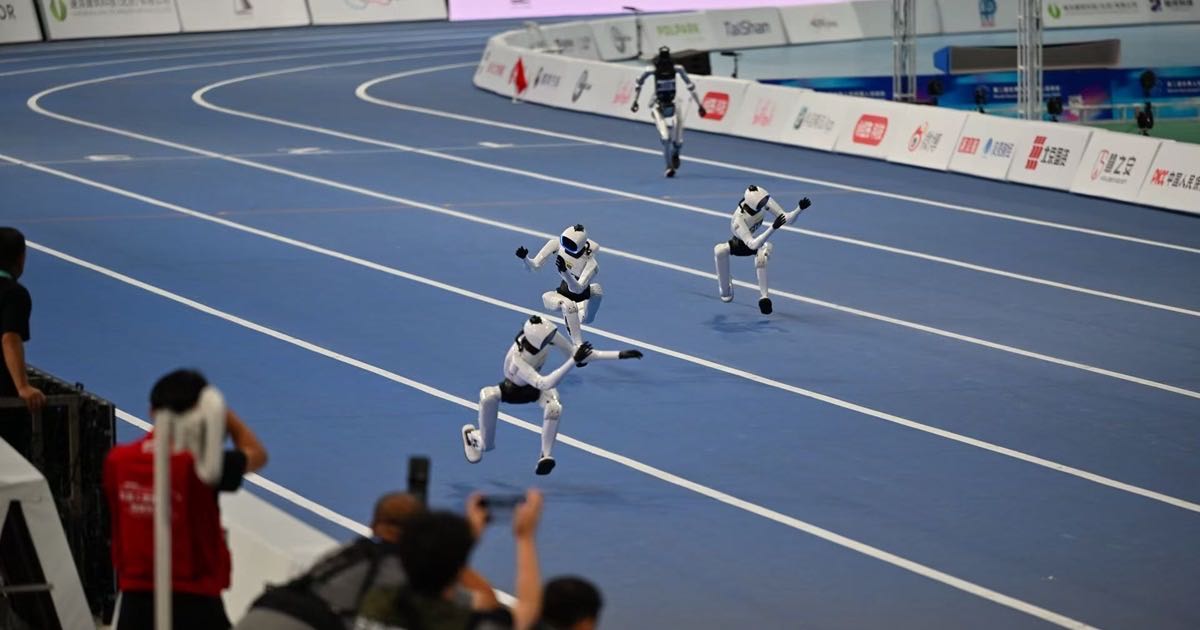
During preparations for the World Humanoid Robot Games and the World Robot Conference, multiple humanoid robots malfunctioned. Videos shared by robotics expert Eren Chen on X showed robots running off the track and crashing into electrical boxes, colliding with padded walls, and falling backwards onto their heads. One robot broke at the waist on impact, sending sparks flying.
Another clip showed a robot — later identified as Unitree’s new Superman humanoid — sprinting off course during a test run and slamming into equipment on the sidelines. Unitree had previewed Superman earlier in the week with a video of it jumping approximately 2 metres and running at 12.658 metres per second, faster than Bolt’s recorded peak. The robot that can outrun a human couldn’t stay on a marked track without a human at the controls.
The OECD’s AI incident tracker catalogued the breakdowns under a single entry: “multiple humanoid robots malfunctioned” during the Beijing events, including loss of control, crashes, and what one observer described as a robot “throwing a tantrum” on the floor.
The Autonomy Switch
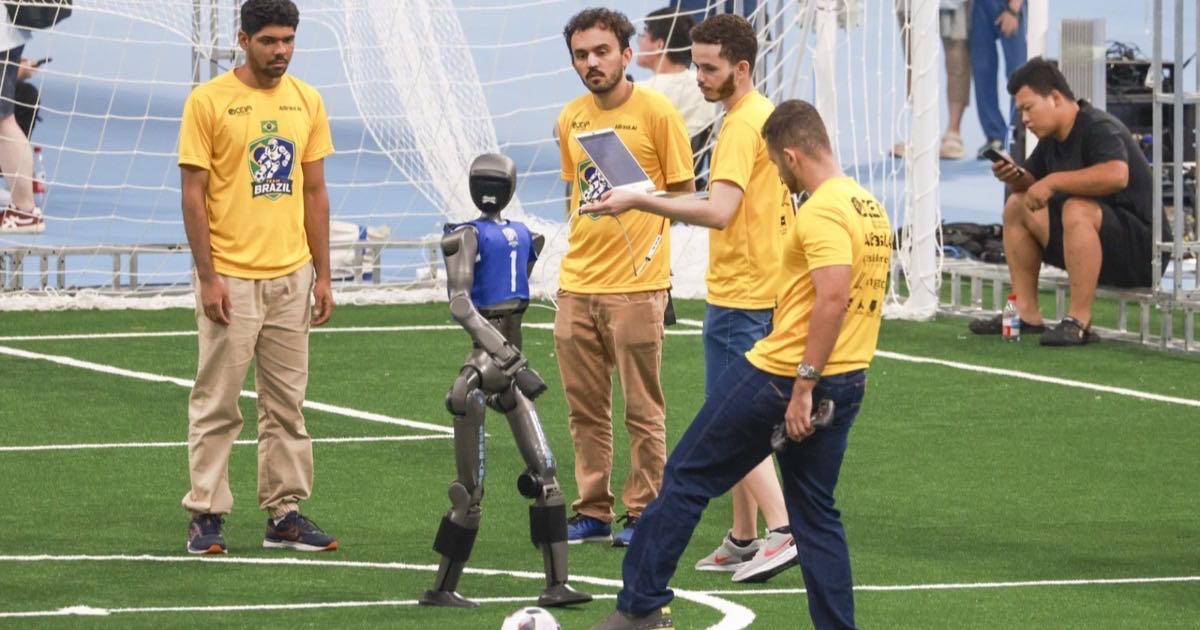
Here’s why these failures matter more than the sprint records. The 2026 games changed several events from remote-controlled to fully autonomous. Breakdancing, cheerleading, and the 4x100-metre relay now require robots to act independently — no human operator, no joystick, no fallback.
Chen observed that this year’s runners appeared to have more difficulty navigating than at last year’s event. That sounds backwards — a year of progress should mean fewer crashes, not more. But the rule change explains it. When humans were steering, the robots looked competent. When the robots had to steer themselves, the competence evaporated.
The events that still allow remote control — long jump, kickboxing — didn’t produce the same viral failures. The scenario-based events allow both autonomous and remote-controlled entries, but autonomous submissions get double points. The incentive structure is pushing teams toward autonomy. The results are showing why that’s hard.
The Gap Between Locomotion and Perception
A robot that can sprint at 14.5 metres per second has solved a hardware problem: actuator power, joint stiffness, balance control at speed. A robot that can’t detect a wall, plan a turn, and adjust its trajectory in real time has an unsolved software problem: perception, path planning, reactive control under uncertainty.
These are different engineering challenges. The first is about force and materials. The second is about inference and decision-making. The records at the games show the first is advancing fast. The crashes show the second is lagging.
Robotics expert Chen put it precisely: “Last year, running and dynamic motion control were meaningful because they proved a basic point: before a humanoid can do useful work, it first needs a capable body. But once that foundation exists, simply making the robot run faster gives you diminishing returns.”
The body is ready. The brain is not.
What the Industry Is Saying
The conference floor told a parallel story. Lumos Robotics founder Yu Chao said “the stage of running and jumping has basically passed” and that reliability in industrial deployment is the real test. Xiaomi showcased a humanoid that spent four months on a real factory line — not a track. Schaeffler is tooling up to mass-produce gearboxes for humanoid joints by 2027, betting that the component supply chain is the next bottleneck.
And Lightwheel AI, with Hugging Face, released EgoSuite-Open100K — 100,000 hours of annotated human hand video for robot training. The dataset targets the exact problem the crashes exposed: robots need more data on how to interact with the physical world, not just how to move through it.
The Off Switch Problem
The viral reaction to the thrashing robot focused on one detail: engineers couldn’t shut it off immediately. That’s not a software problem. It’s a safety engineering problem. Industrial robots have had emergency stops for decades. Humanoid robots built for demonstrations don’t always have accessible kill switches, because the assumption is that a human operator can intervene through the control link.
When the link fails, the assumption breaks. For robots deployed in homes, hospitals, or factories — the use cases everyone says are coming — a reliable physical kill switch isn’t optional. The Beijing incident wasn’t dangerous. A 40-kilogram robot thrashing on a factory floor next to a worker would be.
FAQ
Did anyone get hurt in the robot malfunctions? No injuries were reported from any of the incidents at the World Robot Conference or the World Humanoid Robot Games.
Why couldn’t the engineers turn off the thrashing robot? The robot’s remote-control connection had failed, and it appears the physical kill switch was not easily accessible. The incident highlights a safety engineering gap in demonstration robots that will need to be addressed before deployment in real-world settings.
Why did more robots crash this year than last? The 2026 games switched several events from remote-controlled to fully autonomous mode. Robots that looked competent with a human operator struggled when they had to navigate independently, exposing the gap between locomotion and perception capabilities.
What is the OECD AI incident tracker? A database maintained by the OECD that catalogues AI-related incidents and hazards. The Beijing robot malfunctions were logged as a single entry covering multiple breakdowns during the World Robot Conference and Games preparations.
📰 Sources
- Mashable — Robots running into walls go viral ahead of 2026 World Humanoid Robot Games
- NDTV — Humanoid robot malfunctions and suffers seizure at China conference
- AP News — Chinese humanoid robots break human records at Beijing games
- OECD AI Incident Tracker — Humanoid robot malfunctions at Beijing robotics events
- Machine Dawn — Today in Robotics, August 23 2026