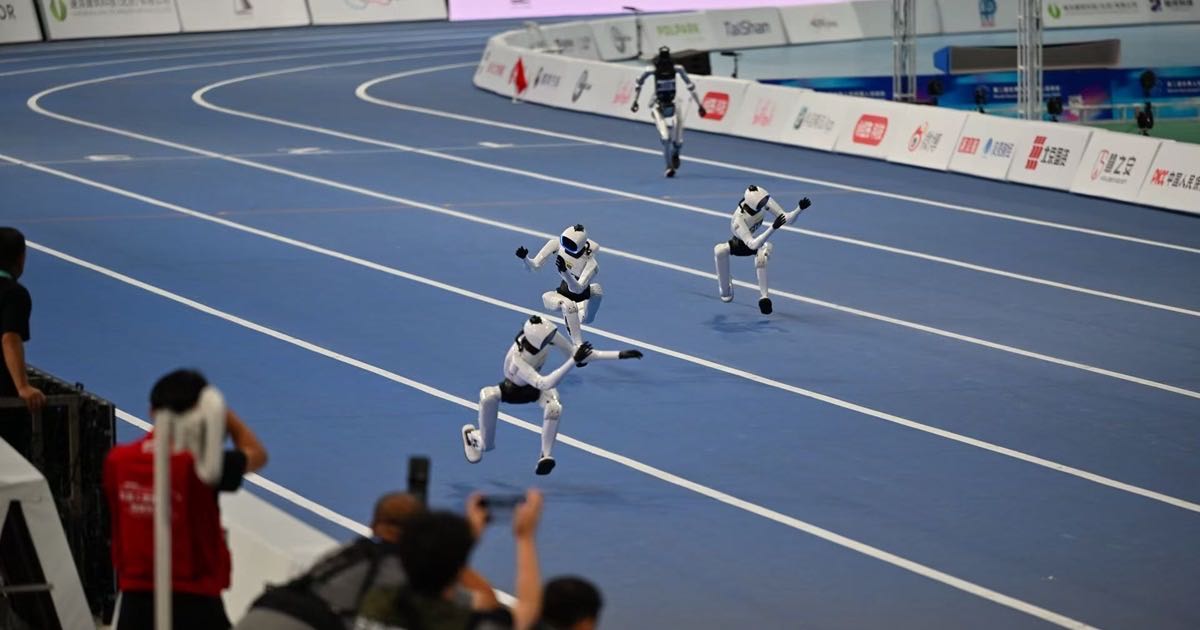
A humanoid robot has broken Usain Bolt’s 100-metre world record. The machine, built by Beijing-based X-Humanoid, crossed the line in 9.39 seconds during a preliminary heat at the second World Humanoid Robot Games on August 22. Bolt’s record — 9.58 seconds, set in Berlin 17 years ago — finally has a challenger that isn’t human.
Minutes earlier, a robot named Lightning from Chinese smartphone maker Honor had run a trial in 9.32 seconds, reaching a peak speed of 14.5 metres per second. That’s faster than Bolt’s recorded top speed of 12.42 m/s. Lightning stood 169 centimetres tall with 95-centimetre legs at April’s Beijing half marathon, which it won in 50 minutes 26 seconds. Researchers have since lengthened its legs by 10 centimetres for these games.
A standing high jump of 2.88 metres — clearing Javier Sotomayor’s 1993 human record of 2.45 metres — rounded out the opening-day records. Both the sprinting and jumping robots came from X-Humanoid, the Beijing Humanoid Robot Innovation Center backed by the city government, UBTECH, Baidu, and the Beijing AI Industry Investment Fund.
The Numbers Are Real. The Context Matters.
Last year’s inaugural games saw a best 100m time of 21.50 seconds. This year: 9.39. That’s not incremental improvement. That’s a leap.
But the comparison to human athletics only gets you so far. The robots run on a track. They don’t deal with wind, fatigue, or the biomechanical constraints of tendons and muscle. A robot that can sprint in a straight line on a controlled surface is not the same as a robot that can navigate a warehouse, climb stairs, or pick up a dropped tool. As CNBC reported, industry leaders at the conference were blunt: the big challenge is still getting the technology to work well in real environments, not just on a stage.
Jeff Burnstein, president of the Association for Advancing Automation, told AP the impact of US restrictions on foreign-made robots “isn’t yet that great because few humanoids are being used in the country.” The demonstration gap and the deployment gap are widening at the same time.
The Autonomous Shift
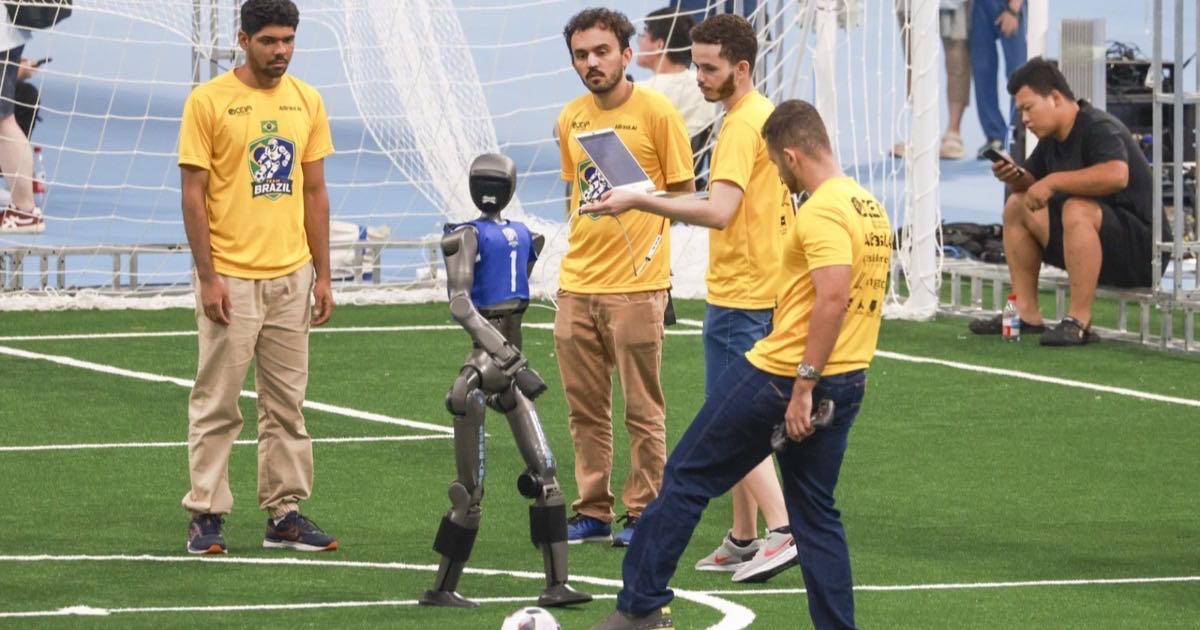
Here’s the detail that got less attention than the Bolt headline. The 2026 games changed several track events from remote-controlled to fully autonomous. Breakdancing, cheerleading, and the 4x100-metre relay now require robots to act independently. Sporting events like long jump and kickboxing still permit human operators, and scenario-based events allow both — but autonomous entries get double points.
Robotics expert Eren Chen noted on X that this year’s runners seemed to have more difficulty navigating than at last year’s event. The switch from remote control to autonomy exposed the gap between a robot that can move its legs fast and one that can perceive its environment, plan a path, and adjust in real time.
One viral clip showed Unitree’s new Superman humanoid — which can jump 2 metres and run at 12.658 m/s — sprinting off the track during a test run and crashing into electrical boxes. Another showed an unidentified robot colliding with a padded wall, falling backwards, and snapping at the waist. The robot that broke the 100m record ran in a straight line on a marked track. The ones asked to navigate autonomously? They fell apart.
That’s the story. Not the record.
What This Means for the Industry
The World Humanoid Robot Games is a strategic showcase as much as a sporting event. More than 2,000 robots from 666 teams across 16 countries are competing in 51 events over five days at Beijing’s National Speed Skating Oval — the same venue built for the 2022 Winter Olympics. Participation quadrupled from last year. The games run alongside the World Robot Conference, where 300 exhibitors showed 3,000 products.
China makes the majority of the world’s humanoid robots. The US has pushed back: the FCC banned imports of new foreign-made humanoid robots last month, citing national security. The Pentagon added Unitree — one of China’s leading humanoid makers — to its list of companies with alleged military ties. Beijing disputes the accusations.
The records at the games are a flex. The autonomous events are a diagnostic. When a robot can sprint faster than Bolt but can’t navigate a track without crashing, the bottleneck isn’t hardware. It’s the software stack — perception, planning, control under uncertainty. That’s where the real competition is.
The Commercial Reality
Lumos Robotics founder Yu Chao put it bluntly at the conference: “The stage of running and jumping has basically passed. The most important thing now is improving reliability in actual industrial deployment.” His company targets 300 robot deliveries this year — wheeled, dual-arm machines for factory inspection. Not sprinters.
Schaeffler, the German automotive supplier, is gearing up to mass-produce humanoid robot gearboxes by 2027. Xiaomi spent four months training a humanoid on a real auto production line. The companies investing in deployment — not spectacle — are the ones betting on the market that exists, not the one that makes headlines.
Unitree’s founder Wang Xingxing, addressing the conference the day after his company’s 460 per cent IPO surge, underscored the challenges ahead for humanoids entering the workforce. The ChatGPT moment for humanoid robots, he said, is still years away.
FAQ
Did a robot really beat Usain Bolt’s record? Yes. X-Humanoid’s robot ran 9.39 seconds in a preliminary heat. Honor’s Lightning ran 9.32 in a trial. Both beat Bolt’s 9.58-second world record set in 2009. The runs took place on a controlled track, not under competition conditions identical to human athletics.
Were the robots running autonomously? The 100m sprint event allowed remote control. Some events at the 2026 games — breakdancing, cheerleading, relay — required full autonomy. The autonomous events saw more crashes and navigation failures, exposing the gap between locomotion and perception.
What is the World Humanoid Robot Games? A multi-day competition in Beijing, now in its second year, featuring 2,056 humanoid robots from 666 teams across 16 countries. It runs August 22-26 at the National Speed Skating Oval alongside the World Robot Conference.
Does this mean humanoid robots are ready for real-world use? No. Industry leaders at the conference said humanoids are still mostly used for demonstrations, performances, and research. Mass deployment in manufacturing, logistics, and consumer applications remains years away. The records showcase hardware progress; the autonomous events reveal the software gap.
📰 Sources
- Associated Press — Chinese humanoid robots break human records at Beijing games
- The Guardian — Chinese robot runs 100m sprint quicker than Usain Bolt’s world record
- Global Times — Humanoid robot breaks human 100m record with 9.39 dash
- Mashable — Robots running into walls go viral ahead of 2026 World Humanoid Robot Games
- Fortune — Chinese robots smash athletic records set by humans
- CNBC — Chinese humanoid robots’ biggest obstacle: Humans are still (mostly) better