Warehouse robotics startup Ultra Robotics has raised $62 million across two funding rounds, with the bulk arriving as a $50 million Series A led by crypto-native investment firm Framework Ventures. Fortune first reported the Series A figures on October 9, and SiliconANGLE confirmed the round the same day. The company’s earlier seed was jointly led by Y Combinator and NextView Ventures.
The money is not funding a concept. According to RobotToday, the Brooklyn-based company’s OP1 Operator robots have already processed more than half a million orders across packing, sorting and kitting workflows. HumanoidsDaily’s original report, which RobotToday republished in its industry briefing, describes the round as underscoring growing demand for warehouse automation that actually runs in production.
What the OP1 Operator actually is
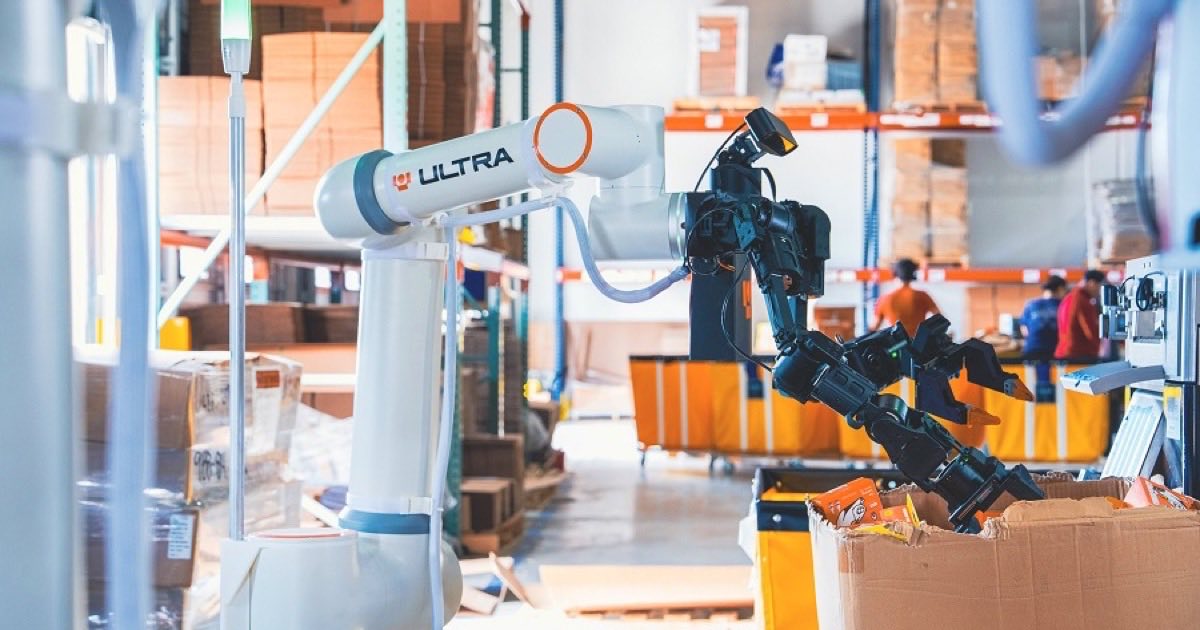
The OP1 Operator is not a free-standing humanoid, and that is the most interesting thing about it. Per SiliconANGLE’s reporting, it looks like a humanoid robot mounted on the end of a traditional robotic arm, fitted with a pair of grippers shaped like forklift prongs, and set on a flat wheeled base. There is no engine and no battery: workers roll the unit between warehouse stations by hand, the wheels lock in place so it cannot tip over, and it draws power from a standard wall outlet.
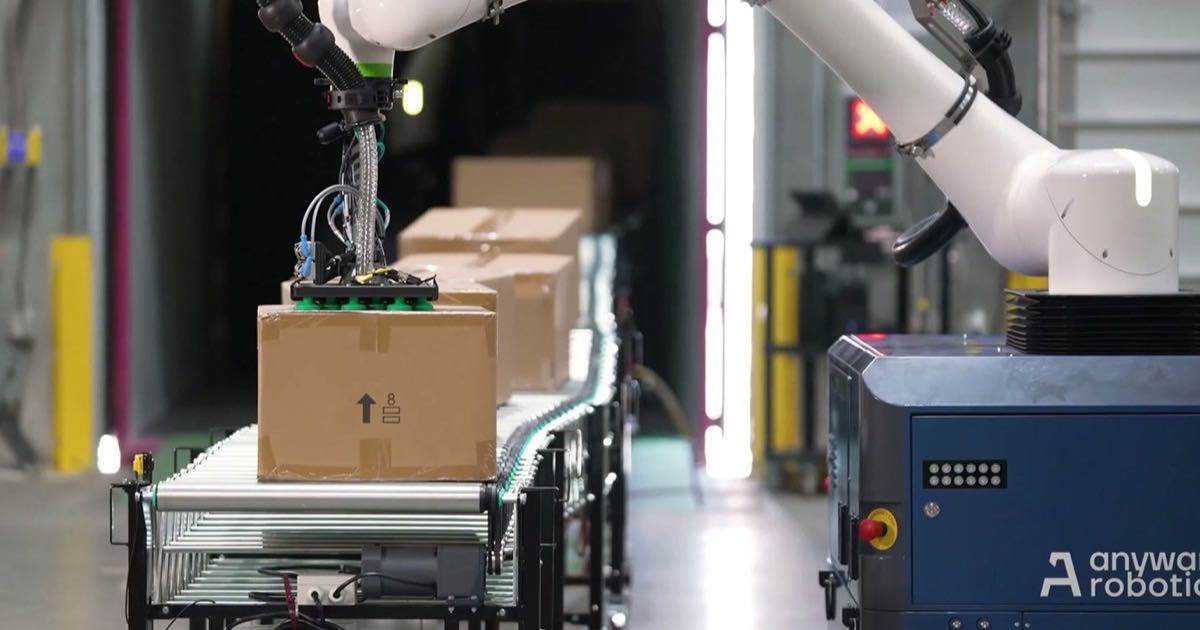
The machine handles the unglamorous middle of e-commerce fulfilment. It can decant mixed inbound containers into single-type bins, perform kitting by combining items from different containers into one parcel, and then finish the job — placing items into envelopes or plastic bags, sealing and labelling them. Its vertical reach reaches up to 10 feet for shelf picking, and if an item falls to the floor, the robot can retrieve that too. Ultra claims a single unit can process up to 1,000 items per day, and says setup takes just a few hours because its AI models need no extensive customer configuration.
A second cable connects the robot to the local network, and that connection is doing more work than it appears. Sensor data from each OP1 flows back to Ultra, where it trains the AI models that power the hardware — a deployment data loop the company is deliberately tightening. The new capital arrives alongside a deepened partnership with Physical Intelligence, the robot-foundation-model startup whose AI models run on Ultra’s systems. “The robots that are actually changing the world are the ones doing valuable work for real people,” founder and chief executive Jon Miller Schwartz said, per SiliconANGLE. “And this isn’t some far-off dream. It’s happening right now.”
The unwired, the unglamorous, and why that wins
There is a lesson in what Ultra chose not to build. While humanoid startups compete on bipedal showmanship, Ultra shipped something a warehouse manager could actually approve: no batteries to charge and eventually replace, no autonomous navigation to certify, no fall-risk liability on a 10-foot walking platform. Wheels that lock and a wall plug read as constraints, but they are also the reason the unit can be moved between stations by whoever is nearest and run 12-hour shifts on cheap electricity. Compare the trajectory with Europe’s production-line humanoid deployments at Bosch — different form factors, same underlying bet that real warehouse and factory floors, not demo stages, decide which robot designs survive.
The half-a-million-orders figure deserves more attention than the funding number. In an industry where startups have raised more than $23 billion on the promise of general-purpose labour, actual processed-order counts are still rare in public. Ultra’s claim that its fleet has crossed that threshold — quietly, on Brooklyn fulfilment floors, outside the Amazon-adjacent spotlight where most humanoid news is made — suggests the company’s Series A was priced on operational evidence rather than demonstration videos.
It also clarifies what Physical Intelligence is buying with the partnership. Warehouse picking is repetitive, high-volume, physically grounded work: exactly the training distribution a robot foundation model needs. Every OP1 on a fulfilment floor is a data collection rig that pays for itself while it learns. If that loop compounds, Ultra’s moat is not the forklift-prong gripper — it is the order history.
For New Zealand readers, the relevance is indirect but real: this class of arm-mounted, wall-powered, human-rolled robot is the shape that automation takes in mid-sized markets first. Big-ticket humanoids will debut in Shenzhen and Texas megasites; the decant-and-kit machine that plugs into a standard outlet is the one a Tauranga 3PL could actually lease.
Sources: SiliconANGLE · RobotToday · HumanoidsDaily · Fortune (attribution via SiliconANGLE)